

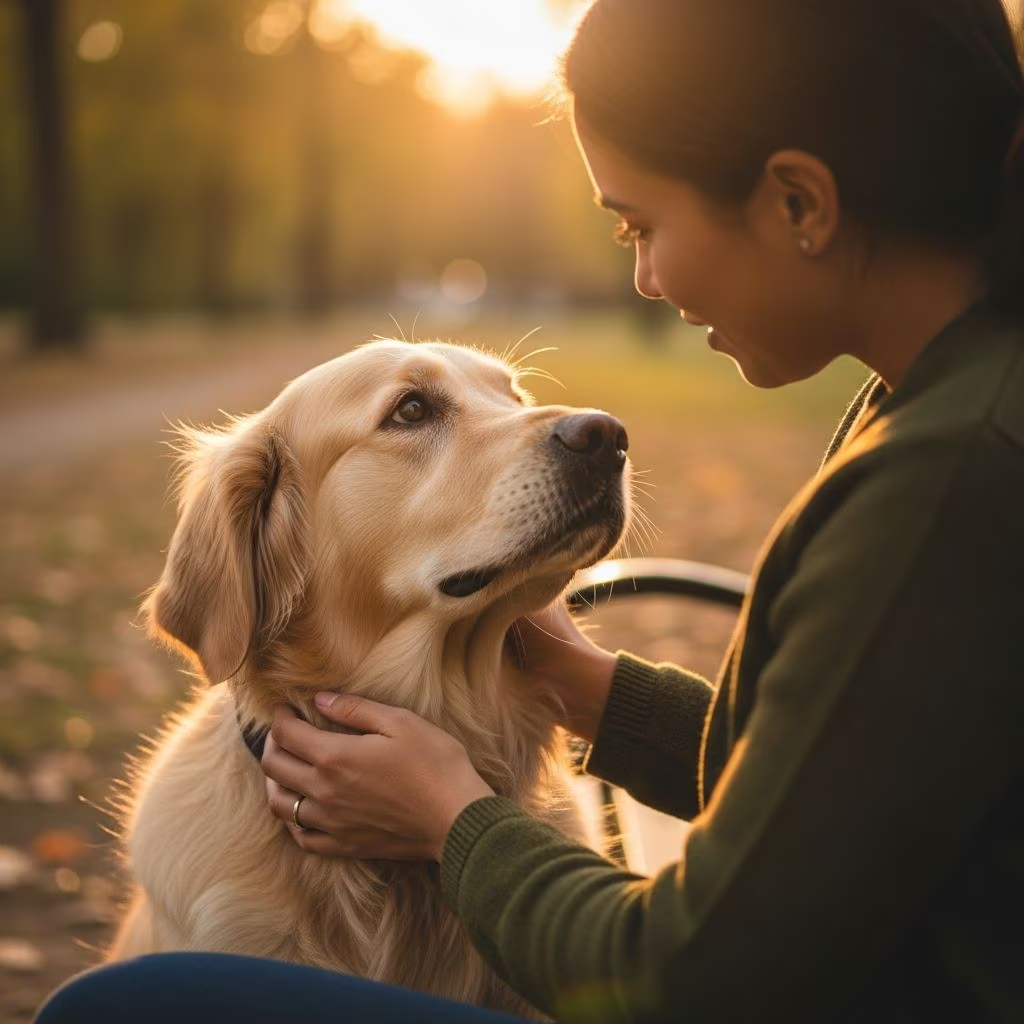
Building a strong relationship with your dog starts with truly understanding them. Dogs communicate primarily through body language, exhibit unique personalities, form deep attachments, and show breed-specific traits. This guide covers key aspects of canine behavior to help you interpret signals, respond effectively, and foster mutual trust.
Dog Body Language: Reading the Signs
Dogs express emotions and intentions via subtle cues in posture, tail, ears, eyes, and mouth. Misreading these can lead to misunderstandings; recognizing them prevents conflicts and enhances communication.
**Tail Wagging Nuances:** A broad, loose wag indicates happiness, while stiff, high wags signal alertness or aggression. Slow tucks show fear.
- Happy wag: Full body involvement, circular motions.
- Alert wag: Stiff, rapid side-to-side.
- Fearful tuck: Tail between legs, body lowered.
**Ear Positions:** Forward ears mean interest; flattened back indicate submission or fear. Play bows (front down, rear up) invite fun.
**Eye Contact:** Soft, blinking eyes show relaxation; hard stares signal threat. Avoid prolonged staring to prevent escalation.
**Yawning and Lip Licking:** Stress signals, not tiredness. Dogs ‘displace’ with these during tension.
| Signal | Meaning | Response |
|---|---|---|
| Raised hackles | Arousal (fear/aggression) | Give space, de-escalate |
| Whale eye (whites showing) | Anxiety | Remove stressor |
| Play bow | Invitation to play | Engage safely |
Observing clusters of signals provides context. A wagging tail with stiff posture isn’t joy.
Dogs Have Unique Personalities
Like humans, dogs show consistent traits across situations, akin to the ‘Big Five’ model: extraversion, agreeableness, neuroticism, openness, conscientiousness.
Research using C-BARQ (Canine Behavioral Assessment & Research Questionnaire) identifies dimensions: sociability, playfulness, chase-proneness, aggressiveness, curiosity/fearlessness. Puppy mill rescues often score high on fear, showing personality persists post-adoption.
- Sociable: Enjoys company, greets eagerly.
- Playful: Initiates games, toys obsessed.
- Chase-prone: Triggers on movement.
- Aggressive: Resource guards, snaps.
- Curious/Fearful: Bold explorers vs. shy avoiders.
Owners and dogs converge personalities over time; extraverted owners have bolder dogs. Neurotic owners may amplify dog anxiety bidirectionally. Breed standards influence perceptions (e.g., Papillons as ‘perky’), but individuals vary.
Human-Dog Kinship and Attachments
Dogs evolved ‘human-like’ social skills via convergent evolution, reading gestures better than primates. They form infant-like attachments to owners.
In post-industrial societies, falling kinship networks elevate dogs’ social roles (companionship 31.1%), paralleling family shifts. ‘Child-like’ dogs (morphology, behavior) fulfill emotional gaps.
**Attachment Styles:** Secure (confident explorers), anxious (clingy), avoidant (independent), disorganized (erratic from trauma).
Owners viewing dogs as ‘children’ report more attention-seeking; multi-role dogs (guard/family) are calmer. Companion dogs face isolation, unrealistic petting demands, risking bites.
People/dogs physically resemble via grooming, expression mimicry; behaviors sync (movement, personality). Free-living dogs historically thrived sans ownership, challenging ‘pet’ ideology.
Breed Differences in Behavior
Breeds retain working legacies: Herding (nipping heels), Terriers (prey drive), Guards (territorial).
**Herders (Border Collie):** Eye-stalk, circle to control movement.
**Sighthounds:** High chase instinct.
**Companion breeds:** More separation anxiety.
Individual variation trumps breed; match lifestyle to traits.
| Breed Group | Traits | Management Tips |
|---|---|---|
| Herding | High energy, bossy | Jobs, agility training |
| Terrier | Feisty, diggers | Mental puzzles, secure fencing |
| Guardian | Protective, aloof |
Common Behavior Problems and Solutions
Jumping (33.2%), chasing (28.5%), territoriality (26.7%), overexcitement (20.9%) prevalent.
- Jumping: Turn away, reward four paws down.
- Chasing: Train recall, impulse control.
- Territorial barking: Desensitize triggers.
- Anxiety: Crate training, enrichment.
Obedient/safe off-leash: 25%/30.6% owners. Multi-role perceptions boost these.
Frequently Asked Questions (FAQs)
Q: Why does my dog stare at me?
A: Seeking attention, love, or guarding resources. Context matters (relaxed vs. tense).
Q: Can dogs sense emotions?
A: Yes, via cues/olfaction; attachments mirror human bonds.
Q: How to read stress in dogs?
A: Yawning, lip licks, avoidance, whale eye—intervene early.
Q: Do personalities change?
A: Stable but modifiable via training/environment.
Q: Best for multi-dog homes?
A: Assess sociability; supervise intros.
Building a Deeper Bond
Consistent training, positive reinforcement, exercise, and respect for signals strengthen ties. View dogs as kin, not property—honor their resilience and social genius.
References
- Co-Becoming: The Human-Dog Kinship — Coonoor & Co. 2023. https://coonoorandco.com/journal/co-becoming-the-human-dog-kinship
- People And Their Dogs Really Do Look Alike, New Research Finds — Kinship. 2023. https://www.kinship.com/news/people-and-dogs-look-alike-study
- The role of dogs is associated with owner management practices — PMC/NCBI (Peer-reviewed). 2024-10-15. https://pmc.ncbi.nlm.nih.gov/articles/PMC11557872/
- Does Your Dog Have a Unique Personality? — Kinship. 2023. https://www.kinship.com/dog-behavior/dogs-personalities
- Dog Behavior — Kinship. 2023. https://www.kinship.com/dog-behavior
- Redefining Parenting and Family – The Child-Like Role of Dogs — Hogrefe (Peer-reviewed). 2023. https://econtent.hogrefe.com/doi/10.1027/1016-9040/a000552



