

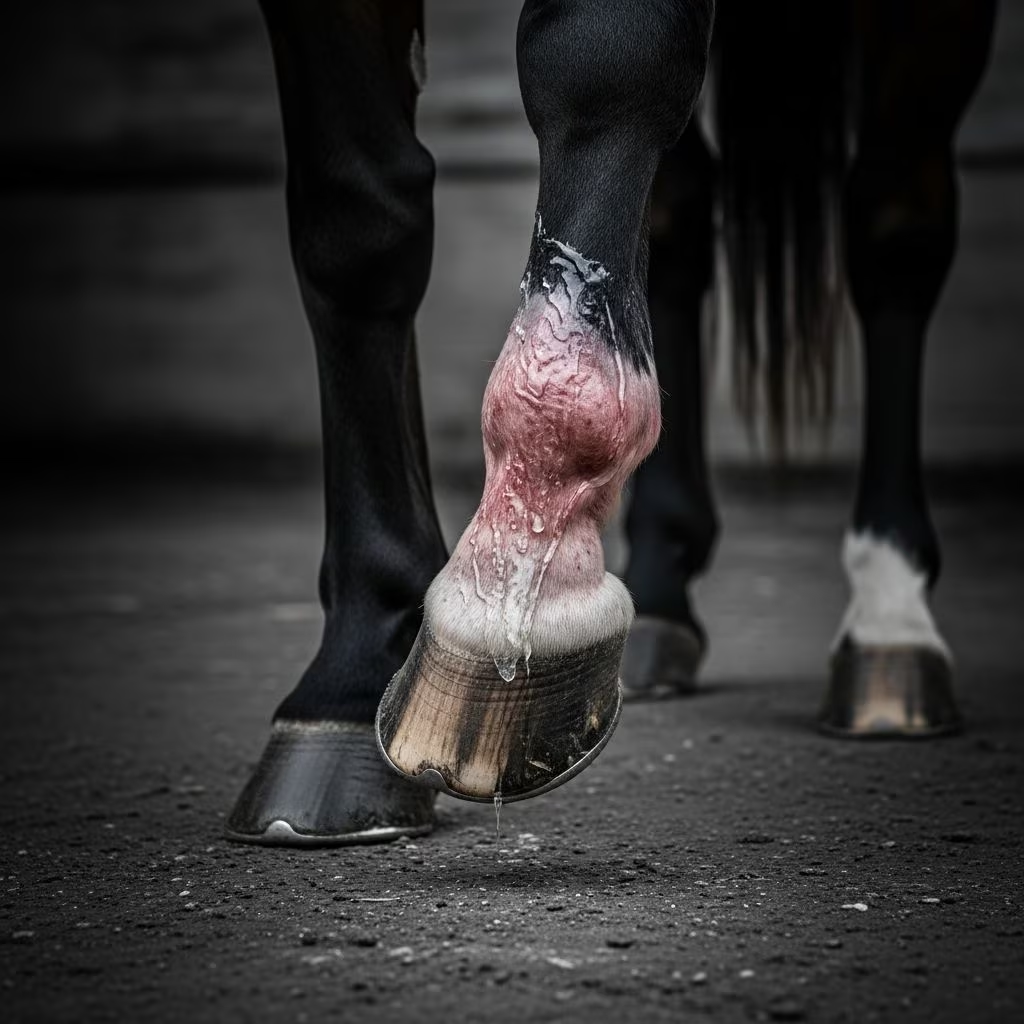
Horse soring is a deliberate act of inflicting pain on the legs and hooves of gaited horses to produce an unnaturally high-stepping gait prized in certain competitions. This abusive method targets breeds like Tennessee Walking Horses and racking horses, forcing them to lift their front feet rapidly to avoid agony when they touch the ground.
The Mechanics of Soring: How Pain Produces the ‘Big Lick’
The ‘Big Lick’ refers to the exaggerated, flashy gait where a horse flings its forelegs high while dropping its hindquarters low. This style is achieved not through natural talent but by making every step excruciating for the front limbs. Horses respond by snatching their feet off the ground as quickly as possible and overextending their hind legs to shift weight rearward.
Soring alters the horse’s natural movement through targeted irritation. The pain intensifies with each stride, compelling the animal into this stylized motion that judges in some shows reward. Without intervention, gaited breeds exhibit smooth, natural strides, but soring creates the dramatic lift demanded in padded or flat-shod classes.
Chemical Methods: Burning the Legs for Show Appeal
One prevalent technique involves applying caustic substances directly to the pastern—the sensitive area between the hoof and fetlock. Agents like mustard oil, kerosene, diesel fuel, or croton oil cause severe chemical burns. Trainers often wrap the legs in plastic and bandages to ‘cook’ the chemicals into the skin, heightening absorption and tenderness.
These irritants blister and inflame the tissue, making even light contact painful. Heavy chains or rollers are then attached around the pasterns, rubbing against the raw skin with every movement. This combination ensures the horse lifts its legs swiftly to minimize contact time.
- Mustard oil: Produces intense blistering and prolonged sensitivity.
- Diesel fuel or kerosene: Causes deep chemical irritation without immediate visible scarring.
- Dimethyl sulfoxide (DMSO): Enhances penetration of other agents into deeper tissues.
To conceal evidence before inspections, trainers may shave lesions, apply concealing lotions, or time applications so effects peak during performance.
Mechanical and Pressure Techniques: Bruising Without Chemicals
Not all soring relies on chemicals; mechanical abuses exploit the hoof structure. Pressure shoeing trims the hoof excessively, exposing the sensitive quick or sole. Shoes or pads are then nailed tightly, pressing directly on bruised tissue. Horses may be ‘road foundered’ by forcing them over hard surfaces on these over-trimmed hooves to amplify soreness.
Other devices include inserting tacks, screws, metal beads, or sharp objects between the hoof pad and sole. These create pinpoint pressure points that stab with weight-bearing. Stacked platforms or ‘action devices’ add weight and alter impact angles, exacerbating pain when hidden irritants are present.
| Method | Description | Pain Mechanism |
|---|---|---|
| Pressure Shoeing | Extreme hoof trimming + tight shoeing | Direct compression on sensitive sole |
| Object Insertion | Tacks/screws under pads | Piercing pressure on hoof interior |
| Heavy Chains | Weighted bands on pasterns | Constant rubbing on irritated skin |
| Stacks/Platforms | Elevated, weighted shoe extensions | Abnormal force and concealed soreness |
These non-chemical approaches evade some detection methods, as they leave subtler traces.
Legal Framework: The Horse Protection Act and Its Definitions
Congress passed the Horse Protection Act (HPA) in 1970 to criminalize soring at shows, sales, and auctions. Enforced by the USDA’s Animal and Plant Health Inspection Service (APHIS), it prohibits entering, transporting, or exhibiting sored horses.
The HPA legally defines soring as any act where a person applies an irritating agent, inflicts burns/cuts, injects substances, or uses devices/practices causing the horse to suffer pain, distress, inflammation, or lameness. Violations carry fines up to $3,000 and potential jail time, though enforcement has historically lagged.
In 2014, USDA updated regulations via the Horse Protection Act Prevent All Soring Tactics (PAST) Act framework, banning stacked shoes, chains over certain weights, and certain devices outright. It also shifted inspection duties from industry self-policing to federal veterinary inspectors.
Detection Challenges: Evading Inspectors
Inspectors check for soring via visual exams, palpation (pressing legs for pain reactions), gait observation, and tools like thermography or fluoroscopy. Bilateral asymmetry in leg temperature or flinching indicates abuse.
Trainers counter with ‘stewarding’—harsh training to suppress reactions. Horses endure mock palpations followed by beatings with whips or bats if they flinch, conditioning them to stand stoically. Numbing agents wear off post-inspection, chemicals timed for ring entry, or trainers skip events with strict federal oversight.
Targeted Breeds and Show Culture
Tennessee Walking Horses dominate soring scandals due to their naturally smooth running walk, which judges amplify via the ‘Big Lick’ in performance classes. Spotted Saddle Horses and rackers face similar pressures. Padded divisions with towering stacks epitomize the style, though flat-shod classes see abuses too.
Show culture perpetuates soring: prizes and prestige incentivize trainers despite risks. Some events reward the exaggerated gait explicitly, sustaining demand.
Health Impacts: Long-Term Damage to Horses
Beyond acute pain, soring causes chronic issues: scarred pasterns, hoof deformities, laminitis, infections from burns, and joint strain from unnatural postures. Repeated abuse shortens careers and leads to euthanasia in severe cases. Veterinary consensus deems it profoundly inhumane.
Enforcement Progress and Ongoing Battles
USDA inspections have increased violations cited, with over 1,000 horses disqualified annually in recent years. However, industry self-regulation via Horse Industry Organizations (HIOs) has been criticized as lax, prompting calls for full federal oversight.
The PAST Act, reintroduced periodically, seeks to eliminate HIO inspections, ban all action devices, and stiffen penalties. Advocacy from groups like the AVMA and AAEP supports reform.
Alternatives: Promoting Natural Gaits
Ethical breeders and trainers showcase naturally gaited horses in ‘flat-shod’ or trail pleasure classes, emphasizing soundness over flash. Education and consumer boycotts of ‘Big Lick’ events pressure change. Supporting legislation like PAST accelerates progress.
Frequently Asked Questions (FAQs)
What breeds are most affected by soring?
Primarily Tennessee Walking Horses, Racking Horses, and Spotted Saddle Horses in show circuits.
Is soring detectable at all times?
No; evasions like timing chemicals or stewarding hide signs during brief inspections.
What does the Horse Protection Act ban?
Any practice causing pain via chemicals, devices, or methods to exaggerate gaits.
How can I report suspected soring?
Contact USDA APHIS hotline or local inspectors at events.
Has legislation ended soring?
No, though regulations strengthened in 2014; full bans on devices pending PAST Act.
References
- Soring – Wikipedia — Wikipedia contributors. 2023-10-15. https://en.wikipedia.org/wiki/Soring
- What is horse soring? | Humane World for Animals — Humane World for Animals. 2023. https://www.humaneworld.org/en/resources/what-horse-soring
- Position on the Practice of Soring – AAEP — American Association of Equine Practitioners. 2022-06-01. https://aaep.org/resource/position-on-the-practice-of-soring/
- Horse Protection Act – USDA APHIS — U.S. Department of Agriculture. 2025-01-10. https://www.aphis.usda.gov/hpa
- Soring Show Horses to Improve Their Gait – PetMD — PetMD. 2012-10-01. https://www.petmd.com/blogs/thedailyvet/aobrien/2012/soring-horses-to-improve-their-gait-29555
- Statement on Soring — Dr. Ron DeHaven, AVMA. 2013-11-13. https://docs.house.gov/meetings/IF/IF17/20131113/101469/HHRG-113-IF17-Wstate-DeHavenR-20131113.pdf
- USDA Strengthens Regulations to Protect Horses from Soring Abuse — USDA APHIS. 2014-11-04. https://www.aphis.usda.gov/news/agency-announcements/usda-strengthens-regulations-protect-horses-soring-abuse



