

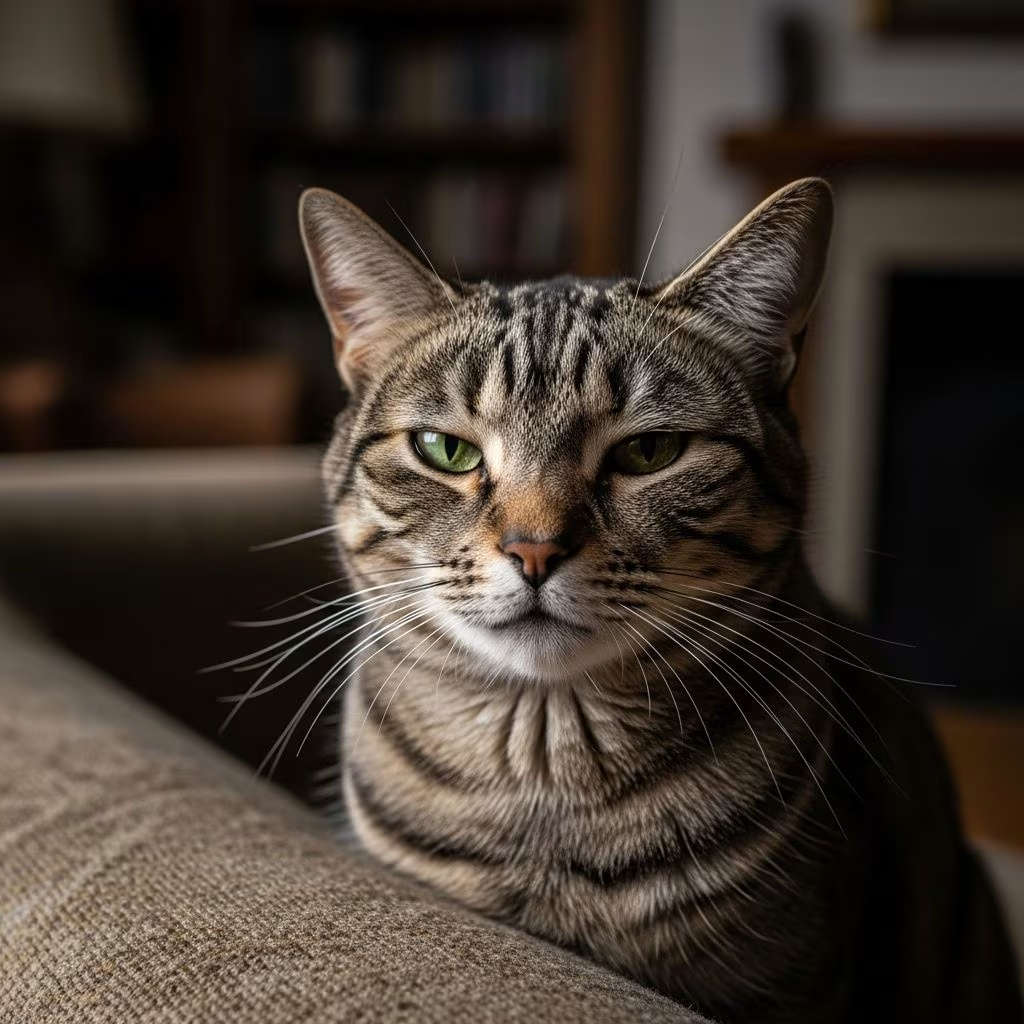
Despite cats ranking among the world’s most beloved pets, a significant portion of the population expresses frank dislike or even hostility toward them. This phenomenon stands in sharp contrast to the universal admiration dogs seem to command across cultures. The reasons behind this polarization are far more complex than simple personal preference, involving historical prejudices, biological misunderstandings, and deep-rooted cultural associations that warrant serious examination.
The Gender Stereotype Connection
One of the most compelling explanations for widespread cat aversion traces back to centuries-old gender associations embedded in our social fabric. Throughout history, cats have been predominantly linked with femininity, while dogs have earned their reputation as masculine companions and symbols of loyalty associated with traditionally male pursuits. This seemingly innocent categorization has profound implications for how we collectively perceive these animals.
Society’s longstanding tendency to diminish, mock, and trivialize anything associated with women extends naturally to their animal counterparts. Because cats carry feminine associations, expressing disdain for them becomes more socially acceptable than voicing similar sentiments about dogs. Historical evidence supports this pattern—publishers released numerous books overtly attacking cats dating back decades, including titles designed specifically to mock feline companions, while no equivalent canon exists for canine criticism.
The linguistic framework reinforces this bias daily. When a woman speaks harshly or engages in petty conflict, observers label her behavior as “catty”—a term rarely applied with the same consistency to men exhibiting identical conduct. This linguistic devaluation perpetuates the association between cats and negative female stereotypes, creating a self-reinforcing cycle where dismissing cats becomes a socially tolerated form of expression.
Misunderstanding Feline Attachment and Affection
A prevalent misconception suggests that cats operate on a fundamentally different emotional plane than dogs, viewing their human companions with indifference or even disdain. Cat detractors frequently claim these animals lack genuine attachment capacity and would abandon their owners without hesitation if given the opportunity. Some even advance the disturbing claim that cats would harm humans if they possessed sufficient physical capability.
The reality, however, reveals a more nuanced picture. While dogs underwent extensive selective breeding specifically to enhance dependence and obedience toward humans, cats followed a markedly different domestication trajectory. Cats essentially domesticated themselves, retaining greater autonomy and decision-making capacity regarding their interactions with people. This fundamental difference doesn’t indicate emotional deficiency—rather, it reflects distinct survival strategies and behavioral frameworks.
Research examining attachment patterns demonstrates that cats exhibit the same fundamental attachment styles documented in dogs and human children. Scientists studying feline behavior have identified secure attachment, anxious-ambivalent attachment, disorganized attachment, and avoidant attachment patterns—mirroring the classification system established decades ago for human psychology. Cats display affection through more subtle mechanisms than their canine counterparts, including slow blinks, head bunting, and selective proximity seeking that reveal deep emotional bonds to their chosen humans.
The difference lies not in emotional capacity but in behavioral expression. A cat’s affection manifests through independence and selective engagement rather than constant physical proximity or enthusiastic obedience. This distinction confuses individuals accustomed to the openly demonstrative attachment style dogs typically exhibit, leading them to incorrectly interpret feline autonomy as emotional coldness.
The Predatory Hunting Behavior Controversy
One of the most legitimate criticisms leveled against cats involves their hunting behaviors and environmental impact. Cats, as obligate carnivores, possess powerful predatory instincts that manifest regardless of domestic living arrangements. Both indoor-outdoor and outdoor cats kill small mammals, birds, reptiles, and other creatures with remarkable efficiency.
The ecological concern gains particular weight when discussing feral and outdoor cat populations in regions where prey species never evolutionarily adapted to such effective predators. Native birds, small mammals, and reptiles lacking natural defenses against felid predation suffer devastating population declines in areas with significant cat populations. This represents a legitimate environmental problem worthy of serious consideration and management.
However, the narrative becomes more complicated when examined closely. Many cat owners remain unaware of the extent of hunting their pets engage in when unsupervised outdoors. Cats don’t hunt solely for nutritional sustenance—they pursue prey for entertainment, exercise, and instinctive satisfaction. An indoor cat receives environmental enrichment, play opportunities, and stimulation that can partially redirect these drives. Outdoor cats, conversely, operate within their full predatory capacity.
The environmental argument against cats holds particular strength when discussing invasive species in vulnerable ecosystems. Yet for most domestic cats in residential settings, the predatory behavior, while concerning, represents a manageable issue through responsible containment and environmental modification rather than a reason for categorical hatred of the species.
The Personality Perception Gap
A fundamental misunderstanding regarding feline temperament shapes much of the cat antipathy in society. People who express hatred toward cats frequently characterize them as hostile, aggressive, selfish, and fundamentally untrustworthy. They describe cats using dehumanizing language typically applied to entities lacking emotional capacity or moral consideration.
This perception error stems largely from unfamiliarity and misinterpretation of normal feline behavior. Cats communicate through body language, vocalization patterns, and behavioral cues that differ substantially from canine communication. An individual unfamiliar with these signals may interpret a cat’s normal defensive posture as aggression, or a cat’s independent exploration of their environment as rejection or disdain.
The mysterious quality inherent to cats—their tendency to maintain psychological distance, their predatory grace, their unpredictable bursts of playful energy—can indeed appear intimidating or unsettling to those without proper context. To someone accustomed to a dog’s transparent eagerness to please and constant physical affection-seeking, a cat’s selective engagement and measured independence genuinely seems cold or hostile.
The Generalization Problem
Human psychology contains a troubling tendency to judge entire groups based on individual encounters. Upon meeting an aloof, unfriendly, or aggressive cat, many people extrapolate that experience into a sweeping condemnation of all felines. A single negative interaction becomes justification for categorical dismissal of an entire species.
This generalization pattern mirrors problematic social dynamics where individuals base their assessment of entire demographic groups on limited exposure to particular members. Just as it remains illogical to judge all women based on encounters with specific individuals, it remains equally irrational to condemn all cats based on experiences with one or two animals. Cats possess distinct personalities, behavioral preferences, and individual trauma histories. An unsocialized, poorly treated, or temperamentally reserved cat should not anchor judgment of the species as a whole.
Self-Selection and Domestication Differences
Unlike dogs, which underwent deliberate, multi-generational selective breeding to enhance traits humans found desirable—obedience, eagerness to please, constant affection-seeking—cats largely avoided this intensive behavioral modification. Cats domesticated themselves through association with human agricultural settlements, selecting primarily for tolerance of proximity rather than personality transformation.
This historical difference means cats retain far greater autonomy and behavioral independence than their canine counterparts. They haven’t been genetically engineered over millennia to suppress their instincts in favor of human-pleasing behaviors. This independence, which many cat enthusiasts celebrate as sophistication and self-determination, frustrates those expecting animal companions to function as subordinate extensions of human will.
FAQ Section
Why do cat haters tend to be more vocal than dog haters?
Social acceptability plays a significant role. Due to historical gender associations linking cats with femininity and the cultural devaluation of feminine attributes, expressing cat dislike faces fewer social consequences than voicing equivalent dog criticism. Additionally, the emotional intensity some cat haters experience—sometimes approaching pathological levels—may drive more assertive expression of their negative feelings.
Do cats actually show less attachment than dogs?
No. Research demonstrates cats exhibit attachment styles identical to those observed in dogs and human children. The difference lies in expression—cats show affection through independence and selective engagement rather than constant physical proximity and obedience. This doesn’t indicate less emotional depth; it reflects different communication styles.
Should people keep cats indoors due to ecological concerns?
Many experts recommend indoor housing or contained outdoor enclosures for cats to protect local wildlife while allowing cats to express natural behaviors safely. This approach balances ecological responsibility with feline welfare and remains practical for most residential settings.
Can cat haters learn to appreciate cats?
Exposure and education can shift perspectives significantly. Understanding feline behavior, communication, and emotional capacity often transforms initial skepticism into appreciation. Patient, positive interactions with well-socialized cats provide practical demonstration that cats offer genuine companionship and emotional connection.
The Intersection of Preference and Prejudice
While personal preference regarding companion animals remains entirely valid, the intensity and vehemence with which some individuals express cat hatred suggests deeper factors than simple aesthetic preference. The convergence of gender bias, historical conditioning, behavioral misunderstanding, and cultural reinforcement creates an environment where categorical dismissal of cats faces social approval.
Understanding these underlying factors doesn’t require converting cat skeptics into enthusiasts. Rather, it invites recognition that much cat aversion reflects learned prejudice and misunderstanding rather than objective assessment of feline characteristics. Cats possess genuine value as companions, environmental participants, and sentient beings deserving respect regardless of individual preference.
The polarization between cat and dog enthusiasts likely persists because it serves social functions beyond simple pet preference. It allows expression of deeper attitudes about independence, femininity, autonomy, and control in a supposedly neutral context. Examining this phenomenon reveals not primarily something wrong with cats, but rather something worth understanding about human psychology, cultural conditioning, and the surprising ways we project our biases onto innocent animals.
References
- The Historic Reason So Many People Hate Cats — Outdoor Bengal. https://www.outdoorbengal.com/blogs/cat-advice/the-historic-reason-people-hate-cats
- The Sexist Reason So Many People Hate Cats — An Injustice Magazine. https://aninjusticemag.com/the-sexist-reason-so-many-people-hate-cats-835a85ecfacb
- The Irreverent Vet Speaks Out on People That Don’t Like or HATE Cats — Pet Place. https://www.petplace.com/article/cats/pet-news-videos/irreverent-vet-speaks-people-dont-like-hate-cats
- Why Do Some People Hate Cats — The Cat Butler, YouTube. October 15, 2022. https://www.youtube.com/watch?v=jm43AQi3KLM
- Why Do People Hate Cats? What Science Tells Us — Catster. https://www.catster.com/cat-behavior/why-do-people-hate-cats/



