

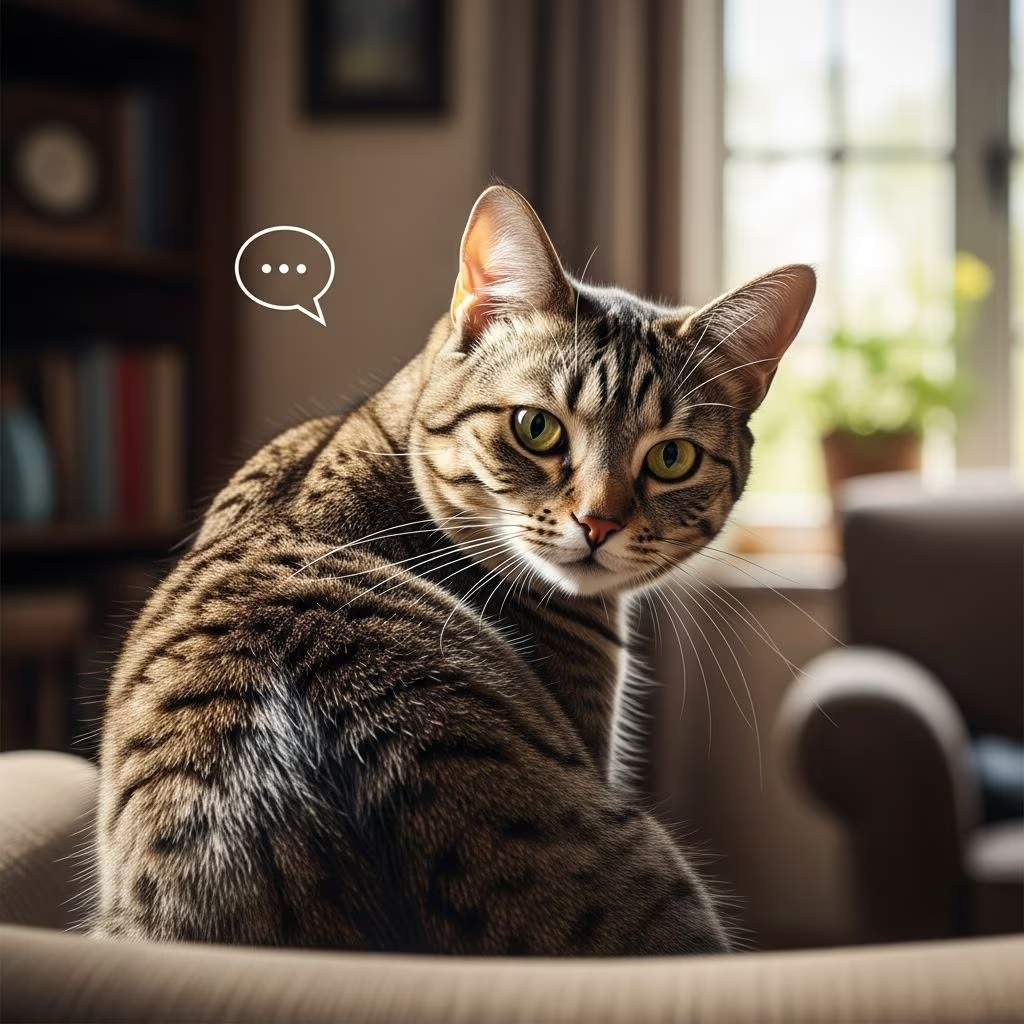
Pet owners have long puzzled over a fundamental difference between their feline and canine companions: dogs enthusiastically bound toward you when called, while cats often regard your summons with indifference. This behavioral gap isn’t a personal rejection or sign of a defective pet. Rather, it reflects deep evolutionary differences in how these species developed relationships with humans. Understanding the reasons behind your cat’s selective attention can transform your perspective on feline behavior and help you build a more effective communication strategy with your pet.
The Evolutionary Origins of Feline Independence
The foundation of cats’ reluctance to obey commands lies in their unique domestication history. Unlike dogs, which humans deliberately bred over thousands of years to respond to human direction and authority, cats essentially chose domestication themselves. As agricultural societies developed and stored grain, rodents naturally congregated around these resources. Cats discovered an easy food source by preying on these pests, leading them to establish themselves near human settlements. In essence, cats domesticated themselves rather than being domesticated by humans.
This self-directed domestication process meant that cats never evolved the genetic predisposition to obey human commands that dogs developed. The selective breeding practices applied to dogs over millennia—specifically choosing animals that responded well to human direction—never occurred with cats. Consequently, cats lack the neural pathways and behavioral instincts that make dogs naturally inclined to follow orders. Instead, cats maintain their ancestral role as independent hunters who make their own decisions about when and how to interact with their environment.
The Science of Selective Hearing Versus Selective Listening
A common misconception about cat behavior involves their hearing abilities. Cats can actually hear three times better than humans and possess exceptional auditory capabilities that allow them to detect a wide range of frequencies. However, superior hearing doesn’t equate to willingness to respond. Recent research from the University of Tokyo provides compelling evidence that cats can recognize their owners’ voices and distinguish them from strangers’ voices. Furthermore, cats recognize their own names and display physiological responses when hearing them—their ears twitch, their heads turn, their tails move, and they may vocalize.
The critical distinction emerges in what happens next. When researchers played recordings of cat owners calling their pets, the cats showed significantly greater responses than when strangers called them. Despite this recognition of familiar voices, the cats didn’t actually move toward the sound source or attempt to locate their owners. This phenomenon reveals a fundamental truth: cats aren’t ignoring you because they don’t hear you or don’t understand you. They’re making a conscious choice not to respond.
Personality Traits That Explain Feline Indifference
Natural Independence and Self-Reliance
Cats are descended from solitary hunters rather than pack animals. This lineage profoundly shapes their personalities and how they interact with their environment and the humans in it. While dogs evolved alongside wolves—creatures that hunt cooperatively and maintain strict hierarchies—cats evolved as solo predators who rely entirely on themselves for survival. This solitary background means cats don’t naturally view humans as authority figures or pack leaders. Instead, they see themselves as autonomous agents who choose whether interaction is worth their time.
Studies examining pet attachment patterns demonstrate this independence clearly. When separated from owners, cats show significantly less distress than dogs. They don’t seem to view their humans as sources of security in the same way dogs do. While cats may still prefer being around people and can form strong bonds with their owners, they don’t require constant reassurance or validation. This fundamental difference in attachment style means cats are simply less motivated to maintain proximity or respond to your commands.
The Reward-Seeking Motivation Structure
Unlike dogs, which possess an intrinsic drive to please their owners, cats operate on a strictly reward-based system. A cat won’t perform a behavior simply to make you happy or to demonstrate obedience. However, this same characteristic means cats are trainable—if the reward is sufficiently valuable to them. The challenge lies in identifying what truly motivates your individual cat.
Food treats represent the obvious choice, but not all cats respond equally to standard commercial treats. Some cats value playtime more highly, while others prioritize affection or access to preferred locations. The most effective approach involves experimenting with different rewards to determine what your specific cat finds irresistible. Once you’ve identified the right incentive, you can leverage it to encourage desired behaviors and responsiveness.
Environmental and Emotional Factors Affecting Responsiveness
Mood and Mental State
Cats are incredibly sensitive creatures whose emotional states significantly impact their willingness to engage. A cat deeply focused on play, hunting a toy, or investigating something in their environment simply won’t prioritize your call. Similarly, a cat in a relaxed, drowsy state may lack the motivation to rouse themselves for interaction. Understanding your cat’s current mood and activity level helps explain why they sometimes ignore you.
Stress and anxiety represent another critical factor. When cats feel anxious or threatened, they retreat to safe spaces and become less receptive to external stimuli. If your cat is nervous, providing a calm, secure environment takes precedence over expecting compliance with commands. Forcing interaction with an anxious cat can actually damage your relationship and make them more likely to avoid you in the future.
Health and Physical Wellbeing
Sometimes cats ignore commands because they’re experiencing physical discomfort or illness. A cat suffering from pain, nausea, or illness may seem unusually withdrawn or unresponsive. If your normally responsive cat suddenly becomes indifferent to your calls, changes in eating habits, or displays other behavioral shifts, consulting a veterinarian becomes important. Many health issues can manifest as behavioral changes that owners might initially interpret as simple disobedience.
The Role of Learned Associations and Past Experiences
Cats are creatures of habit who quickly learn to associate specific sounds and events with particular outcomes. If your cat has learned that being called typically precedes unpleasant experiences—such as trips to the veterinarian, nail trimming sessions, or being forced into a carrier—they’ll actively avoid responding. Your cat’s “ignoring” of your calls actually represents a logical survival strategy from their perspective.
Conversely, if calling your cat’s name has been consistently paired with positive experiences like treats, playtime, or affection, they become much more likely to respond. Building these positive associations requires patience and consistency. Every time you call your cat successfully, reward them immediately. This reinforcement gradually shifts their perception of the call from neutral or negative to positive, increasing future responsiveness.
Fear and Punishment: Counterproductive Training Methods
Many cat owners attempt to enforce obedience through punishment, using techniques like yelling, water spraying, or physical swatting. These approaches consistently backfire with cats. Because cats don’t possess the same drive to please humans that dogs do, they don’t interpret punishment as a correction that should modify their behavior. Instead, they perceive it as a threat, causing them to view you as a potential danger to avoid.
Punishment-based training erodes the trust in your relationship with your cat. Once a cat associates you with negative experiences, they become even less responsive to your calls. The damage to your bond can take considerable time to repair. Effective cat training focuses entirely on positive reinforcement—rewarding desired behaviors and redirecting or ignoring undesired ones.
Effective Training Methods That Actually Work
The Clicker Training Approach
Clicker training, traditionally associated with dog training, proves equally effective for cats. This method involves creating an association between a clicking sound, a desired behavior, and an immediate reward. The process works as follows:
- Identify a high-value reward your cat loves
- When your cat naturally performs a desired behavior, immediately click a clicker device
- Immediately provide the reward following the click
- Repeat this sequence consistently over multiple training sessions
- Eventually, the cat associates the behavior with the click and reward
- Gradually introduce your verbal command before the behavior occurs
Keep training sessions brief—just 2 to 5 minutes—to maintain your cat’s interest. Cats have shorter attention spans than dogs and become bored with extended training. Short, frequent sessions prove far more effective than lengthy ones. Practice in a quiet room with minimal distractions to help your cat focus on the training rather than their surroundings.
Gradual Reward Transition
Once your cat reliably responds to a command, you don’t need to provide food treats every single time. Begin alternating between treat rewards and other forms of positive reinforcement like verbal praise, petting, or playtime access. This variable reward schedule actually strengthens the behavior over time, similar to how slot machines keep people engaged through unpredictable payouts. Eventually, you may reduce treats to every other successful response while maintaining the desired behavior through praise and affection.
The Bottom Line: Understanding Versus Accepting
The evidence clearly demonstrates that cats understand us far better than many assume. They recognize our voices, learn their names, and comprehend our intentions. Their apparent indifference reflects not a cognitive failing or defiance, but rather a conscious choice rooted in their evolutionary history and independent nature. Cats simply operate under a different social contract than dogs—one where they maintain decision-making authority over their own actions.
Rather than viewing this as a flaw in feline nature, understanding it allows you to work with your cat’s inherent personality rather than against it. By leveraging their reward-seeking nature, respecting their emotional state, and building positive associations with your commands, you can significantly improve your cat’s responsiveness. The key lies in recognizing that your cat isn’t broken or stubborn—they’re simply being authentically feline.
FAQ Section
Can cats actually be trained to listen?
Yes, cats can be trained, but their motivation differs from dogs. They respond best to clear rewards rather than a desire to please. Using high-value treats and short training sessions of 2-5 minutes yields the best results.
Why does my cat respond sometimes but not always?
Your cat’s responsiveness depends on their current mood, environment, and what they find more interesting at that moment. Consistency in positive reinforcement helps increase reliability over time.
Is my cat deliberately ignoring me?
Research suggests cats do consciously choose whether to respond to their owners. They hear and recognize you but decide whether interaction is worth their effort.
What rewards work best for cat training?
This varies by individual cat. Some prefer food treats, while others value playtime, toys, or affection more highly. Experiment to find what truly motivates your specific cat.
Will punishment help my cat listen better?
No. Punishment damages your relationship and makes cats less responsive. Cats don’t connect punishment to behavioral correction the way dogs do. Focus entirely on positive reinforcement.
References
- Why Cats Ignore You When You Call Them? — Pet Barn. https://petbarnkw.com/why-cats-ignore-you-when-you-call-them/
- Cats Recognize Their Owner’s Voice But Choose to Ignore It — Smithsonian Magazine. https://www.smithsonianmag.com/smart-news/cats-recognize-their-owners-voice-but-choose-to-ignore-it-180948087/
- Why Don’t Cats Listen? 6 Vet-Verified Possible Reasons — Catster. https://www.catster.com/cat-behavior/why-dont-cats-listen/
- My cat ignores me – why? — Burgess Pet Care. https://www.burgesspetcare.com/blog/cat/my-cat-ignores-me-why/
- Why do cats ignore humans? — VCA Animal Hospitals. https://vcahospitals.com/resources/behavior-cat/why-do-cats-ignore-humans



