

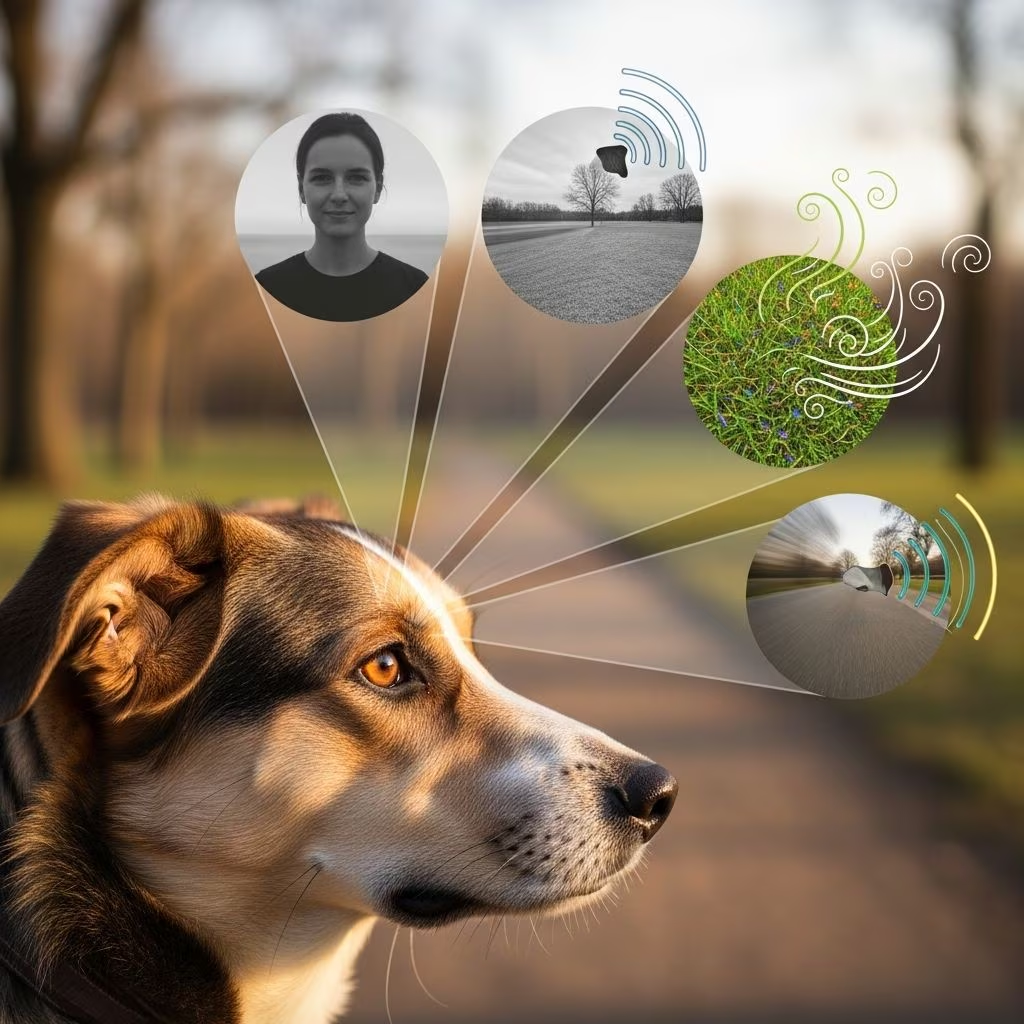
Understanding Your Dog’s Umwelt: How Dogs Perceive Their World
Have you ever wondered why your dog reacts to things you cannot even see or hear? Why they become fixated on a particular spot on the ground or suddenly alert to a sound that seems completely silent to your ears? The answer lies in a fascinating concept called umwelt—a term that explains how your dog experiences reality in a fundamentally different way than you do.
Umwelt is a German word introduced by biologist Jakob von Uexküll in the early 20th century that describes the unique sensory world each organism experiences. Unlike humans, who rely primarily on vision to interpret their environment, dogs inhabit a rich sensory landscape dominated by smell, hearing, and motion detection. Understanding your dog’s umwelt is not merely an academic exercise—it is a practical tool that can transform how you interpret your dog’s behavior, train more effectively, and deepen your relationship with your canine companion.
What Is Umwelt?
At its core, umwelt refers to the subjective perceptual world experienced by an individual organism based on its unique sensory and cognitive capabilities. Every animal, from bees to dogs to humans, lives within its own bubble of perception—a filtered version of reality shaped by what that organism can detect and how its brain interprets that information.
Think of umwelt as a set of sensory glasses unique to each species. Bees perceive ultraviolet light patterns invisible to humans. Bats navigate using echolocation that creates a detailed sonic landscape. Dogs, meanwhile, experience the world through a highly refined olfactory system that processes information in ways we can barely imagine.
The key insight is that no two animals experience the world identically. Even though humans and dogs share the same physical environment, the information they extract from it—and what they consider important—differs dramatically. This difference is not a limitation of your dog’s perception; it is simply their particular way of interpreting reality based on their evolutionary needs and biological capabilities.
Why Humans Misunderstand Dogs
One of the primary reasons we struggle to understand our dogs is a cognitive bias called anthropomorphism—the tendency to attribute human thoughts, intentions, and personalities to nonhuman animals. We do this naturally because it feels intuitive. After all, we share homes with our dogs, watch their facial expressions, and interpret their actions through a human lens.
However, anthropomorphism falls short. When we assume our dogs think like us, we miss the fundamental truth about their nature. We expect our dogs to find joy in the activities we find rewarding. We become frustrated when they seem uninterested in visual toys or games that engage us. We sometimes even feel personally insulted when our dogs ignore us to sniff a seemingly unremarkable patch of grass—not realizing that patch contains a detailed history of every dog, fox, or rabbit that has passed through that spot.
As ethologist Temple Grandin notes, when a dog sniffs a tree, he is receiving a wealth of important information that is simply unavailable to our visual-centric brains. Understanding this gap between our umwelt and our dog’s umwelt is the first step toward genuine empathy and better dog ownership.
The Sensory Differences Between Dogs and Humans
Dogs and humans perceive the world through very different sensory systems. While humans are primarily visual creatures, dogs rely on a multisensory approach where smell, hearing, and motion detection take precedence. Here is how they compare:
Smell: The Dominant Sense
For dogs, the world is made up of numerous smells, and smell is by far their most developed and important sense. Dogs have approximately 300 million olfactory receptors in their noses, compared to about 6 million in humans. More importantly, dogs possess a three-dimensional sense of smell—they can discern scent in layers and detect odors at concentrations as low as one part per trillion.
Dogs even have anatomical features specifically designed for smelling. Unlike humans, who share a single passage for both breathing and smelling, dogs have one nasal passage dedicated exclusively to breathing and another reserved for smelling. Additionally, dogs possess a vomeronasal organ (also called the Jacobson organ) that detects pheromones—chemical signals that convey information about other animals’ emotional and physiological states.
This olfactory superiority means that when your dog sniffs the ground during a walk, they are not simply taking in air. They are reading a detailed narrative written in chemical markers. They are learning about the health status of other dogs in the neighborhood, identifying territorial boundaries, and gathering survival-critical information that human senses cannot access.
Hearing: Detecting Ultrasonic Frequencies
Dogs hear at frequencies far beyond human capability. While humans can hear sounds up to approximately 20,000 Hz, dogs can detect sounds up to 65,000 Hz or higher. This means your dog is constantly aware of sounds you cannot perceive—ultrasonic frequencies produced by electronic devices, animal vocalizations, and other environmental noise.
This explains why your dog might suddenly alert to something that seems completely silent to you. They are responding to a world filled with information you literally cannot hear.
Vision: Different Colors and Motion Sensitivity
Contrary to popular belief, dogs do not see in black and white. However, their color vision is significantly different from ours. Humans can perceive red, green, and blue light and all variations and combinations of these colors. Dogs, by contrast, see primarily in shades of blue and yellow.
This means reds and greens—colors that humans distinguish easily—appear as shades of brown or gray to dogs. A red toy on green grass, which pops visually for you, may be much harder for your dog to spot. However, this limitation is offset by dogs’ superior motion detection. Dogs have more rod cells than cone cells in their retinas, making them exceptionally sensitive to movement. This evolutionary adaptation served their wolf ancestors well in hunting, allowing them to detect prey movement from significant distances.
How Experience Shapes Your Dog’s Umwelt
A dog’s umwelt is not determined solely by their sensory organs. It is also shaped by history, experience, and what matters to the individual dog. Two dogs with identical genetics and sensory abilities may perceive and prioritize different aspects of their environment based on their past experiences.
A dog who has had positive experiences at the veterinary clinic may notice the clinic’s scent and feel calm, while a dog with negative associations may become anxious at the same odor. A dog trained to detect explosives has developed a umwelt that prioritizes certain chemical signatures, while a search-and-rescue dog prioritizes human scent. Experience literally shapes how your dog’s brain filters and interprets sensory information.
This is why early socialization is so important. Every experience your puppy has helps construct their umwelt—what they notice, what they fear, what they find rewarding, and how they interpret ambiguous situations. A dog socialized to enjoy car rides has a different automotive umwelt than a dog who has only experienced stressful veterinary visits in cars.
Why Understanding Umwelt Matters for Dog Owners
Recognizing that your dog inhabits a different sensory world has profound practical implications for how you live with and train your dog:
- Training becomes more effective: When you understand that your dog prioritizes smell over sight, you can design training environments and rewards that align with their natural sensory hierarchy. Using high-value scented treats may be more motivating than visual praise.
- Behavior problems make more sense: Instead of asking “Why is my dog being bad?” you can ask “What is my dog experiencing right now that is causing this behavior?” This shift in perspective often reveals that the behavior is a rational response to their sensory experience, not a character flaw.
- Exercise needs are better understood: A 20-minute walk that allows your dog to sniff freely is far more enriching and tiring for your dog than 20 minutes of running at your pace. Your dog is gathering mental and social information, not simply covering distance.
- Environmental stressors become apparent: Understanding that your dog hears frequencies you cannot helps explain noise anxiety. Your dog may be genuinely distressed by ultrasonic sounds from electronic devices or neighboring homes.
- Quality of life improves: When you design your home and routines around your dog’s umwelt rather than forcing your dog into your perceptual world, your dog experiences less stress and confusion.
Practical Applications: Viewing the World Through Your Dog’s Eyes
What Does Your Dog’s Walk Feel Like?
To understand your dog’s umwelt during a walk, imagine moving through an environment where scent is as informative as sight is to you. Every tree, fence post, and patch of grass contains messages. Imagine also that your hearing is extraordinary—every dog barking blocks away is crystal clear, every car engine a minor distraction, every leaf rustle potentially significant. This is your dog’s walk.
A dog’s “sniff walk” where they determine the pace and direction is not laziness or stubbornness. It is them gathering essential information about their territory, the presence of other animals, and environmental changes. Allowing your dog to sniff is not a waste of time; it is providing mental enrichment equal to—or exceeding—the physical enrichment of a fast-paced walk.
Understanding Your Dog’s Reactions
When your dog suddenly reacts to something invisible to you, they are responding to sensory information in their umwelt. A dog alerting to a sound you cannot hear, fixating on a scent trail, or moving toward a distant rustling is not being stubborn or distracted. They are responding appropriately to their perception of reality.
Rather than interpreting these moments as disobedience, consider what your dog might be sensing. Are they detecting an animal in the distance? Have they caught the scent of another dog? Are they responding to an ultrasonic frequency? This reframing shifts your response from frustration to curiosity and empathy.
The Importance of Respecting Your Dog’s Natural Behaviors
Understanding umwelt also means recognizing which behaviors, while perhaps inconvenient for humans, are deeply important to your dog’s wellbeing. Scavenging, sniffing, rolling in pungent-smelling substances, and investigating odors are not misbehaviors to eliminate—they are expressions of your dog’s natural umwelt.
Rolling in fox excrement may seem disgusting to humans, but to your dog, it is a complex communicative and sensory experience. Discouraging all sniffing and scavenging can lead to frustration and anxiety. The key is finding balance—allowing your dog to express these natural behaviors in safe environments while preventing behaviors that are genuinely dangerous.
Building a Better Relationship Through Understanding
One of the greatest gifts you can give your dog is the effort to see the world through their eyes. This does not mean becoming a dog or abandoning human values in your household. It means acknowledging that your dog’s perception is valid, that their reactions are rooted in biology, and that their needs are different from yours.
Dogs tolerate an enormous amount of human inadequacy—the insistence that they conform to our visual-centric, human-paced world. They live in our homes, follow our rules, and try to understand our often confusing expectations. The least we can do is extend our understanding toward them, recognizing that they are not small humans but creatures with their own rich inner worlds.
Key Takeaways for Dog Owners
- Umwelt is the unique sensory world each organism experiences based on their biological capabilities, experiences, and priorities.
- Dogs perceive reality fundamentally differently than humans, prioritizing smell over sight and hearing ultrasonic frequencies.
- Understanding your dog’s umwelt requires moving beyond anthropomorphism and recognizing your dog as a different kind of being with different needs.
- A dog’s umwelt is shaped not only by their senses but also by their individual experiences and learning history.
- Practical applications of umwelt understanding include more effective training, better interpretation of behavior, and improved quality of life for your dog.
- Respecting your dog’s natural behaviors—sniffing, scavenging, and exploring—is essential to their mental and emotional wellbeing.
Frequently Asked Questions About Dog Umwelt
Q: Can I ever truly understand my dog’s umwelt?
A: While we cannot experience the world exactly as dogs do, we can develop deeper understanding by learning about their sensory capabilities, observing their reactions, and imagining their perspective. This practice of perspective-taking significantly improves the human-dog relationship and training outcomes.
Q: How does umwelt apply to training my dog?
A: Understanding umwelt means recognizing that your dog may not be motivated by the same rewards you find appealing. High-value scented treats, olfactory enrichment, and allowing time for sniffing may be more rewarding to your dog than visual games or fast-paced play.
Q: Is it bad to stop my dog from sniffing on walks?
A: Constantly preventing sniffing can lead to frustration and anxiety in dogs. Allowing “sniff breaks” where your dog determines the pace and direction provides essential mental enrichment and respects your dog’s natural umwelt. Balance is key—you can still maintain safety and structure while allowing sniffing time.
Q: Why does my dog ignore me to focus on a smell?
A: Your dog is not intentionally ignoring you. They are gathering critical information from their sensory environment that you cannot perceive. To your dog, the information in that scent is more urgent or important in that moment than your attention.
Q: Does every dog have the same umwelt?
A: No. While all dogs share similar sensory capabilities, individual differences in experience, training, and personality create unique umwelts for each dog. A dog trained to detect drugs, a socialized companion dog, and a frightened rescue dog will perceive the same environment very differently.
Q: How does understanding umwelt help with behavior problems?
A: Rather than labeling your dog as stubborn or aggressive, understanding umwelt allows you to ask what your dog is perceiving that triggers the behavior. Is your dog responding to an ultrasonic frequency? A scent that signals threat? This perspective shift often reveals solutions grounded in addressing your dog’s actual experience rather than punishing the behavior.
References
- Umwelt – Dog Behaviour Clinic — Dog Behaviour Clinic. https://www.dogbehaviourclinic.co.uk/post/umwelt
- Looking at your dog’s visual umwelt — Miss Behavior. 2025-06-25. https://www.youtube.com/watch?v=tfoBUoGRZnE
- Have you heard of the term ‘umwelt’? — Bonny Dog Behaviour. https://www.bonnydogbehaviour.com/post/have-you-heard-of-the-term-umwelt
- Umwelt: The hidden sensory world of animals — Big Think. https://bigthink.com/series/explain-it-like-im-smart/animal-senses/
- The Umwelt of Artificial Intelligence — American College of Radiology. 2024. https://www.acr.org/Blogs/DSI/2024/The-Umwelt-of-Artificial-Intelligence
- Imagining my dog’s “umwelt” helps us be a better team — Paws and Reflect. https://www.pawsandreflect.blog/p/imagining-my-dogs-umwelt-helps-us-grow-as-a-team



