

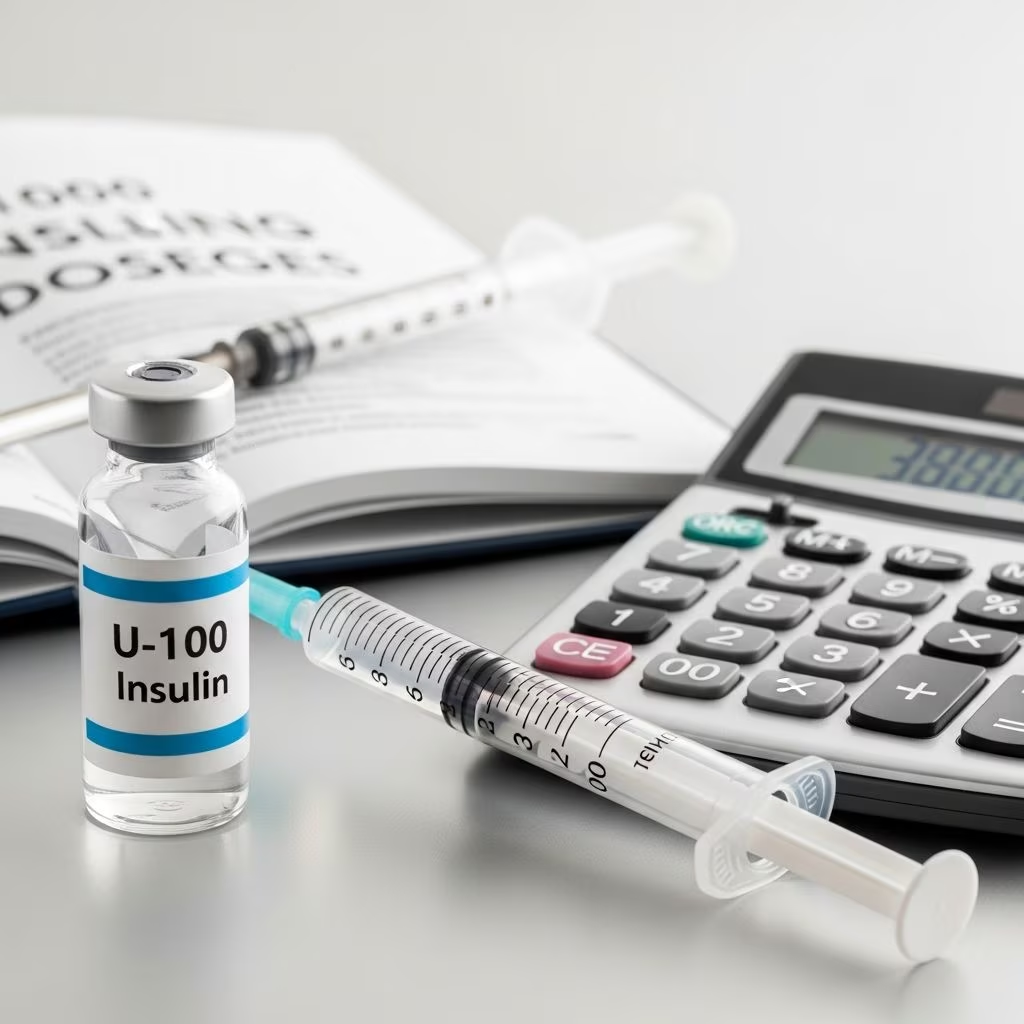
Managing diabetes in pets requires precision, and one of the most critical aspects of insulin therapy is understanding how to properly convert units to milliliters. Whether you’re administering insulin to your dog or cat for the first time or you’ve been doing it for years, grasping the fundamentals of insulin measurement ensures your pet receives the exact dose prescribed by your veterinarian. This comprehensive guide breaks down the science behind insulin concentrations and provides practical tools for accurate medication administration.
The Basics of Insulin Strength and Concentration
Insulin medications are labeled with a “U” designation followed by a number, indicating the concentration or strength of the medication. This number represents how many units of active insulin are present in each milliliter of liquid. The most commonly prescribed formulation in modern veterinary and human medicine is U-100, meaning 100 units of insulin are contained in every milliliter of the solution. Understanding this fundamental relationship forms the foundation for all subsequent conversions and dosing calculations.
The insulin itself is dissolved or suspended in a sterile liquid called a diluent, which makes up the total volume of the medication vial. The ratio of active insulin to this diluent determines the final strength designation. For example, U-100 insulin contains a higher concentration of active insulin compared to U-40 insulin, which has 40 units per milliliter. This difference in concentration is why using the correct syringe type and performing accurate conversions are so important—using the wrong combination could result in your pet receiving an incorrect dose.
Why U-100 Became the Standard Formulation
Decades ago, multiple insulin concentrations were commonly available for both human and veterinary use, including U-40, U-80, and U-100. Standardizing on U-100 simplified prescribing, reduced medication errors, and made insulin more accessible worldwide. Today, U-100 is the default insulin strength you’ll encounter in most veterinary clinics and pharmacies. Some patients with severe insulin resistance may require U-500 insulin, which is five times as concentrated as U-100, but these cases are relatively uncommon.
Older veterinary insulins, particularly Vetsulin, were formulated as U-40 preparations and required special U-40 syringes for accurate dosing. While U-40 insulin is rarely prescribed for new cases, pet owners may still encounter it when switching medications or in international settings. Understanding how to work with both formulations ensures you can adapt if circumstances change.
The Mathematical Foundation: Converting Units to Volume
The conversion between insulin units and milliliters follows a straightforward mathematical principle. Since U-100 insulin contains 100 units per milliliter, the conversion factor is simple: one unit equals 0.01 milliliters. This ratio allows you to calculate any volume needed for your pet’s prescribed dose.
The primary conversion formula: Volume (mL) = Units ÷ 100
To demonstrate this calculation, consider these practical examples with U-100 insulin:
- A 5-unit dose = 5 ÷ 100 = 0.05 mL
- A 10-unit dose = 10 ÷ 100 = 0.1 mL
- A 20-unit dose = 20 ÷ 100 = 0.2 mL
- A 30-unit dose = 30 ÷ 100 = 0.3 mL
Conversely, if you need to determine how many units are in a specific volume, you multiply the milliliters by 100. For instance, 0.5 mL of U-100 insulin contains 50 units of active medication. This reverse calculation becomes useful when you’re working with a regular syringe that measures only in milliliters rather than units.
Practical Scenarios Requiring Unit-to-Milliliter Conversion
Most pet owners will use syringes specifically marked for their insulin strength, making conversions unnecessary. However, several situations may require you to perform these calculations:
- Emergency situations: If your insulin syringe is damaged or unavailable and you need to use a regular medical syringe marked only in milliliters
- International travel: When purchasing insulin outside your home country where different concentrations might be standard
- Medication changes: When your veterinarian prescribes a different insulin formulation that requires converting from your pet’s previous dosage
- Veterinary communication: Understanding the relationship between units and volume helps you communicate more effectively with your veterinarian about your pet’s dosing
Particularly for pet owners managing diabetes across borders or those dealing with medication shortages, being comfortable with these conversions provides essential flexibility and ensures your pet doesn’t miss doses.
Comparing Different Insulin Concentrations
While U-100 dominates the modern market, understanding how other concentrations compare helps you navigate different scenarios. The relationship between concentrations is proportional—U-40 insulin has 40 units per milliliter, making U-100 exactly 2.5 times as concentrated.
| Insulin Type | Units per mL | 1 Unit Equals | Common Use |
|---|---|---|---|
| U-40 | 40 | 0.025 mL | Veterinary (older formulations) |
| U-100 | 100 | 0.01 mL | Standard for dogs and cats |
| U-500 | 500 | 0.002 mL | Severe insulin resistance |
This table illustrates why using the correct syringe is absolutely critical. Administering U-100 insulin with a U-40 syringe would result in your pet receiving 2.5 times the intended dose—a potentially dangerous error. Similarly, using a U-100 syringe with U-40 insulin would deliver only 40% of the prescribed amount, leaving your pet’s blood glucose dangerously elevated.
Selecting Appropriate Injection Equipment
Modern insulin syringes are manufactured in specific sizes matched to their corresponding insulin strength. U-100 syringes typically come in three sizes: 1 mL, 0.5 mL, and 0.3 mL capacities. The 0.3 mL size has become increasingly popular because most diabetic pets require relatively small doses, and smaller syringes provide better accuracy for measuring precise volumes.
When selecting a syringe, consider your pet’s prescribed dose. If your dog requires a 20-unit injection, a 0.3 mL U-100 syringe (which holds up to 30 units) would be ideal, as it provides clear, easy-to-read markings. For cats or small dogs with doses below 10 units, the 0.3 mL syringe is nearly always the best choice.
The needle gauge and length also matter for your pet’s comfort and injection technique. Most veterinarians recommend 28 or 29-gauge needles in 6-8mm lengths for subcutaneous insulin injection in small animals. Always use new needles for each injection to maintain sterility and minimize pain.
When Conversions Become Essential: Cross-Concentration Scenarios
If you find yourself with U-100 insulin but only have access to a U-40 syringe, or vice versa, accurate conversion is necessary. The conversion factor between these two concentrations is 2.5—representing the ratio of their concentrations (100 ÷ 40 = 2.5).
Converting U-40 insulin to U-100 syringe measurements: Multiply the U-40 dose by 2.5
- If your cat needs 2 units of U-40 insulin, draw 5 units (2 × 2.5) in a U-100 syringe
- If your dog needs 4 units of U-40 insulin, draw 10 units (4 × 2.5) in a U-100 syringe
Converting U-100 insulin to U-40 syringe measurements: Divide the U-100 dose by 2.5
- If your cat needs 5 units of U-100 insulin, draw 2 units (5 ÷ 2.5) in a U-40 syringe
- If your dog needs 10 units of U-100 insulin, draw 4 units (10 ÷ 2.5) in a U-40 syringe
These calculations are crucial for maintaining proper blood glucose control. Any error in conversion could result in either overdosing or underdosing your pet, potentially leading to serious complications including hypoglycemia or uncontrolled hyperglycemia.
Critical Safety Considerations and Common Mistakes
One of the most serious medication errors in pet diabetes management occurs when the wrong syringe is paired with the wrong insulin concentration. A pet owner might inadvertently use a U-40 syringe with U-100 insulin without performing the necessary conversion, believing the syringe markings apply directly to their insulin bottle. This mistake would result in the pet receiving 2.5 times the prescribed dose—a potentially life-threatening error.
Another common confusion involves communication with veterinarians. If you’re using mismatched equipment without proper conversion, you might tell your veterinarian “I’m giving 10 units” when in reality you’re administering 25 units due to the concentration mismatch. This miscommunication prevents your vet from properly monitoring your pet’s response to therapy and adjusting doses appropriately.
Always verify the following before each injection:
- The insulin bottle label matches your syringe type (both U-100 or both U-40)
- You’ve performed any necessary conversions if equipment doesn’t match
- You can clearly see the dose marking on your syringe before injecting
- The insulin hasn’t expired or changed appearance
- You’re drawing from a properly stored vial at room temperature
Frequently Asked Questions About Insulin Conversion
How many milliliters equal one unit of U-100 insulin?
One unit of U-100 insulin equals 0.01 milliliters. This relationship is constant and forms the basis for all U-100 conversion calculations.
Can I use human insulin for my pet?
Some veterinarians recommend human insulin for dogs and cats when veterinary-specific formulations are unavailable. Human insulins are typically U-100, so they follow standard conversion calculations. Always consult your veterinarian before switching insulin types.
What happens if I accidentally give my pet the wrong volume?
Overdosing can cause hypoglycemia (dangerously low blood sugar), leading to weakness, seizures, or loss of consciousness. Underdosing leaves blood glucose elevated and worsens diabetes complications. Contact your veterinarian immediately if you suspect a dosing error.
Are there insulin concentrations other than U-40 and U-100?
Yes, U-500 insulin exists for patients requiring very high doses and is used when insulin resistance is severe. Some older formulations included U-80, but these are rarely encountered today.
Ensuring Accuracy in Your Pet’s Insulin Therapy
Successful diabetes management in pets depends on consistent, accurate insulin administration. Taking time to understand unit-to-milliliter conversions, selecting appropriate syringes, and maintaining clear communication with your veterinarian significantly reduces medication errors and improves outcomes for your diabetic pet.
Before making any changes to your pet’s insulin regimen or equipment, consult your veterinarian to ensure all conversions are correct and appropriate for your specific situation. Record each injection accurately and monitor your pet’s response to therapy through regular blood glucose monitoring. With proper knowledge and careful attention to detail, you can confidently manage your pet’s diabetes and maintain their health and quality of life.
References
- How to Convert Insulin Units to mL? — 4AllFamily. 2024. https://4allfamily.com/blogs/diabetes/how-to-convert-insulin-units-to-ml
- Converting U-100 & U-40 Insulin Syringes for Dogs and Cats — PetPlace. 2024. https://www.petplace.com/article/drug-library/drug-library/library/how-to-convert-u-100-and-u-40-insulin-and-syringes-for-dogs-and-cats
- Converting U40 insulin units for U100 insulin syringes — RayMed. 2024. https://www.raymed.co.uk/blogs/news/converting-u40-insulin-units-to-u100-insulin-syringes
- Insulin Conversions: U-40 and U-100 — Felinediabetes.com. 2024. https://felinediabetes.com/insulin-conversions/
- Insulin Syringes Difference between U 100 and U 40 — University of Minnesota Open Textbook Library. 2024. https://open.lib.umn.edu/clinicalskills/chapter/insulin-syringes/



