

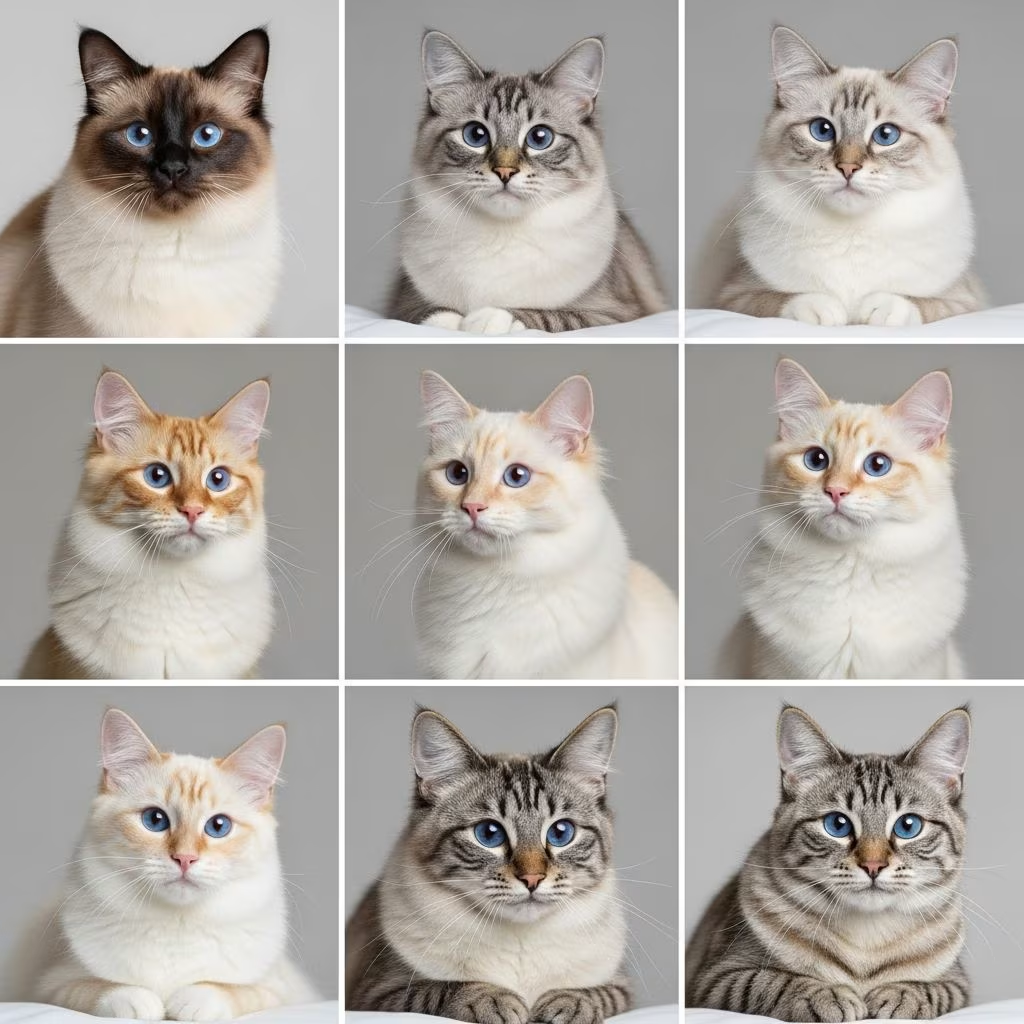
The Birman cat, often called the Sacred Cat of Burma, is renowned for its striking sapphire-blue eyes, semi-long silky coat, and distinctive white-gloved paws. This colorpoint breed comes in various types distinguished by their point colors and patterns, making each variety uniquely beautiful. Originating from ancient legends tied to Burmese temples, Birmans nearly went extinct but were revived through careful breeding.
What Is a Birman Cat?
A Birman is a medium to large domestic cat breed characterized by its colorpoint coat pattern—darker shades on the ears, face, legs, and tail contrasting with a lighter body fur. They feature mandatory white markings on the paws (gloves on front, socks on back), a sturdy rectangular body, rounded head with Roman nose, and vivid blue eyes. Birmans are born white and develop their points over time, fully maturing at around two years.
Unlike Siamese, Birmans have a plush, medium-long coat that doesn’t mat easily, and their gentle, dog-like personality makes them ideal family pets. They thrive on human interaction, often following owners room-to-room.
Types of Birman Cats
Birman cats are categorized by their point colors and patterns, recognized by major associations like CFA and TICA. Solid points include seal, blue, chocolate, lilac, red, and cream, while patterned varieties feature tabby (lynx), tortie, torbie, and particolor. Each type must have symmetrical white gloves and socks for breed standard compliance.
Solid Point Birmans
- Seal Point: The classic Birman with deep brown-black points on a creamy body. Most common and iconic variety.
- Blue Point: Softer, slate-blue points on a pale blue-cream body, offering a diluted, elegant look.
- Chocolate Point: Warm milk-chocolate points contrasting a creamy ivory body.
- Lilac Point: The lightest solid, with frosty pinkish-gray points on a white body; rare and delicate.
- Red Point: Bright red-orange points on a creamy body, with males often showing tabby markings due to genetics.
- Cream Point: Pale apricot-cream points, the dilute of red, subtle and beautiful.
Tabby (Lynx) Point Birmans
These feature banded hairs creating stripes, swirls, or spots on points, resembling wild tabby patterns. Available in seal-tabby, blue-tabby, chocolate-tabby, lilac-tabby, red-tabby, and cream-tabby. The markings must be distinct without blotches.
Tortoiseshell & Torbie Point Birmans
- Tortie Point: Intermingled red and cream with a solid color (e.g., seal-tortie) on points.
- Torbie Point: Tortie mixed with tabby patterns, creating complex, marbled effects.
Particolor Birmans
Females predominantly, these have unblended red/cream patches on points alongside solid or tortie colors, such as seal-tortie particolor. Highly prized for uniqueness.
| Type | Point Color | Body Color | Rarity |
|---|---|---|---|
| Seal Point | Dark brown-black | Creamy white | Common |
| Blue Point | Slate blue | Pale blue-cream | Common |
| Chocolate Point | Milk chocolate | Ivory cream | Moderate |
| Lilac Point | Frosty gray-pink | White | Rare |
| Red Point | Red-orange | Cream | Moderate |
| Cream Point | Apricot-cream | Cream | Rare |
| Seal Lynx | Brown tabby | Cream | Moderate |
| Seal Tortie | Seal + red/cream | Cream | Rare |
Birman Cat History & Origins
The Birman’s legend traces to Burma’s Lao Tsun temple, where a cat named Sinh guarded priest Mun-Ha. As the priest died protecting a goddess statue, Sinh’s paws touched the statue, turning white; its coat goldened, eyes blued, birthing the breed’s signature look. All temple cats soon mirrored this.
Historically, Birmans arrived in France in the 1920s via Major Gordon Russell. Recognized in France by 1925, they faced near-extinction in WWII, leaving one pair (Orloff and Xenia). Outcrossed with Persians and Siamese, pure litters returned by the 1950s. UK recognition in 1965, CFA in 1966, TICA later.
Introduced to the US in 1959, Birmans flourished, with early breeders like Mrs. Griswold establishing catteries.
Birman Cat Personality
Birmans are affectionate, laid-back “kitten bears,” forming deep bonds without clinginess. Curious, outgoing, and people-oriented, they greet strangers warmly but may be reserved initially. Quietly vocal, playful yet low-energy, they get along with cats, dogs, and children if socialized.
They lack strong hunting instincts, preferring lap time and gentle play. Loyal like dogs, Birmans adapt to apartments but need interaction to avoid depression.
Birman Cat Size
Males weigh 12-18 pounds, females 8-12 pounds; length 22-26 inches excluding tail. Semi-cobby body, muscular yet elegant, with height around 8-10 inches at shoulder. Medium-large frame supports their plush coat.
Birman Cat Lifespan
Average 12-16 years with proper care, some reaching 18+. Genetics, diet, and vet checkups influence longevity.
Birman Cat Grooming
Semi-long coat requires weekly brushing to remove dead hair and prevent mats. Bath rarely needed; nails trim biweekly, ears clean monthly. Brush teeth regularly. Low shedding compared to Persians.
Birman Kitten
Born white, points darken from week 1 (dark colors) or week 2 (light). Eyes open blue, staying so. Playful, social kittens need early handling. Acquire from reputable breeders at 12 weeks.
Birman Cat Health Problems
Generally robust, but screen for hypertrophic cardiomyopathy (HCM), polycystic kidney disease (PKD from Persian lines), and obesity. Dynamic testing helps maintain health.
- HCM: Heart thickening; annual echoes recommended.
- PKD: Kidney cysts; genetic testing available.
- Obesity: Monitor diet; prone due to sedentary nature.
Birman Cat Price
Kittens from breeders: $800-$2000+, rarer colors higher. Adoption cheaper. Pet quality vs. show quality affects price.
Final Thoughts
Birman types offer diverse beauty and uniform gentleness, rooted in sacred legend. Whether seal or lilac lynx, they make devoted companions. Research breeders, prioritize health-tested lines for a lifetime of joy.
Frequently Asked Questions
What are the different types of Birman cats?
Solid points (seal, blue, chocolate, lilac, red, cream), lynx (tabby), tortie, torbie, and particolor varieties, all with white gloves/socks and blue eyes.
Are Birman cats hypoallergenic?
No, but low-shedding coat produces less allergen than short-haired breeds.
How do I identify a Birman cat?
Look for blue eyes, color points, white-gloved paws, Roman nose, and silky semi-long coat.
Do Birman cats get along with dogs?
Yes, usually; their sociable nature aids harmony with proper introductions.
What is the rarest Birman color?
Lilac point and particolors are among the rarest.
References
- Birman Cat Breed Complete Guide — A-Z Animals. 2023. https://a-z-animals.com/animals/birman/
- Birman Cat | History, Traits, and Care — Feline Fancy. 2024. https://felinefancy.co.uk/blogs/cat-breeds-info/birman-cat
- Birman — The International Cat Association (TICA). 2025-01-10. https://tica.org/breed/birman/
- Historical Facts | The Birman Cat — BirmanBC.org. 2022. http://birmanbc.org/historical-facts.html
- 34 Facts About Birman Cats — FELIWAY. 2024. https://www.feliway.co.uk/blogs/news/34-facts-about-birman-cats
- Sacred Cat of Birma — Wild Cats Magazine. 2023. https://wildcatsmagazine.nl/sacred-cat-of-birma/
- Birman — Cat Fanciers’ Association (CFA). 2025-01-01. https://cfa.org/breed/birman/



