

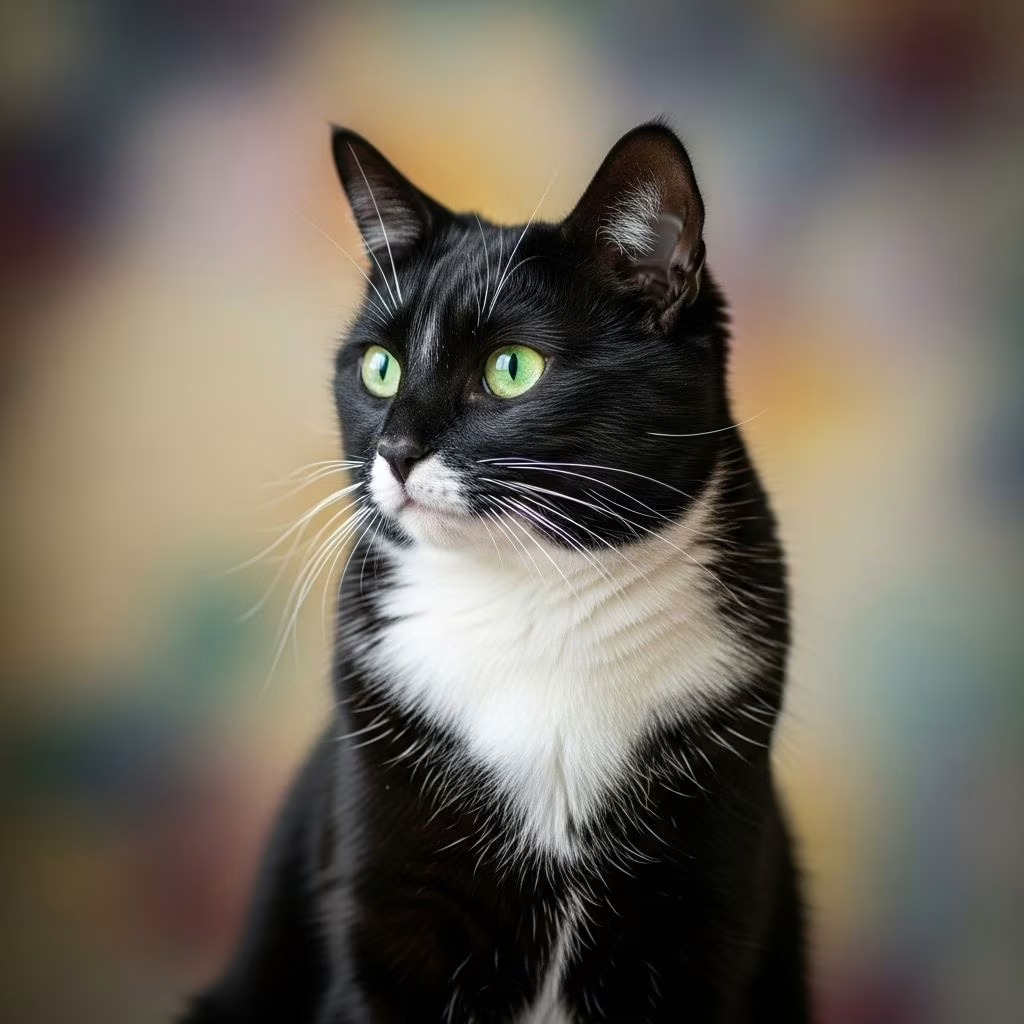
Tuxedo Cats Aren’t a Breed—So What Are They?
When you picture a tuxedo cat, you likely envision a sharp-dressed feline in formal black and white attire. However, many cat lovers are surprised to learn that tuxedo is not an actual cat breed at all. Instead, tuxedo refers to a distinctive bicolor coat pattern that can appear in numerous cat breeds and domestic cats. Understanding this distinction is crucial for anyone seeking to learn more about these elegantly marked felines or considering bringing one into their home.
What Exactly Is a Tuxedo Cat?
A tuxedo cat is defined by its distinctive coat pattern rather than its genetic lineage or breed classification. The pattern consists of a black coat with white patches strategically placed on specific areas of the body. These white markings typically appear on the chest, belly, paws, and sometimes the chin, creating an appearance remarkably similar to formal evening wear. The white spotting is considered low-to-medium grade, generally comprising around 25 percent of the cat’s overall coat.
While the term “tuxedo” is traditionally reserved for black and white cats, the pattern can technically occur in any cat color combination. However, the classic black and white appearance remains the most recognizable and commonly referenced form. Some cats may also be called “Julius cats” or “Felix cats,” referencing the famous cartoon characters who sport this distinctive pattern.
How Is a Tuxedo Cat Different from Other Bicolor Patterns?
The bicolor category encompasses several distinct patterns, each with unique characteristics. Tuxedo cats represent one type of bicolor, but they’re not the only one.
- Tuxedo Pattern: Low-to-medium white spotting (approximately 25% white) limited primarily to the face, paws, throat, and chest
- Van Pattern: High-grade bicolor coloring, typically featuring large white areas with colored patches on the head and tail, characteristic of the Turkish Van breed
- Cap-and-Saddle Pattern: White patches on the head and back, with a colored base coat
- Mask-and-Mantle Pattern: White coloring on the chest and shoulders with a darker face mask
- Harlequin or Magpie Pattern: A random distribution of colored and white patches across the body
Understanding these distinctions helps cat owners better appreciate the specific aesthetic qualities of their tuxedo-patterned companion.
Which Breeds Display the Tuxedo Pattern?
Although tuxedo is not a breed itself, the bicolor pattern appears more frequently in certain established cat breeds. These breeds have developed breed standards that officially recognize and accept the tuxedo pattern as a valid color option for show cats.
Domestic Shorthair and Domestic Longhair
The Domestic Shorthair and Domestic Longhair cats represent the most common carriers of the tuxedo pattern. Often referred to as the “mutts” of the cat world, these cats lack pedigree papers and may be mixtures of multiple breed backgrounds. The tuxedo coat is particularly prevalent in both the short-haired and long-haired domestic varieties, making them the most frequently encountered tuxedo cats.
American Shorthair
The American Shorthair is a recognized breed that frequently displays the tuxedo pattern. Brought to America by English settlers originally for rodent control, American Shorthairs were among the first five breeds officially recognized by the Cat Fanciers’ Association in 1966. These cats are low-maintenance, possess long lifespans, and display the tuxedo pattern when their coloring meets breed standards with pure, unbridled portions of white paired with black, blue, red, or cream.
Maine Coon
The Maine Coon, the largest domesticated cat breed capable of reaching up to 18 pounds and 38 inches in length, frequently appears in tuxedo coloring. Named for their ability to withstand the harsh cold temperatures of the northeastern United States, Maine Coons with tuxedo patterns must meet specific breed standards. They require white on the bib, belly, and all four paws, with coloring combinations limited to black and white, blue and white, red and white, or cream and white.
British Shorthair
Recognizable by their round faces and chubby cheeks, British Shorthairs can display tuxedo patterns when their markings meet breed standards. These cats must present symmetrical patterns with preferred white coloring on the feet, legs, undersides, chest, and muzzle. A white blaze is considered desirable in show cats.
Persian
Though not common, Persian cats—known for their distinctive flat faces and full fur coats—can be bred to display tuxedo patterns. Persian breeders recognize several bicolor combinations including black and white, blue and white, red and white, cream and white, chocolate and white, and lilac and white.
Other Breeds Accepting the Tuxedo Pattern
Additional breeds that accept tuxedo coloring include the Exotic Shorthair, Devon Rex, Cornish Rex, Turkish Van, Siberian Cat, Norwegian Forest Cat, American Curl, and Manx. Each breed maintains specific standards for how the tuxedo pattern should appear while still conforming to the breed’s overall characteristics.
Can Your Tuxedo Cat Be Registered as a Specific Breed?
A crucial distinction exists between a cat displaying a tuxedo pattern and a cat registered as a specific breed. Without official registration papers and verifiable documentation, a tuxedo cat cannot meet official breed standards or participate in competitive cat shows.
Most tuxedo cats encountered in homes are domestic longhairs or domestic shorthairs without pedigree papers. While it may be fun and engaging to speculate about your cat’s ancestry based on physical characteristics, officially recognizing your cat as a breed requires documented proof of lineage. Without these papers, your tuxedo cat cannot compete in breed-specific competitions or participate in purebred breeding programs.
The Genetics of Tuxedo Cats: Are They Predominantly Male or Female?
Unlike certain coat patterns such as tortoiseshell or calico, which are predominantly female due to genetic factors, tuxedo cats show no sex-linked genetic bias. The bicolor pattern occurs equally in both male and female cats, resulting in a relatively even distribution of male and female tuxedo cats in the general population.
Interestingly, a tuxedo kitten can be born even when neither parent displays tuxedo coloring. The kitten simply needs to inherit the appropriate genes for black coloring and white spotting from its parents. This genetic flexibility makes tuxedo patterns unpredictable but possible across many breeding scenarios.
Are Tuxedo Cats Rare?
Tuxedo cats and other bicolor patterned cats are relatively common in the general cat population. The prevalence of the tuxedo pattern across multiple breeds and domestic cats ensures that these formally attired felines are frequently encountered in homes, shelters, and breeding programs. The rarest bicolor variation is actually the cream and white pattern, not the classic tuxedo black and white combination.
Understanding Tuxedo Cat Personality and Temperament
While tuxedo cats are often depicted as sophisticated and formal in appearance, their personalities vary considerably based on breed, individual temperament, and upbringing rather than coat pattern. An anecdotal study suggested that black-and-white and grey-and-white cats may display slightly elevated aggression during handling and veterinary visits compared to other colors. However, a cat’s personality is primarily shaped by its upbringing, environment, and socialization, with breed being a secondary influence.
Therefore, while a tuxedo cat may look like a formal gentleman or lady, its actual behavior depends far more on how it was raised and treated than on its distinctive coat pattern.
Frequently Asked Questions About Tuxedo Cats
Q: Is tuxedo a cat breed?
A: No, tuxedo is not a cat breed. It is a bicolor coat pattern characterized by black and white (or other color combinations) that can appear in numerous recognized breeds and domestic cats.
Q: What makes a cat qualify as a tuxedo cat?
A: A tuxedo cat must display a predominantly solid-colored coat (usually black) with white spotting limited to areas such as the chest, belly, paws, face, and chin, comprising approximately 25% of the total coat.
Q: Can any breed of cat have a tuxedo pattern?
A: While the tuxedo pattern can theoretically appear in many breeds, it is more common in certain breeds like Domestic Shorthairs, Maine Coons, British Shorthairs, American Shorthairs, and Persians that have official breed standards accepting the bicolor pattern.
Q: Are tuxedo cats always male?
A: No, tuxedo cats occur equally in both males and females. Unlike tortoiseshell or calico patterns, the tuxedo pattern shows no sex-linked genetic preference.
Q: Can I show my tuxedo cat in competitions if it has no papers?
A: Without official registration papers and verifiable pedigree documentation, your tuxedo cat cannot be registered as a specific breed or compete in breed-specific cat shows.
Q: How common are tuxedo cats?
A: Tuxedo cats and bicolor patterned cats are relatively common in the general population. They appear frequently in domestic cats and multiple recognized breeds.
Q: If neither parent is tuxedo, can they have tuxedo kittens?
A: Yes, tuxedo kittens can be born from parents without the tuxedo pattern if both parents carry the necessary genes for black coloring and white spotting.
Q: Are tuxedo cats more aggressive than other cats?
A: An anecdotal study suggested slightly elevated aggression in black-and-white cats, but personality is primarily determined by upbringing and breed rather than coat pattern.
References
- What Breed Can A Tuxedo Cat Be?: A Deep Dive Into Bicolor Beauties — TheCatSite. https://thecatsite.com/c/what-breed-tuxedo-cat/
- Tuxedo Cats: Facts, Personality, and Breed Guide — Litter-Robot. https://www.litter-robot.com/blog/7-tuxedo-cat-facts/
- Bicolor cat — Wikipedia. https://en.wikipedia.org/wiki/Bicolor_cat
- What Breed Is My Tuxedo Cat? 9 Common Types — Catster. https://www.catster.com/lifestyle/what-breed-is-my-tuxedo-cat/



