

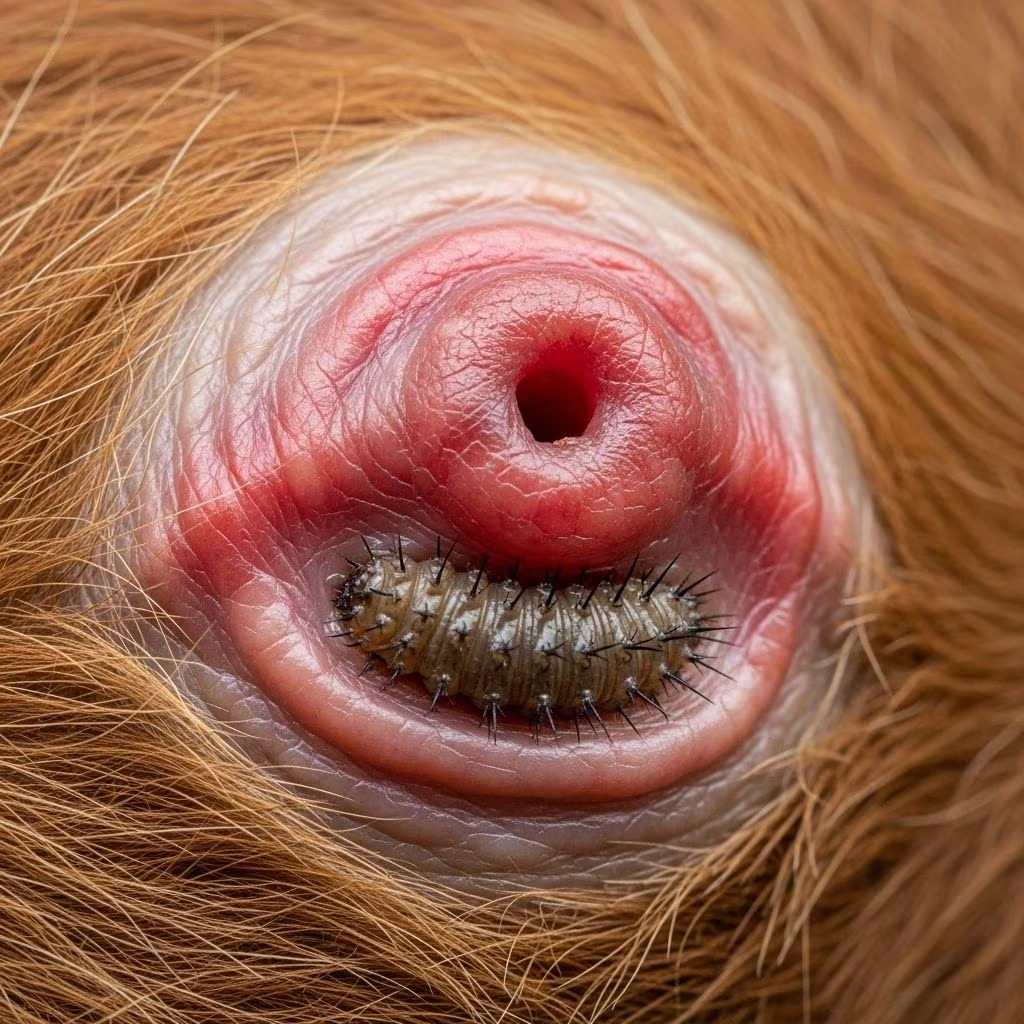
The tropical warble fly, scientifically known as Dermatobia hominis, represents a significant parasitic threat to livestock, particularly cattle, in warm climates of Central and South America. This botfly induces a form of subcutaneous myiasis that leads to painful lesions, reduced animal productivity, and substantial economic losses for farmers. Unlike temperate warble flies, its larvae develop directly under the host’s skin, creating boil-like nodules that disrupt normal health and hide quality.
Biological Profile of the Parasite
Dermatobia hominis belongs to the family Cuterebridae within the order Diptera. Adults are robust flies, typically measuring 12-18 mm in length, with a bluish-gray body and orange-yellow fur on the thorax. Notably, adult flies do not feed; their brief lifespan of 3-4 days is dedicated solely to reproduction. Females are polygynous, capable of laying 800 to 1,000 eggs in clusters, employing a sophisticated dispersal mechanism that involves arthropod vectors.
The fly’s reproductive strategy is uniquely adapted for survival in humid, forested environments. After mating, which lasts about 9 minutes, the female captures a ‘porter’ insect—often a mosquito, tick, or other fly—and glues eggs to its abdomen using a water-insoluble adhesive. This paratenic host then carries the eggs to a mammalian or avian definitive host. Upon contact with the warm skin of the host, often during a blood meal, the eggs hatch within 5-9 days. Larvae penetrate the skin within minutes, establishing themselves in the subcutaneous tissue.
Complete Life Cycle Stages
The life cycle of D. hominis spans approximately 4-18 weeks, depending on environmental conditions and host factors. Key phases include:
- Egg Stage: Eggs develop externally on the porter for 5-9 days, sensitive to temperature cues for hatching.
- First Instar Larva: Lasts about 12 days; larvae bore into the skin, feeding on tissue fluids and causing initial irritation.
- Second Instar Larva: Around 18 days; the parasite grows, with transverse spines aiding anchorage.
- Third Instar Larva: 12 days or more; fully mature larvae exit the host, drop to the soil, and pupate for 1-7 weeks before adult emergence.
This cycle allows multiple generations per year in tropical settings, exacerbating infestation risks during rainy seasons.
Host Range and Predilection Sites
While cattle are the primary economic host, D. hominis exhibits a broad host specificity, infecting over 40 mammalian species including dogs, sheep, pigs, horses, and even humans. Birds like toucans and turkeys can also serve as hosts. In livestock, larvae prefer exposed areas such as the back, flanks, legs, and scrotum, though they can occur anywhere on the body.
Infestations often peak in cattle moved from lowlands to higher, drier areas, as observed post-natural disasters in regions like Nicaragua. A survey there revealed 95% of farms reporting cases, with cattle affected in 100% of instances, highlighting the parasite’s adaptability.
Clinical Manifestations in Affected Animals
Early infestation is subtle, with larvae penetrating unnoticed. Within days, characteristic furuncular lesions—raised, boil-like swellings 1-2 cm in diameter—appear. Each nodule features a central breathing hole through which the larval posterior spiracles protrude for oxygenation. Hosts exhibit restlessness, skin twitching, and reduced feed intake due to pruritus and pain.
Heavy burdens, sometimes exceeding thousands of larvae per animal, lead to weight loss, anemia, secondary bacterial infections, and hide damage. In severe cases, mortality occurs from exhaustion or opportunistic pathogens. Lesions predispose to other myiases, though studies in Costa Rica indicate limited attraction for screwworm flies (Cochliomyia hominivorax), with only 2.5-7.4% oviposition success on botfly sites.
| Host | Common Sites | Average Larvae per Animal | Economic Impact |
|---|---|---|---|
| Cattle | Back, legs, scrotum | 100-1000+ | High (hide damage, milk loss) |
| Dogs/Humans | Head, limbs | 1-10 | Moderate (pain, treatment costs) |
| Sheep/Pigs | Flanks | 50-200 | Medium (growth reduction) |
Diagnosis Methods
Diagnosis relies on visual identification of nodules with a central black dot—the larval spiracle. Larvae are pyriform, covered in spines, with sclerotized mouthparts visible upon extraction. Differential diagnoses include tick bites, abscesses, or other warbles like Hypoderma spp., which migrate internally rather than remaining subcutaneous.
Histopathology reveals subcutaneous tunnels with inflammation, eosinophils, and larval fragments. In endemic areas, seasonal patterns aid presumptive diagnosis during peak fly activity (rainy season).
Treatment Approaches
Effective management targets larval stages. Mechanical removal involves occluding the breathing hole with petroleum jelly or bacon fat to suffocate the larva, followed by extraction with forceps once it surfaces. Injectable macrocyclic lactones (e.g., ivermectin, doramectin) at 200 mcg/kg are highly efficacious against all instars, killing larvae within days.
Topical pour-ons with organophosphates or pyrethroids provide herd-level control but require caution to avoid resistance. In Nicaragua, surveys noted misuse of insecticides, underscoring the need for farmer education. Post-treatment, wounds should be cleaned to prevent secondary infections.
Prevention and Control Strategies
Integrated pest management is key:
- Vector Reduction: Insecticide-treated nets for livestock and environmental spraying targeting porters like mosquitoes.
- Strategic Antiparasitics: Timed applications of macrocyclic lactones during predicted fly seasons have nearly eradicated grubs in some regions.
- Herd Management: Avoid moving cattle to endemic highlands; use fly repellents.
- Surveillance: Regular skin inspections and farmer training on life cycles.
In Costa Rica, understanding low screwworm synergy with D. hominis lesions informs targeted controls.
Economic and Public Health Implications
In the Neotropics, D. hominis causes billions in losses annually through depreciated hides (punctures reduce value by 10-20%), milk yield drops (up to 25%), and treatment costs. Mortality in untreated heavy infestations compounds this. Public health risks arise from zoonotic transmissions, with human cases causing painful furuncles, especially in rural communities.
Climate change may expand ranges, necessitating vigilant monitoring.
Research Advances and Future Directions
Recent PubMed studies emphasize biological insights: Nicaragua’s post-disaster surveys revealed knowledge gaps, while Costa Rican experiments debunked screwworm predisposition myths. Genetic studies on porter preferences could yield novel traps. Vaccine development lags, but endectocides remain gold standards.
Frequently Asked Questions (FAQs)
What does a Dermatobia hominis larva look like?
Pyriform maggots with spine rows, dark mouthparts, and posterior spiracles.
Can humans get infected?
Yes, via porter contact in endemic areas; lesions mimic boils.
Is ivermectin safe for pregnant cattle?
Generally yes, per label doses; consult vets.
How to prevent in small farms?
Use pour-ons, inspect daily, reduce mosquito breeding.
Does it spread to temperate zones?
Rarely; requires tropical humidity.
References
- An initial survey of the cattle grub Dermatobia hominis (L. Jr.) in Nicaragua — PubMed/NCBI. 2003-11-01. https://pubmed.ncbi.nlm.nih.gov/14623415/
- The role of botfly myiasis due to Dermatobia hominis L.Jr. in the introduction of screwworm myiasis in cattle in the tropics — PubMed/NCBI. 1996-08. https://pubmed.ncbi.nlm.nih.gov/8784525/
- Overview of Cattle Grubs — Merck Veterinary Manual. 2023. https://www.merckvetmanual.com/integumentary-system/cattle-grubs/overview-of-cattle-grubs
- Dermatobia hominis — Animal Diversity Web, University of Michigan. 2023. https://www.animaldiversity.org/accounts/Dermatobia_hominis/



