

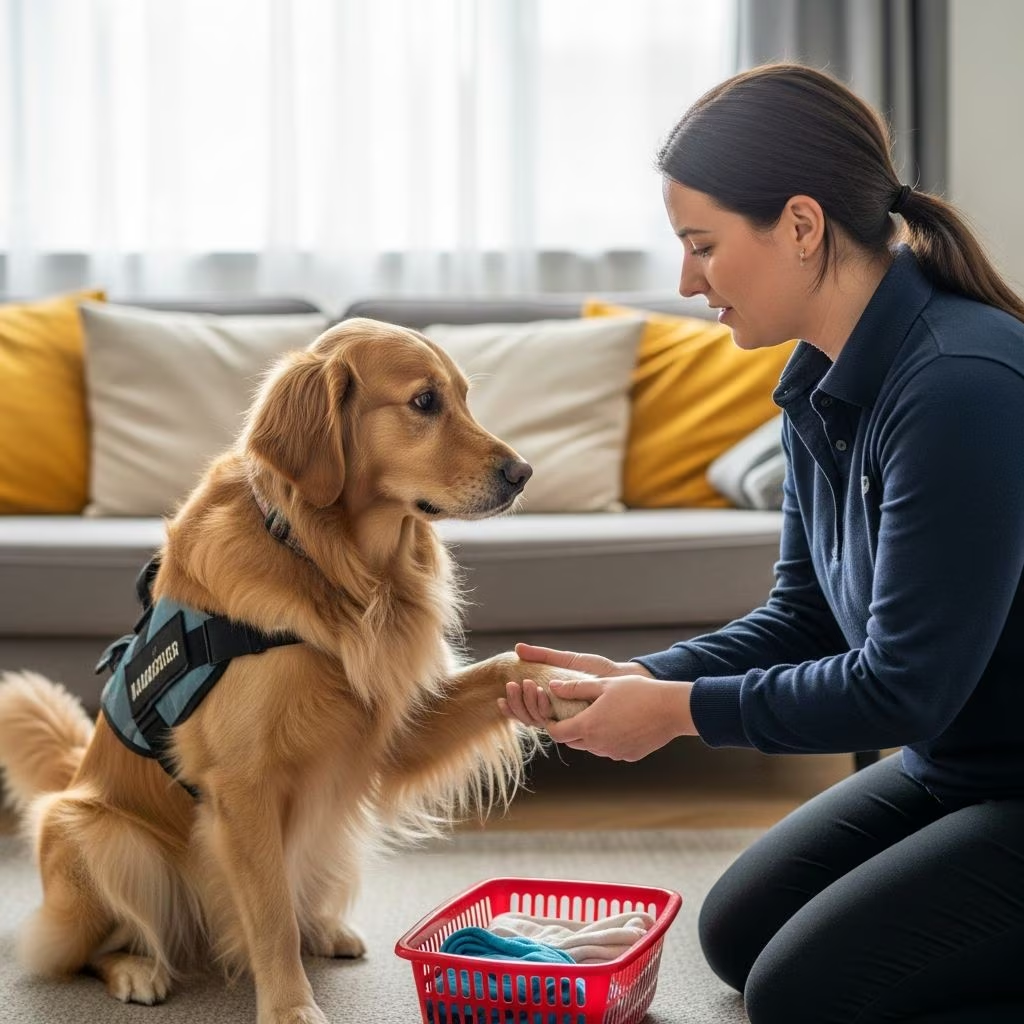
Dogs possess remarkable cognitive abilities and a natural desire to work alongside their human companions. Beyond traditional obedience training, many dogs can learn practical skills that contribute meaningfully to household management. This capacity to assist with everyday responsibilities transforms your pet from a passive household member into an active participant in family life. The process requires patience, consistency, and a clear understanding of how to break complex tasks into manageable steps that align with canine learning patterns.
Building the Foundation: Essential Prerequisites
Before embarking on teaching your dog specialized household tasks, establishing a strong foundation with fundamental obedience commands is essential. Commands such as “sit,” “stay,” “come,” and “fetch” serve as building blocks for more complex behaviors. These core competencies provide the language through which you communicate with your dog and allow them to understand what you expect. Without mastering these basics, attempting to teach specialized tasks becomes frustrating for both dog and owner.
Your dog’s comprehension of basic commands demonstrates their ability to respond to verbal cues and understand the reward system you’ve established. This foundation is particularly important because it teaches your dog that following instructions leads to positive outcomes. The training process should involve short, focused sessions lasting approximately 10 to 15 minutes, as dogs—particularly younger ones—have limited attention spans and benefit from concentrated practice rather than marathon sessions.
Retrieving Items: The Gateway Skill
Teaching your dog to retrieve household items represents one of the most practical and widely applicable skills in a working dog’s repertoire. This ability creates a bridge between simple obedience and complex task completion. The retrieval skill can be adapted for numerous household needs, from fetching newspapers and remote controls to delivering socks or gathering scattered items.
The training process begins with highly motivating, familiar objects like toys or balls. Present the item with enthusiasm and use the command “fetch” while allowing your dog to interact with the object. When your dog retrieves the item, immediately provide rewards in the form of treats and enthusiastic praise. As your dog becomes proficient, gradually increase the distance between you and the object, and progressively introduce different household items. This systematic approach prevents overwhelming your dog while building confidence and competence simultaneously.
Organizing and Tidiness: Teaching Cleanup Behaviors
Dogs can learn to actively participate in maintaining household order by retrieving and organizing their belongings. Teaching your dog to place toys into designated containers combines retrieval skills with spatial awareness and sequence recognition. This task not only keeps your living space more organized but also provides your dog with a sense of purpose and accomplishment.
Start by identifying a specific location—such as a toy basket or designated bin—where items should be deposited. When your dog picks up a toy, use a clear command like “put it away” while gently guiding them toward the container. Upon successful placement, reward your dog generously with treats and praise. Gradually reduce your physical assistance as your dog demonstrates understanding, allowing them to complete the behavior independently. With consistent practice, your dog develops the ability to self-organize their toys without prompting.
An advanced variation of this skill involves teaching your dog to pick up trash and deposit it in garbage containers. This skill builds naturally from toy-cleanup training and serves a genuinely practical purpose. Begin by offering non-edible trash pieces directly above the garbage container while issuing a clear “take it” command. When your dog grasps the item, immediately follow with a “drop” command near the container so the item naturally falls into the receptacle. Reward this behavior enthusiastically.
Laundry Assistance: Multi-Step Task Training
Involving your dog in laundry management demonstrates how retrieval and carrying skills can extend into multi-step household processes. Dogs often find fabric textures engaging and enjoy handling soft objects, making laundry assistance a naturally appealing task for many canines. Training your dog to bring socks, towels, or other laundry items to designated areas transforms a mundane chore into interactive engagement.
Begin by acclimating your dog to the laundry basket, allowing them to investigate and become comfortable with this equipment. Then, toss a laundry item into the basket while using your established “fetch” command. Once your dog successfully retrieves the item, direct them toward the laundry area and encourage them to drop the item in its designated location. This progressively teaches your dog to associate laundry items with specific actions and locations. With practice, your dog can learn to participate in sorting laundry by type, though the primary task focuses on retrieval and delivery rather than true categorization.
Door Management: Precision Target Tasks
Teaching your dog to interact with doors—whether opening, closing, or managing them—represents a more advanced application of targeting skills. Dogs can learn to close refrigerator doors, pantry doors, cabinet doors, and other household entryways using either their nose or paw. Using the nose for this task prevents marks and damage to furniture and fixtures, making it preferable to paw contact in most household settings.
Begin by introducing your open hand to your dog, allowing them to sniff your palm. When they make contact through sniffing, immediately say “yes” and provide a treat. This establishes the basic targeting behavior that forms the foundation for door interaction. Next, introduce a towel or cloth as an intermediary target between your hand and the door. Eventually, your dog learns to push doors closed using their nose as you fade out the intermediate tools and verbal cues. This progression teaches precision and control while minimizing frustration.
Environmental Awareness: Search and Patrol Behaviors
Dogs naturally investigate their environments through smell and sight. You can harness this instinctive behavior by teaching your dog to patrol your home systematically. This task works particularly well for dogs with natural alerting tendencies or those who bark when people approach. The skill involves teaching your dog to move through different rooms of your home in a methodical pattern.
Place small target plates or markers in each room of your home, positioning a treat on each plate. Walk your dog through the house on a leash, introducing them to each target location. Once your dog understands the pattern, take them to your front door and release them with a clear cue such as “patrol” or “look.” Your dog will navigate from room to room, visiting each target location. After several repetitions, gradually remove the treat targets while maintaining verbal cues and transitioning to reward your dog upon completion of the patrol. This behavior provides mental stimulation while creating a practical security routine.
Carrying and Transportation: Practical Application
Dogs with strong fetching instincts and appropriate physical size can learn to carry items from one location to another, effectively functioning as your personal courier. This skill works well for dogs who enjoy holding objects in their mouths and have demonstrated reliable drop commands. When you arrive home with groceries, your dog can carry smaller bags or lightweight items from your vehicle to the kitchen. Similarly, if laundry items drop or if you’re managing multiple loads, your dog can retrieve and deliver individual articles.
Before introducing this skill, ensure your dog has mastered both “fetch” and “drop-it” cues with various toys and objects. Once these foundational skills are solid, begin with lightweight, low-value items before progressing to more delicate or valuable household goods. Always supervise your dog during this task to ensure they don’t accidentally damage items or ingest anything inappropriate while carrying objects throughout your home.
Training Methodology: Keys to Consistent Success
Regardless of which household tasks you teach your dog, certain universal training principles ensure success. Consistency in command language is fundamental—use identical verbal cues and accompanying hand signals every time you request a behavior. Dogs learn through repetition and pattern recognition, so varying your language or gestures confuses the learning process and prolongs training timelines.
Positive reinforcement remains the most effective motivator for canine learning. Reward your dog immediately upon successful task completion with treats, praise, or a combination of both. The timing of rewards significantly impacts learning speed—the closer the reward comes to the desired behavior, the stronger the association your dog develops. Patience throughout the training process cannot be overstated; each dog learns at their individual pace, and maintaining a positive attitude prevents frustration from undermining progress.
Determining Appropriate Tasks for Your Dog
Not every household task suits every dog. Consider your dog’s size, physical capabilities, energy level, and natural inclinations when selecting tasks to teach. Smaller dogs may struggle with heavy items but excel at retrieving lightweight objects or interacting with low-hanging switches. Older dogs might not have the physical stamina for complex multi-step tasks but could master simple retrieval behaviors. Dogs with high prey drives might excel at finding hidden items, while more laid-back dogs may prefer simple delivery tasks requiring minimal movement.
Additionally, evaluate your dog’s motivation profile. Some dogs are treat-driven and respond enthusiastically to food rewards, while others prioritize play, praise, or physical affection. Matching your reward system to your individual dog’s preferences accelerates learning and maintains enthusiasm throughout the training process. Your dog’s natural behaviors and talents should inform task selection—attempting to force a non-retriever to excel at complex fetching tasks creates unnecessary conflict and frustration.
Building Behavior Chains: Complex Task Development
Many household tasks involve multiple steps performed in sequence. Teaching your dog to execute complex chains of behaviors requires breaking the final goal into individual, learnable components. One effective approach involves “backchaining”—teaching the final step of a behavior chain first, then progressively adding earlier steps in reverse order. This method works particularly well for multi-step tasks like trash disposal or complex retrieval sequences.
For example, if your goal is teaching your dog to pick up trash and deposit it in a garbage can, begin by teaching the “drop” behavior directly over the can. Once your dog reliably drops items into the container, add the preceding “take it” behavior. Eventually, your dog learns the complete sequence: locate trash, grasp it, carry it to the can, and release it. This progressive approach prevents overwhelming your dog and builds confidence at each stage of learning.
References
- How to Train Your Dog to Help with Household Tasks — Dog Trainer Albany. 2026. https://www.dogtraineralbany.com/how-to-train-your-dog-to-help-with-household-tasks/
- Teaching Your Dog to Perform Household Chores — PetCareRx. 2026. https://www.petcarerx.com/article/teaching-your-dog-to-perform-household-chores/5171
- How to Give Your Dog Jobs to Do at Home — American Kennel Club. 2026. https://www.akc.org/expert-advice/training/give-your-dog-jobs-to-do-at-home/
- Teach Your Dog to Help With Chores Around the House — Whole Dog Journal. 2026. https://www.whole-dog-journal.com/training/teach-your-dog-to-help-with-chores-around-the-house/



