

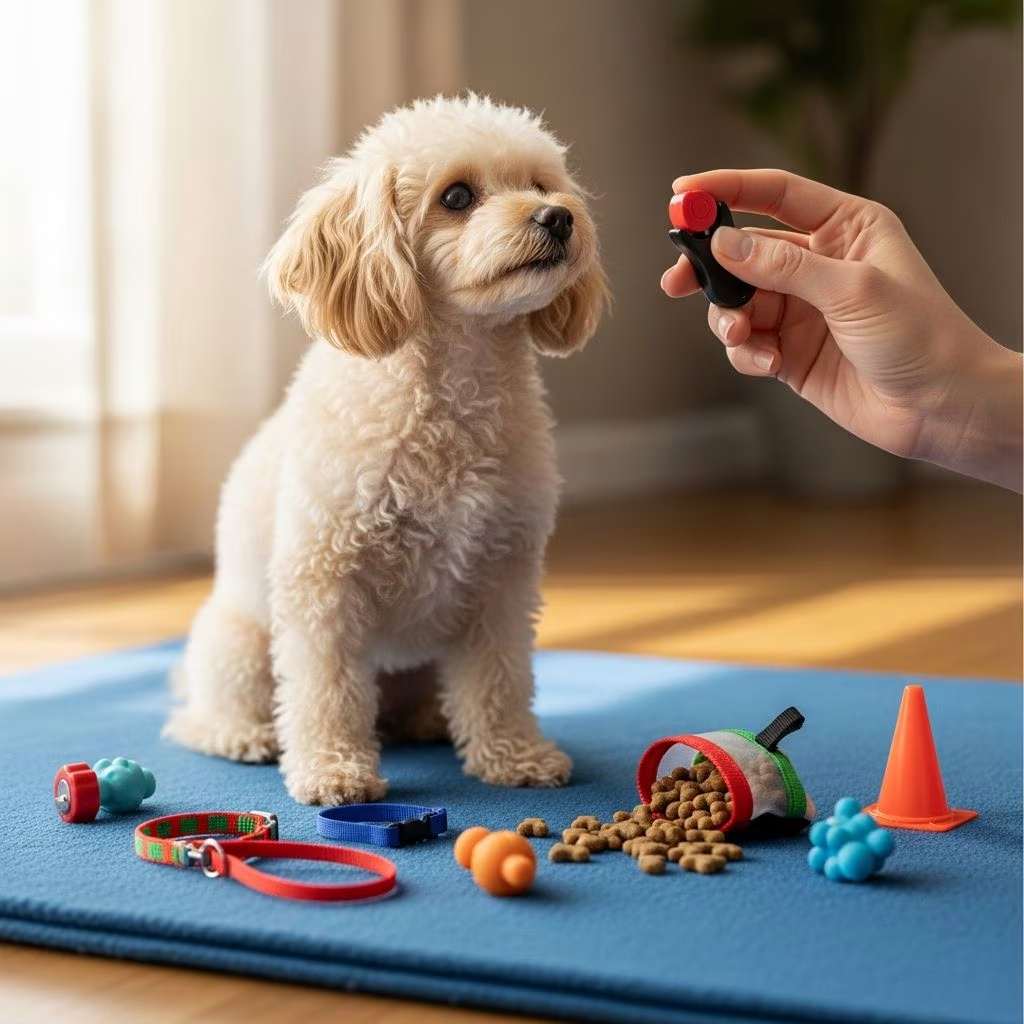
Toy poodles are renowned for their intelligence, charm, and spirited personalities. However, their small stature often leads owners to overlook the importance of structured training. Unlike their standard and miniature counterparts, toy poodles require a thoughtful approach that acknowledges both their unique psychological needs and their capacity for learning. This comprehensive guide explores evidence-based training methodologies designed specifically for toy poodle owners seeking to develop well-behaved, confident companions.
Understanding Your Toy Poodle’s Learning Style
Toy poodles possess keen intelligence and respond exceptionally well to structured training environments. To effectively train your toy poodle, begin by recognizing that dogs experience the world fundamentally differently than humans. Rather than processing verbal commands as their primary language, dogs rely heavily on body language and contextual cues to understand their environment and interpret human intentions.
When you communicate with your toy poodle using spoken words alone, they must first decode what those sounds mean through repeated pairing with physical actions and environmental context. Over time, your dog learns to associate specific words with particular outcomes or behaviors. This understanding fundamentally changes how you should structure your training sessions. Instead of simply repeating commands verbally, successful toy poodle training involves consistent body language, timing, and environmental reinforcement that allows your dog to make meaningful connections between actions and consequences.
The initial phase of training should focus on building this bridge between human communication styles and canine comprehension. Patience during this period is essential, as your toy poodle is essentially learning a new language while simultaneously learning behavioral expectations.
The Foundation: Starting with Basic Command Training
Before advancing to complex behavioral modifications or specialized training, establish a solid foundation with fundamental commands. The most effective starting point involves teaching your toy poodle to respond consistently to basic directives such as sit, down, stand, and come.
When teaching these foundational commands, timing proves critical to success. Research indicates that you should pair your verbal command with the completed action within approximately three seconds for maximum effectiveness. This tight timing window helps your toy poodle clearly associate the command word with the specific behavior they’ve just performed. Without this precise timing, your dog may struggle to understand which action corresponds to which command, leading to confusion and slower learning progression.
Most toy poodles will require between eight and fifteen practice sessions to reliably perform basic commands in a controlled environment. However, the number of sessions can vary based on individual temperament, prior socialization experiences, and the consistency of training across different handlers. When multiple family members participate in training sessions, dogs actually learn more quickly because they receive reinforcement from various sources and learn to generalize their responses across different people and environments.
Creating a Consistent Training Schedule
Rather than conducting long, infrequent training marathons, opt for multiple brief training sessions throughout the day. Short ten-minute sessions prove far more effective for toy poodles than extended training periods. These concise sessions maintain your dog’s focus and enthusiasm while preventing the mental fatigue that can result from prolonged training activities.
Breaking training into manageable chunks also allows you to fit practice sessions seamlessly into your daily routine. Family members can conduct sessions before work, during lunch breaks, or while relaxing in the evening. This distributed practice approach reinforces learning more effectively than concentrated single sessions.
Positive Reinforcement: The Science Behind Effective Toy Poodle Training
Scientific research consistently demonstrates that positive reinforcement represents the most effective training methodology for dogs while simultaneously strengthening the bond between dog and owner. This approach involves rewarding desired behaviors with praise, treats, or play rather than punishing unwanted behaviors.
For toy poodles specifically, positive reinforcement works exceptionally well because it leverages their natural desire to please and their eagerness for social interaction. Rather than using outdated punishment-based methods, modern training emphasizes what your dog should do instead of what they should avoid. This reframing creates a psychologically healthier learning environment where your toy poodle feels motivated rather than intimidated.
When implementing positive reinforcement, consistency matters enormously. Every family member should use the same rewards, the same commands, and the same timing protocols. If one household member rewards a behavior that another punishes, your toy poodle receives contradictory messages that impede learning and create confusion.
Building Confidence Through Progressive Skill Development
Many toy poodles experience anxiety that manifests as excessive barking, jumping, circling, or social withdrawal. One of the most effective antidotes to canine anxiety involves teaching new skills and commands. Successfully learning and performing commands provides psychological reassurance and builds confidence through achievement.
This confidence-building process works best when you start with commands your toy poodle can easily accomplish and gradually increase difficulty. Each successful performance delivers a small dopamine boost that reinforces learning and increases your dog’s willingness to engage in future training. Over time, your anxious toy poodle transforms into a more secure, trusting companion.
Family members can amplify confidence-building efforts through environmental support. Regular walks, consistent play sessions, and supervised interaction with trusted individuals all contribute to psychological development. When children or other family members reliably provide positive experiences—walks, play, praise—your toy poodle learns that the world contains predictable, pleasant interactions worth anticipating.
Advanced Training Techniques for Managing Complex Behaviors
Beyond basic commands, toy poodles benefit from advanced training approaches that address specific behavioral challenges. One particularly effective technique involves what trainers call “passive training” or strategic engagement and disengagement.
Passive training works by strategically timing your attention and interaction based on your toy poodle’s behavior. For example, if your dog circles around seeking attention, you can reward focused engagement by petting and praising during moments when they circle back toward you, while withdrawing attention during times of unfocused wandering. This approach, sometimes called “light switch on and light switch off,” teaches your dog to make independent behavioral choices that result in positive outcomes.
This technique proves particularly valuable for toy poodles displaying jumping, excessive attention-seeking, or manipulative behaviors. Rather than constantly commanding and correcting, you create an environment where your dog naturally gravitates toward appropriate behaviors because those behaviors reliably produce rewards.
Mental Stimulation: Addressing the Intelligent Toy Poodle’s Needs
Toy poodles possess remarkable intelligence and require mental challenges to maintain psychological health and behavioral stability. Boredom in intelligent dogs frequently manifests as destructive behaviors, excessive vocalization, or anxiety-driven actions.
Combat boredom through diverse mental stimulation strategies. Puzzle toys require problem-solving; interactive games teach focus and decision-making; and varied training exercises provide cognitive challenge. Regularly rotating toys and introducing new games prevents your toy poodle from becoming habituated to their environment.
Advanced training activities like agility courses or scent work provide dual benefits, combining physical exercise with mental engagement. These activities simulate the problem-solving challenges that dogs encounter in nature, satisfying deep biological drives for investigation and achievement.
Physical Exercise and Lifestyle Balance
Despite their small size, toy poodles require regular physical exercise to maintain health and emotional stability. Multiple daily walks, play sessions, and interactive activities keep your dog physically fit while preventing the weight gain that small breeds often experience.
When introducing exercise routines, ensure your toy poodle has completed growth and skeletal development before engaging in high-impact activities. Puppies and young dogs require gentler exercise that builds strength without stressing developing joints. Consult with your veterinarian regarding appropriate exercise intensity for your dog’s age and individual health profile.
Physical exercise and mental stimulation should work together synergistically. An agility training session provides both physical conditioning and problem-solving engagement, creating a more efficiently trained and satisfied toy poodle than exercise or training alone.
Socialization: Building Confidence in Diverse Environments
Socialization involves exposing your toy poodle to various environments, people, and other animals in positive contexts. This experience proves especially important for toy poodles, which sometimes exhibit reserved or anxious behavior around unfamiliar individuals.
Effective socialization requires intentional design. Rather than randomly exposing your dog to new situations and hoping for positive results, carefully orchestrate experiences to build positive associations. Invite friends to interact with your poodle, visit multiple environments during calm periods, and facilitate controlled introductions to other dogs in neutral settings.
The goal involves teaching your toy poodle to remain calm and focused on you despite environmental distractions. Using treats, play, and praise, reward your dog for maintaining attention on you when encountering new people or stimuli. This technique transforms your dog from a reactive, anxious animal into a confident companion who trusts your guidance in novel situations.
Establishing Structure and Behavioral Boundaries
Toy poodles, like all dogs, thrive within structured environments with clear rules and consistent expectations. Ironically, providing structure allows you to offer your dog greater freedom and facilitate their involvement in more activities. A dog that understands boundaries can be trusted in situations where an untrained dog would require constant supervision or confinement.
Structure involves establishing consistent routines for feeding, potty breaks, exercise, training, and sleep. Your toy poodle learns to predict what comes next and adjusts behavior accordingly. This predictability reduces anxiety and provides psychological reassurance that the environment is stable and controllable.
Boundaries should be communicated clearly through consistent enforcement. If your toy poodle learns that jumping on furniture is sometimes tolerated and sometimes punished depending on mood or context, they receive confusing information that undermines training. Clear, consistent rules prevent your dog from discovering and exploiting loopholes in your training system.
Addressing Common Toy Poodle Behavioral Challenges
Certain behavioral issues appear more frequently in toy poodles than in other breeds. Understanding these common challenges and implementing targeted solutions improves training outcomes.
Excessive barking: Often stems from anxiety, boredom, or attention-seeking. Address excessive vocalization by increasing mental and physical stimulation, establishing a consistent routine, and rewarding quiet behavior with praise and treats.
Separation anxiety: Toy poodles form strong attachments and sometimes struggle when left alone. Gradually acclimate your dog to alone time by practicing brief departures and rewarding calm behavior during separation. Create a dedicated safe space where your dog receives treats or engaging toys only during your absence.
Jumping and attention-seeking: Toy poodles frequently jump to demand attention. Deliberately withdraw your attention when jumping occurs, and reward all four paws remaining on the ground. This passive training approach teaches your dog that calm behavior produces attention while jumping results in interaction cessation.
Practical Training Timeline for Toy Poodles
| Age/Stage | Primary Focus | Training Objectives | Exercise Requirements |
|---|---|---|---|
| 8-12 weeks | Socialization and foundation | Name recognition, basic sit, potty routine introduction | Short 5-minute play sessions, frequent bathroom breaks |
| 3-6 months | Command development | Sit, down, come, basic recall training | Multiple 10-minute sessions, 3-4 walks daily |
| 6-12 months | Reinforcement and refinement | Reliability in various environments, stay command, impulse control | Increased duration of play sessions, longer walks |
| 12+ months | Advanced skills | Complex commands, trick training, agility introduction | Regular exercise routine established |
Frequently Asked Questions About Toy Poodle Training
How long does it typically take to train a toy poodle?
Basic command training usually requires eight to fifteen practice sessions for reliable performance. However, complete behavioral management and advanced training may take several months of consistent effort. Individual variation exists based on prior socialization, temperament, and training consistency across household members.
Can treat-based training be effective for toy poodles?
While treats provide positive reinforcement, some toy poodles respond better to alternative reward systems including praise, play, or access to preferred activities. Varying rewards prevents habituation and maintains training engagement over extended periods.
What’s the best age to begin training a toy poodle?
Training can commence as early as eight weeks of age with age-appropriate activities. Early training establishes foundation behaviors and accelerates overall development. However, advanced training requiring sustained focus should wait until your poodle demonstrates improved attention span around three to four months old.
Should I hire a professional trainer for my toy poodle?
Professional trainers provide valuable guidance, especially for owners addressing significant behavioral challenges or seeking specialized training. However, owner participation remains essential regardless of professional involvement, as dogs must learn to respond to family members in their home environment.
How do I prevent my toy poodle from developing anxiety?
Preventative strategies include early, positive socialization; consistent routines; regular exercise and mental stimulation; and confidence-building through command training. Addressing early signs of anxiety through professional guidance prevents development of more severe behavioral issues.
References
- Teaching a Pair of Red Toy Poodles Basic Commands to Boost their Confidence — Doggone Problems, David Codr. 2018-07-26. https://www.doggoneproblems.com/bailey-murphy-sit-down-up-stand-training/
- How to train your Poodle: 5 key steps from the dog’s perspective — One Mind Dogs. https://www.oneminddogs.com/blog/how-to-train-your-poodle-5-key-steps-from-the-dogs-perspective/
- A Realistic, Honest Poodle Training Guide — Best Mate Dog Training. https://www.bestmatedogtraining.co.nz/training-poodles



