

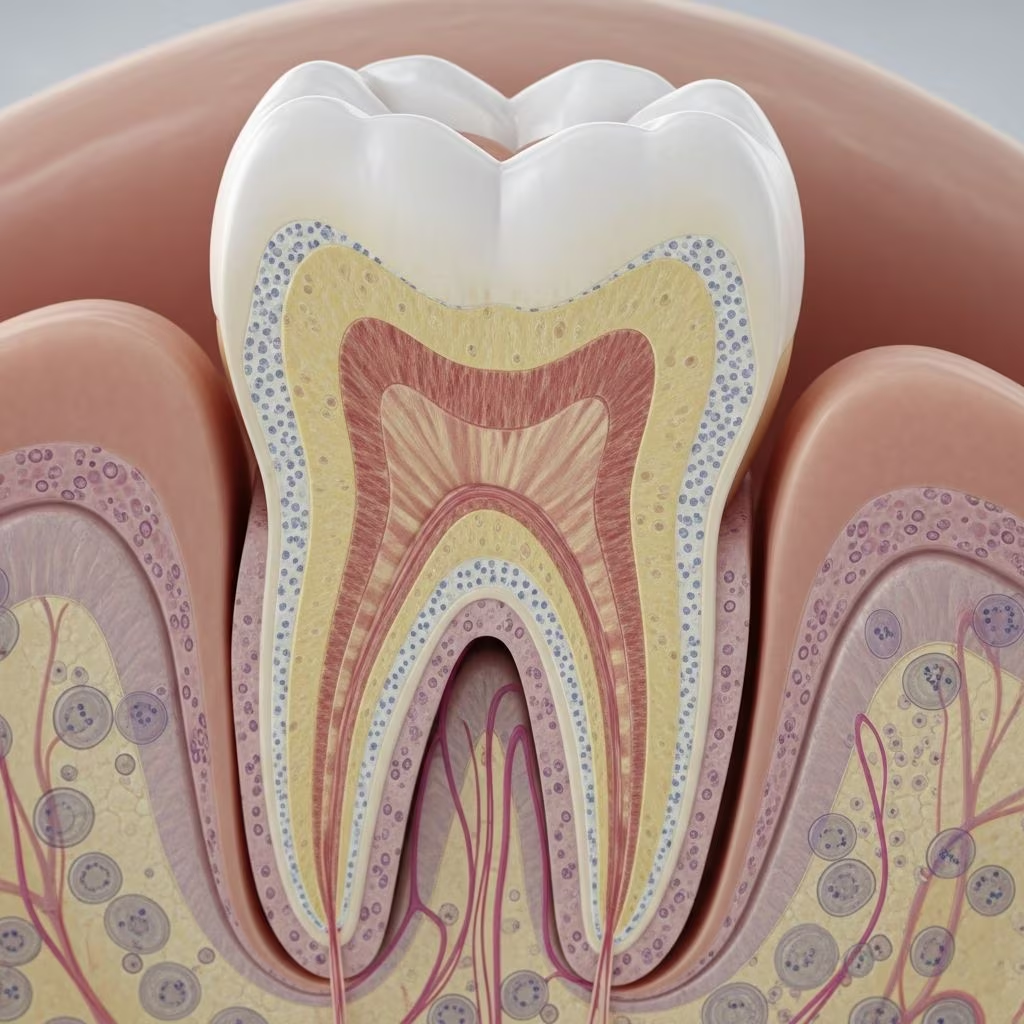
Teeth in animals emerge through a precisely orchestrated developmental process that begins in embryonic life and culminates in functional occlusion. This journey involves epithelial-mesenchymal interactions shaping buds into complex structures capable of grinding, tearing, and shearing food across diverse species.
Origins of Dental Structures
The foundation of tooth development lies in early embryogenesis. Around the 25th day in many mammals, the oral epithelium thickens into a structure called the dental lamina, forming U-shaped bands that outline future dental arches in both upper and lower jaws. These bands spawn epithelial buds that penetrate underlying mesenchymal tissues derived from neural crest cells, initiating odontogenesis.
In dogs and cats, branchial arches form by day 21, with maxillary and mandibular processes defining jaw bones. The mandibular symphysis remains fibrous lifelong in these species, influencing dental alignment. Similar patterns occur in horses and ruminants, though timelines vary with gestation length.
Progressive Stages of Tooth Morphogenesis
Tooth germs evolve through distinct phases named for their morphological resemblance: bud, cap, and bell stages. Each phase marks critical cellular events driving differentiation.
Bud Stage: Initial Protrusions
The bud stage features epithelial invaginations from the dental lamina into mesenchyme. Condensed ectomesenchymal cells cluster around bud tips, signaling future tooth positions. In mice, this begins at embryonic day 12, with thickenings progressing to buds. Veterinary species follow analogous paths, with buds corresponding to deciduous dentition sites.
- Epithelial buds proliferate rapidly.
- Mesenchymal condensations form dental papilla precursors.
- Dental sac outlines emerge, fated for periodontal tissues.
Cap Stage: Shaping the Foundation
Buds develop concavities, resembling caps over condensed mesenchyme. The inner enamel epithelium (IEE) interfaces with dental papilla, while outer enamel epithelium (OEE) encloses the structure. Hertwig’s epithelial root sheath precursors appear at cervical loops.
This stage sets crown outlines. In dogs, cap formation aligns with jaw growth, ensuring spatial harmony.
Bell Stage: Differentiation and Patterning
The enamel organ bellies out, with IEE cells elongating into preameloblasts opposite odontoblasts from papilla. A primary enamel knot acts as a signaling hub, dictating cusp patterns via non-proliferative cells. Secondary knots refine species-specific morphologies, like carnassial teeth in carnivores.
Dentin matrix deposition starts as odontoblasts retreat centrally, laying predentin. Enamel forms appositionally on this base. By late bell, dental lamina fragments, isolating germs.
Hard Tissue Genesis
Mineralization follows histodifferentiation. Odontoblasts secrete collagen-rich matrix mineralizing into dentin. Preameloblasts induce amelogenesis, producing enamel rods. Cementoblasts from dental follicle deposit cementum on roots.
| Tissue | Origin | Function |
|---|---|---|
| Dentin | Dental papilla | Structural core, supports enamel |
| Enamel | Inner enamel epithelium | Protective outer layer |
| Cementum | Dental follicle | Anchors periodontal ligament |
Primary dentin forms pre-eruption; secondary dentin accrues lifelong. Roots elongate via Hertwig’s sheath, guiding odontoblast induction apically.
Deciduous and Permanent Dentitions
Most animals exhibit diphyodonty: deciduous (milk) teeth replaced by permanents. Humans initiate successional teeth at 16 weeks gestation; veterinary species parallel this.
Dogs and cats have 28 deciduous teeth erupting 6-8 weeks postnatally. Permanent sets (42 teeth) follow by 7 months. Horses possess hypsodont teeth with continuous eruption, differing from brachydont carnivores.
- Deciduous: Temporary, resorb via odontoclasts.
- Permanent: Larger roots, adapted for adult diets.
- Accessional teeth: Post-permanent molars, e.g., horse premolars.
Species-Specific Timelines
Eruption varies by breed, nutrition, and genetics. Dogs: Incisors 12-16 weeks, molars 20-32 weeks. Cats align closely.
| Species | Deciduous Eruption | Permanent Eruption |
|---|---|---|
| Dog | 6-8 weeks | 3-7 months |
| Cat | 3-6 weeks | 3-6 months |
| Horse | Birth-1 month | 2.5-5 years |
| Cow | Birth-3 weeks | 2-6 years |
Ruminants shed deciduous progressively; equids retain hypsodont permanents for grazing abrasion.
Root Development and Eruption Dynamics
Roots form post-crown completion. Hertwig’s sheath proliferates apically, indenting dentin for multi-rooted teeth (e.g., canine maxillary first molar: three roots). Alveolar bone and periodontium develop concurrently from follicle.
Eruption involves gubernacular cords guiding teeth through bone. Reduced enamel epithelium fuses with gingiva pre-eruption. Delays signal pathology like retained deciduous teeth.
Comparative Dental Formulas
Dental notation reflects evolutionary adaptations. Dogs: I 3/3, C 1/1, P 4/4, M 2/3 = 42 permanents. Cats: I 3/3, C 1/1, P 3/2, M 1/2 = 30.
Horses: Hypsodont, curved roots for wear. Carnivores emphasize carnassials (P4/M1) for slicing.
Clinical Implications for Veterinarians
Understanding timelines aids anomaly detection. Persistent deciduous teeth common in small breeds; brachycephalics risk malocclusions. Radiographs reveal dentin deposition, apex closure.
Nutrition impacts mineralization; calcium deficiencies delay eruption. Parasites or illness in neonates disrupt lamina integrity.
Frequently Asked Questions (FAQs)
What triggers tooth development in puppies?
Embryonic day 25 epithelial thickening initiates buds for 28 deciduous teeth, erupting 6-8 weeks.
How do horse teeth differ developmentally?
Hypsodont structure with perpetual growth counters heavy attrition, unlike carnivore brachydonts.
Why do some pets retain baby teeth?
Failure of permanent eruption or resorption leads to impaction; extraction prevents permanent malocclusion.
Can diet affect tooth formation?
Yes, deficiencies impair mineralization; balanced rations ensure timely dentin/enamel deposition.
What radiographic signs indicate normal development?
Progressive dentin thickening, root elongation to 2/3 crown length pre-eruption.
Advanced Insights: Molecular Regulation
Signaling molecules like BMP, FGF, and Shh from enamel knots pattern cusps. Neural crest ectomesenchyme confers positional identity, explaining heterodonty (incisor to molar gradients).
In polyphyodont fish/reptiles, continuous lamina replacement occurs; mammals limit to diphyodonty via inhibition zones.
Species divergences: Pigs approximate humans with three successional sets; rodents diphyodont incisors only, polyphyodont molars absent.
References
- 3: Tooth development — Pocket Dentistry. 2015. https://pocketdentistry.com/3-tooth-development/
- Oral Anatomy and Physiology — Veterian Key. 2023. https://veteriankey.com/oral-anatomy-and-physiology/
- Development of Teeth and Eruption — University of Mustansiriyah. 2017-12-08. https://uomustansiriyah.edu.iq/media/lectures/3/3_2017_12_08!10_42_15_AM.pdf
- Developmental Structural Tooth Defects in Dogs — PMC (NCBI). 2016. https://pmc.ncbi.nlm.nih.gov/articles/PMC4744861/
- Interpretation of Dental Radiographs in Dogs and Cats, Part 1 — Today’s Veterinary Practice. 2023. https://todaysveterinarypractice.com/dentistry/imaging-essentialsinterpretation-dental-radiographs-dogs-catspart-1-principles-normal-findings/
- Anatomy & pathology — AAHA. 2019. https://www.aaha.org/resources/2019-aaha-dental-care-guidelines-for-dogs-and-cats/anatomy-pathology-2/



