

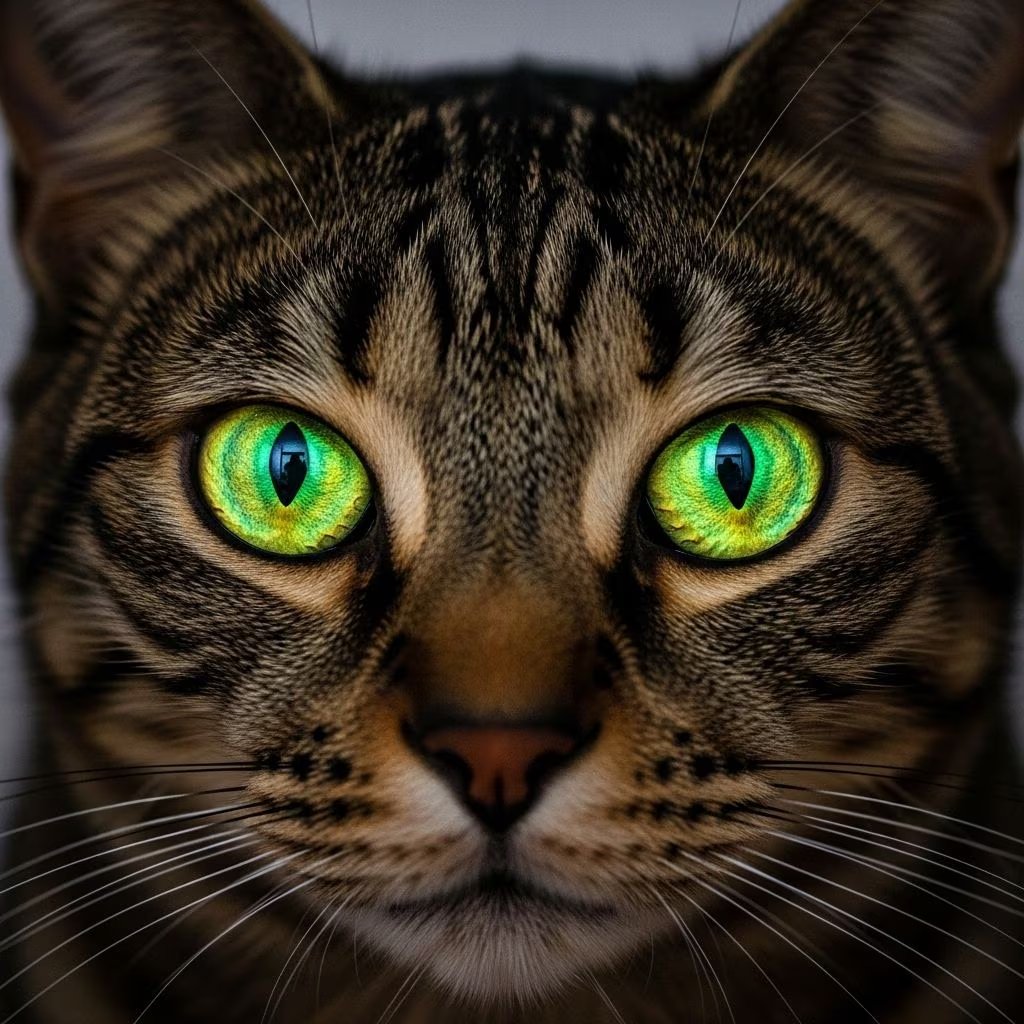
The captivating glow from a cat’s eyes in low light has puzzled and enchanted humans for centuries. This phenomenon, known as eyeshine, stems from a specialized anatomical feature that amplifies a cat’s ability to see in dim conditions, giving them a significant edge as nocturnal hunters.
Understanding the Anatomy Behind the Glow
At the heart of feline eyeshine lies the tapetum lucidum, a reflective layer positioned behind the retina. When light enters the eye, the retina—a light-sensitive tissue lining the back of the eyeball—attempts to absorb it for visual processing. Any unabsorbed photons strike the tapetum lucidum, which acts like a mirror, bouncing them back through the retina for a second opportunity at detection.
This retroreflective mechanism creates the visible glow observed when a light source, such as a flashlight or car headlight, illuminates the eyes at night. The tapetum lucidum consists of cells filled with crystalline structures, often riboflavin rodlets in cats, arranged in a precise hexagonal pattern to maximize reflection efficiency. The result is enhanced sensitivity to low light levels, allowing cats to navigate and hunt effectively during twilight or darkness.
How Eyeshine Enhances Night Vision
Cats are crepuscular animals, most active at dawn and dusk, where light conditions are challenging. The tapetum lucidum boosts retinal illumination by up to six times, dramatically lowering the minimum light threshold needed for vision. Combined with a high density of rod cells—photoreceptors specialized for low-light detection—this adaptation enables cats to perceive motion and subtle changes in their environment that would be invisible to humans.
Unlike humans, who lack this layer and rely solely on direct light absorption, cats’ eyes recycle photons, making their vision roughly six times more sensitive in dim settings. This is evident in everyday scenarios: a cat effortlessly tracks toys or insects in near-total darkness, while humans fumble for lights.
Variations in Eyeshine Colors and Species
The hue of a cat’s eyeshine varies from blue and green to yellow or even red, depending on the tapetum’s composition and the incident light’s angle. Domestic cats typically exhibit green or yellow glows due to their choroidal tapetum cellulosum, a thick structure with 15-20 layers of reflective cells.
- Blue-eyed cats: May lack a fully functional tapetum, resulting in dimmer or absent eyeshine, similar to some dog breeds.
- Wild felines: Big cats like lions and leopards display intense eyeshine, aiding wildlife camera captures in low light.
- Other animals: Cows, horses, and seals possess tapeta for predator detection or deep-sea navigation, while diurnal species like squirrels do not.
These differences highlight evolutionary tailoring: nocturnal or crepuscular species prioritize night vision, whereas daytime animals invest in color discrimination via cone cells.
The Role of Unique Pupil Shapes
Complementing the tapetum, cats’ pupils are vertically elongated slits during bright conditions, constricting to shield the retina from overload while sharpening depth perception for pouncing. In darkness, they expand into near-perfect circles to admit maximum light, further amplifying the tapetum’s effect.
| Condition | Pupil Shape | Function |
|---|---|---|
| Bright Light | Vertical Slit | Blocks excess light, enhances camouflage detection and distance judgment |
| Low Light | Dilated Circle | Maximizes light intake for night vision |
This dynamic pupil control, unique to ambush predators like cats, optimizes vision across lighting extremes. Research shows it aids in breaking natural camouflage, crucial for spotting prey against foliage.
Evolutionary Advantages for Predators
The tapetum lucidum and slit pupils evolved as survival tools. Cats, as ambush hunters, rely on stealth and precision strikes. Enhanced low-light vision allows them to stalk prey silently at night, when rodents and birds are active. Studies confirm domestic cats retain these wildcat traits, explaining their prowess in darkened homes.
In seals, an ultra-thick tapetum supports extreme low-light adaptation, paired with high rod-to-ganglion cell ratios for superior sensitivity. Such specializations underscore how eyeshine is not mere aesthetics but a finely tuned evolutionary innovation.
Human Innovations Inspired by Cat Eyes
Feline ocular biology inspires technology. Researchers have developed cameras mimicking the tapetum lucidum and vertical pupils, improving low-light performance and camouflage detection without extra power.
One breakthrough integrates a reflective layer behind image sensors, recycling light for secondary absorption, akin to cats’ retinas. Adding a slit aperture enhances edge detection in complex scenes, outperforming standard lenses. Applications span robotics, surveillance, and autonomous vehicles operating in variable lighting.
Everyday examples include retroreflective road studs, dubbed ‘cat’s eyes,’ which bounce headlights back to drivers for better visibility. These bio-mimetic designs demonstrate nature’s engineering superiority.
Health Considerations for Cat Owners
While mesmerizing, intense eyeshine can signal health issues if absent or asymmetric. Blue-eyed cats or those with tapetal degeneration may show reduced glow, potentially linked to genetic conditions. Persistent glow changes warrant veterinary checks for retinal diseases or injuries.
Owners should avoid direct flashlight exposure to prevent temporary disorientation. Regular eye exams ensure the tapetum functions optimally, supporting overall vision health.
FAQs
Do all cats have glowing eyes?
Most do, but blue-eyed or certain breeds may have incomplete tapeta, leading to weaker eyeshine.
Why do some animals’ eyes glow different colors?
Reflective granule types and light angles determine colors; cats often glow green-yellow due to riboflavin crystals.
Can humans develop night vision like cats?
Not naturally, but tapetum-inspired prosthetics or implants are under research for enhanced human vision.
Is eyeshine harmful to cats?
Brief exposure is harmless, but prolonged bright lights can cause discomfort; dim environments suit their biology best.
How does eyeshine help in wildlife studies?
It enables night camera traps to detect cats via flash reflections, aiding conservation monitoring.
References
- Why do cats’ eyes glow in the dark? — Popular Science. 2023-10-31. https://www.popsci.com/environment/why-cat-eyes-glow/
- Why Do a Cat’s Eyes Glow? — Hill’s Pet Nutrition. 2024-01-15. https://www.hillspet.com/cat-care/behavior-appearance/why-do-cats-eyes-glow
- The Spooky Science of Glowing Eyes in Cats — Panthera. 2023-11-01. https://panthera.org/blog-post/spooky-science-glowing-eyes-cats
- Feline eye–inspired artificial vision for enhanced camouflage breaking — Science Advances (DOI). 2024-09-11. https://www.science.org/doi/10.1126/sciadv.adp2809
- Retinal Specializations – Glowing Eyes — Neuwrite West. 2022-05-20. http://www.neuwritewest.org/blog/3743



