

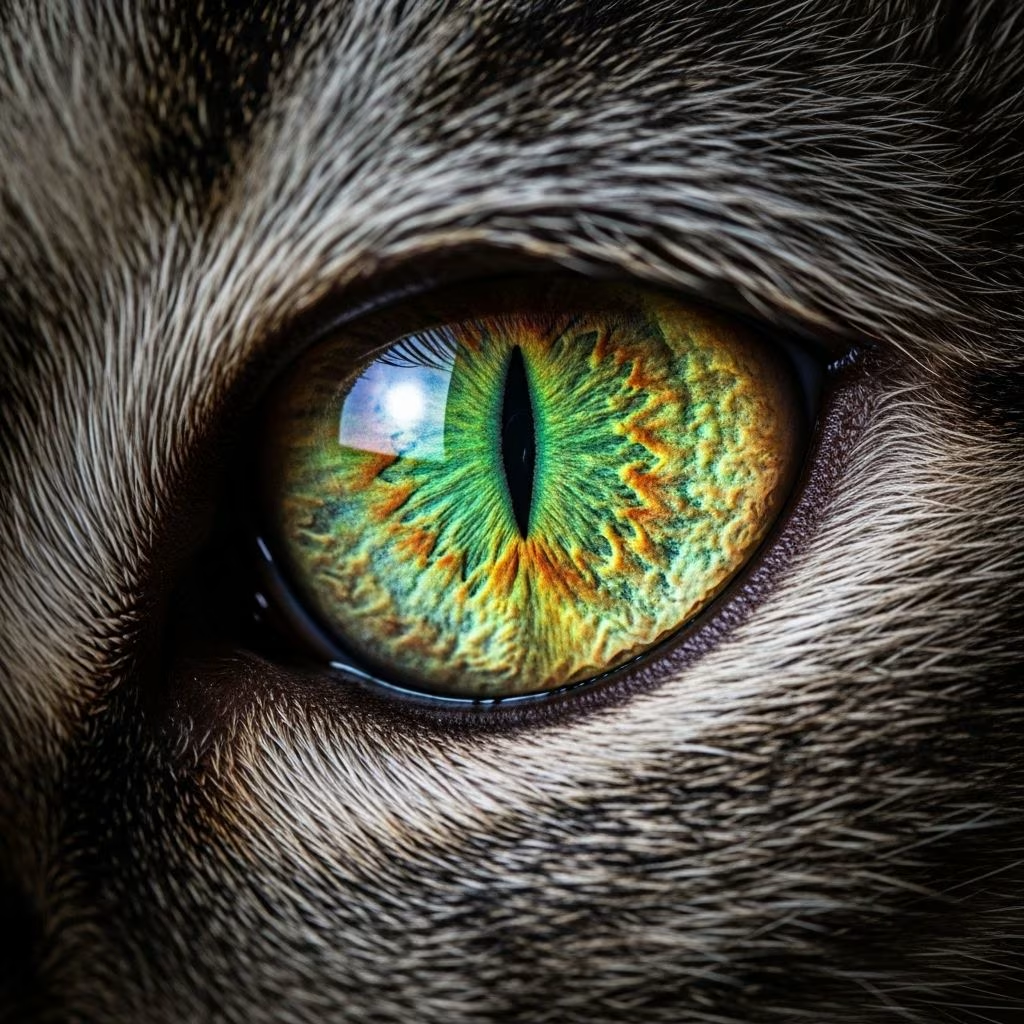
Cat eyes captivate with their luminous glow and diverse palette, ranging from deep copper to icy blue. Unlike many mammals with predominantly brown eyes, felines display a remarkable array of iris shades, a trait tracing back to a pivotal evolutionary shift in their ancestry.
Evolutionary Roots of Feline Iris Diversity
The story begins millions of years ago with the emergence of the Felidae family. Ancestral cats likely possessed both brown and gray eyes, marking a departure from the uniform brown seen in close relatives like linsangs, hyenas, and genets. This gray variant arose from a genetic mutation reducing eumelanin, the brown pigment, creating a balanced mix with pheomelanin, the yellow counterpart.
Researchers at Harvard University modeled the feline family tree, revealing how gray eyes served as a crucial bridge. This intermediate shade enabled the subsequent explosion of colors like green, yellow, and blue across species, from tigers to domestic cats. Quantitative reconstruction even pinpointed ancestral hues, offering a glimpse into eyes unseen for eons.
Intraspecific variation adds intrigue; while some species show uniform tones, big cats like lions and leopards exhibit multiple shades within populations. This diversity exploded post-linsang divergence, suggesting the mutation’s timing aligned with Felidae’s radiation.
Genetic Mechanisms Shaping Iris Pigmentation
Eye color hinges on melanin levels in the iris, produced by melanocytes. Eumelanin yields browns, pheomelanin golds, with low levels scattering light for blues and greens. Key genes orchestrate this: OCA2 regulates melanin synthesis, dictating blue versus non-blue outcomes.
The dominant white gene (W) suppresses pigmentation, often yielding blue eyes in homozygous cats (WW), while heterozygous (Ww) cases can produce heterochromia—one blue, one colored eye. The orange gene (O) influences coat and indirectly iris tones, favoring greens or coppers in its presence.
Coat-linked genes further modulate: pointed patterns in Siamese result from temperature-sensitive albinism, keeping eyes blue due to minimal warmth-induced pigment. White spotting (SIS) heightens heterochromia risk in breeds like Turkish Van.
| Gene | Effect on Eye Color | Examples |
|---|---|---|
| OCA2 | Controls melanin production; low activity = blue | General feline populations |
| W (White) | Suppresses pigment; WW = blue eyes | White cats |
| O (Orange) | Promotes green/amber/copper | Orange-coated cats |
| csd (Colorpoint) | Temperature-sensitive; blue in points | Siamese, Himalayan |
From Kitten Blues to Adult Hues
Newborn kittens universally feature blue eyes, an optical effect from Rayleigh scattering in pigment-free irises, akin to clear skies. Between 6-12 weeks, melanocytes activate, depositing melanin and shifting colors permanently.
This transition varies by genetics: high-melanin kittens darken to coppers, low ones lighten to aquas or stay blue in albinistic breeds. Observing this change offers early health clues—delayed shifts might signal issues.
Prevalent Shades in the Feline World
- Green and Yellow: Most common in domestic cats, reflecting moderate pheomelanin dominance.
- Copper/Amber: Deep, intense tones from abundant eumelanin, seen in many mixed breeds.
- Blue: Rare overall, linked to white fur or points; requires low pigment balance.
- Odd-Eyed (Heterochromia): One blue, one colored; genetic in white-spotted cats, acquired via injury or disease.
- Gray: Ancestral holdover, mediator for other colors; persists in some wild felids.
Brown eyes, while ancestral, are scarce in modern cats, overshadowed by the gray mutation’s legacy. Big cats like lions retain yellow-greens, tigers coppers, snow leopards blues.
Breed-Specific Eye Traits
Certain breeds showcase signature shades:
- Siamese: Striking blue from csd gene.
- Turkish Van/Khao Manee: Prone to heterochromia.
- British Shorthair: Vivid copper or gold.
- White breeds (e.g., Turkish Angora): Often blue or odd-eyed.
These traits enhance breed standards but underscore genetic selection’s role in amplifying natural variations.
Health Indicators Hidden in Eye Color
Beyond aesthetics, eye color signals vitality. Blue eyes in non-white cats may indicate deafness, especially bilaterally, due to shared neural crest cell migration. Heterochromia often pairs with unilateral deafness.
Acquired changes—like sudden lightening—flag issues: glaucoma, uveitis, or trauma altering pigment. Persistent kitten blues past 12 weeks warrant vet checks for albinism or defects. Vibrant, clear colors denote health; cloudiness or unevenness prompts examination.
Myths and Facts About Feline Eyes
Folklore claims blue eyes mean poor night vision—false; tapetum lucidum ensures superior low-light sight regardless. Another: all white cats deaf—only ~65-85% of blue-eyed whites are. Brown rarity stems from evolution, not inferiority.
Frequently Asked Questions
Why don’t most cats have brown eyes?
A gray-eyed ancestor mutated from brown, enabling diverse pigments; brown faded as other colors proliferated.
Can a cat’s eye color change after kittenhood?
Typically sets by 12 weeks, but injury, disease, or age can alter it secondarily.
Is heterochromia harmful?
Genetic forms usually benign, often with deafness risk; acquired types need medical evaluation.
What causes blue eyes in adult cats?
Low melanin from white genes, albinism, or points; light scattering creates the hue.
Do eye color and personality link?
No scientific basis; behavior ties to breed, upbringing, not iris shade.
Caring for Your Cat’s Precious Peepers
Protect eyes with routine checks, avoiding trauma, and monitoring for redness or discharge. Nutrition rich in taurine, omega-3s supports ocular health. Breeds with light eyes benefit from UV protection outdoors. Understanding color origins deepens the human-feline bond, celebrating nature’s artistry.
References
- Cats’ dazzling eye colors may come from 1 unusual ancestor — Live Science. 2024. https://www.livescience.com/animals/cats/cats-dazzling-eye-colors-may-come-from-1-unusual-ancestor
- Unlocking the kaleidoscope of big cat eyes: The surprising evolution — Harvard OEB. 2024. https://www.oeb.harvard.edu/news/unlocking-kaleidoscope-big-cat-eyes-surprising-evolution-felid-eye-color-diversity
- Understanding Cats with Different Colored Eyes — Cat Tree UK. 2023. https://cattree.uk/understanding-cats-with-different-colored-eyes/
- Cat Eye Colors, Explained: Genetics, Health, and Rare Shades — Kinship. 2024. https://www.kinship.com/cat-health/cat-eye-colors
- The Fascinating Journey of Your Cat’s Eye Color — Oreate AI Blog. 2024. https://www.oreateai.com/blog/the-fascinating-journey-of-your-cats-eye-color/e1efff0c09931b9191d30ca9dc77e3c2
- The Science Behind Cat Colors and Genetics — Zoetis Petcare. 2024. https://www.zoetispetcare.com/blog/article/science-behind-cat-colors



