

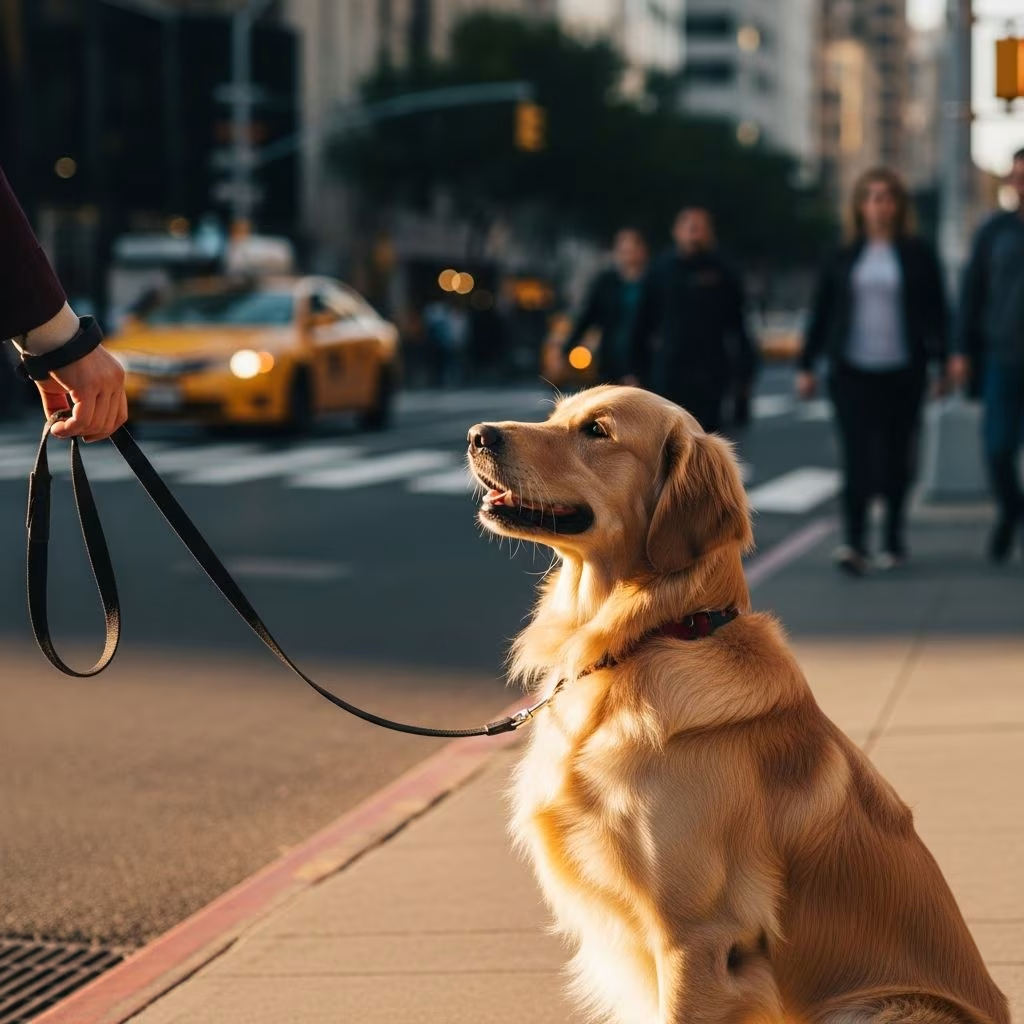
One of the most valuable skills you can teach your canine companion is the ability to resist temptation and ignore items on command. Whether your dog encounters a discarded chicken bone on the sidewalk, a piece of chocolate left on a table, or any other potentially dangerous object, having a reliable recall or restraint command could literally save their life. This foundational training exercise teaches dogs to exercise self-control and respect boundaries, creating a safer environment both at home and during outdoor adventures.
Understanding Why This Training Matters
Dogs are naturally curious creatures with strong instincts to investigate their environment through their mouths. While this exploratory behavior is normal, it can lead to dangerous situations when dogs encounter toxic substances, small objects that pose choking hazards, or foods that are harmful to their digestive systems. Teaching your dog to refrain from consuming items without your explicit permission gives you control over what enters their body and helps prevent accidental poisoning, intestinal blockages, and other health emergencies.
Beyond safety concerns, this command demonstrates respect for your authority as the pack leader. It reinforces that you make decisions about what is acceptable for consumption and what is off-limits. This hierarchical understanding strengthens your bond and makes your dog more responsive to other commands as well. Dogs that understand impulse control are also less likely to steal food from countertops, raid the trash, or consume items during walks.
Foundational Principles Before You Begin
Before starting any training regimen, it’s important to understand the psychology behind reward-based learning in dogs. Dogs repeat behaviors that result in positive outcomes for them. Rather than using punishment or negative reinforcement, modern dog training emphasizes marking the moment when your dog makes the correct choice and immediately rewarding that behavior. This creates a positive association with obedience and encourages your dog to voluntarily choose the desired response.
Your training approach should also account for your individual dog’s personality, age, and learning style. Puppies may have shorter attention spans and require more frequent, brief training sessions. Adult dogs might progress more quickly but may have ingrained habits to overcome. Senior dogs benefit from gentler handling and fewer repetitions per session.
Phase One: Building Impulse Control with Closed Hand Exercise
The first phase of training establishes the foundational concept that restraint brings rewards. Start this exercise in a quiet, distraction-free environment such as your living room or a private training space.
- Hold a treat in your closed fist: Show your dog the treat and let them see and smell it. Your dog will likely attempt to access the treat through nudging, pawing, licking, or other manipulative behaviors. Remain completely passive during these attempts and do not open your hand or acknowledge their efforts in any way.
- Wait for the breakthrough moment: Your dog will eventually realize their current strategy isn’t working and will pause or back away from your hand, even if only briefly. This moment of disengagement is exactly what you’re looking for.
- Mark and reward immediately: The instant your dog creates distance from your closed fist, open your hand and provide the treat along with enthusiastic verbal praise. This teaches your dog that backing away from something tempting results in receiving that very treat plus additional rewards.
- Repeat consistently: Practice this sequence multiple times during short training sessions, ideally 5-10 minutes long. Repeat for several days until your dog reliably backs away from your closed hand.
Phase Two: Introducing the Verbal Cue
Once your dog consistently demonstrates the backing-away behavior, you can begin pairing this action with a verbal command. The word “leave it” or “leave” becomes the trigger that signals your dog to exercise restraint.
Use a calm, firm tone when delivering the command—not angry or punitive, but clear and authoritative. Say the command as your dog begins to disengage from the treat, then immediately open your hand and provide the reward. The timing of the verbal cue is important; saying it right before your dog backs away helps your dog associate the word with the desired behavior.
Gradually transition from rewarding with the treat from your hand to rewarding with a higher-value treat from your other hand or pocket. This prevents your dog from becoming fixated on the closed fist and teaches them that compliance results in an even better outcome.
Phase Three: Progressive Difficulty and Real-World Scenarios
As your dog demonstrates reliability with the closed-hand exercise, introduce increasingly challenging variations:
- Open palm presentation: Place a treat on your open palm and ask your dog to leave it. If your dog attempts to take the treat, close your hand and wait for them to back away. When they do, reward from your other hand. If your dog maintains distance, immediately reward them.
- Floor placement: Place low-value treats on the ground in a controlled setting and practice the “leave it” command as you and your dog walk past them. Keep your dog on a leash and use your foot to cover any treats if your dog tries to snatch them.
- Multiple objects: Arrange several treats in a row with space between them. Practice walking past each one individually, rewarding your dog for maintaining composure and ignoring the temptation.
- Environmental variation: Practice the same exercises in different locations—your yard, the park, busy sidewalks, and other real-world settings where your dog is more likely to encounter actual hazards.
Introducing Distractions and Real-World Applications
Training in a controlled environment is essential for building foundation skills, but the true test comes when your dog must apply these lessons amid real-world distractions. Only introduce distractions once your dog demonstrates reliable responses in quiet settings.
Distractions might include other pets, unfamiliar people, interesting smells, or exciting activity in the environment. When introducing a new distraction element, be prepared with especially high-value rewards—items your dog absolutely loves. Keep your dog on a leash during these advanced sessions to maintain safety and prevent your dog from practicing the incorrect behavior.
The goal is to gradually build your dog’s ability to maintain focus on you and your commands even when environmental factors are competing for their attention. This takes considerable practice and patience, but it’s this stage that truly prepares your dog for safety in unpredictable real-world situations.
Common Training Mistakes to Avoid
Using the command as a last resort: Never rely on “leave it” to save your dog from a situation you didn’t set up properly. If you know your dog isn’t ready for a particular distraction, don’t test the command and hope it works. This teaches your dog that sometimes ignoring you pays off, which undermines the reliability of the command.
Inconsistent practice: Dogs require repetition to cement new behaviors. Training once or twice and then expecting reliability weeks later sets your dog up for failure. Consistency in practice, reward delivery, and command phrasing is essential.
Punishing exploration: Never use punishment or harsh corrections when your dog fails to comply. This creates fear and anxiety around the command rather than understanding. Return to easier steps and rebuild foundation skills instead.
Skipping steps: Each phase of training builds on the previous one. Advancing to floor exercises before your dog masters the closed-hand exercise is premature and often leads to frustration for both trainer and dog.
Session Structure and Training Schedule
Effective training sessions follow a specific structure that maximizes learning while preventing boredom or frustration:
- Keep sessions short, ideally 5-15 minutes depending on your dog’s age and attention span
- Practice in multiple short sessions throughout the day rather than one long session
- End on a positive note with your dog succeeding at a command
- Maintain a consistent routine so your dog anticipates training time
- Gradually space out training sessions as reliability increases, but continue refresher practice regularly
For puppies, several 5-minute sessions daily are ideal. For adult dogs, 2-3 sessions of 10-15 minutes per day will show steady progress. As your dog becomes proficient, reduce frequency but maintain occasional practice to keep skills sharp.
Selecting Appropriate Rewards
The effectiveness of your training depends heavily on the value your dog places on the rewards you offer. Low-value treats like regular kibble work fine for initial training phases, but high-value rewards are necessary when introducing challenging scenarios or distractions.
Consider what your dog finds most rewarding: special treats they rarely get, praise and attention, playtime with a favorite toy, or access to an exciting activity. Rotating rewards prevents your dog from becoming bored with the same treat and maintains enthusiasm during training.
Extending the Command Beyond Food
While food items are the most common focus of “leave it” training, the principle applies to any object your dog shouldn’t touch. Once your dog demonstrates reliable response to food-based training, you can apply the same command to other tempting items like toys that belong to children, remote controls, shoes, or plants.
The training process remains identical: show your dog the object, use the command, and reward them for maintaining distance or disengaging. Over time, your dog learns that the “leave it” command applies universally to any situation where you’ve determined something is off-limits.
Troubleshooting Common Challenges
Dog shows no interest in backing away: Try using a lower-value treat in your closed hand and a higher-value reward in your other hand to create more motivation for disengagement. Some dogs benefit from you turning slightly away or taking a small step back to encourage them to follow your movement.
Dog succeeds randomly but inconsistently: Return to earlier training phases and build more repetitions at each level. Inconsistency usually means your dog hasn’t fully grasped the concept yet, not that they’re being stubborn or deliberately disobeying.
Dog regresses when introduced to new environments: This is completely normal. Distractions make the task more difficult for your dog. Continue practicing in familiar settings while gradually introducing new locations one at a time.
Long-Term Maintenance and Skill Retention
Once your dog reliably responds to the “leave it” command, training isn’t finished—it’s just entering maintenance mode. Dogs’ skills can fade without periodic reinforcement, so continue practicing the command occasionally, even after your dog seems fully proficient.
Integrate the command into your regular routine during walks and other activities. When you notice your dog successfully ignoring a temptation without being prompted, reward them enthusiastically to reinforce the behavior. This keeps the skill fresh and maintains your dog’s understanding that impulse control brings positive consequences.
Safety Benefits Beyond Food
A well-trained “leave it” response protects your dog from numerous hazards beyond toxic foods. This includes medications, cleaning supplies, batteries, small toys that pose choking hazards, and even dangerous wildlife. In emergency situations where your dog might be in danger, a reliable “leave it” command could be the difference between a scare and a tragedy.
Conclusion
Teaching your dog impulse control through the “leave it” command is one of the most practical and potentially life-saving skills you can develop together. While the process requires patience, consistency, and commitment to progressive training stages, the investment pays dividends in your dog’s safety, obedience, and overall quality of life. Start with foundation work in quiet environments, progress gradually to real-world scenarios, and maintain the skill through occasional reinforcement. Your dedication to this training demonstrates your commitment to responsible dog ownership and provides your dog with the tools to make safe choices in a world full of temptation.
References
- How To Train Your Dog To Leave Something Alone — Royal Society for the Prevention of Cruelty to Animals (RSPCA). https://www.rspca.org.uk/adviceandwelfare/pets/dogs/training/leave
- How to Teach Your Dog the ‘Leave It’ Command — American Kennel Club (AKC). https://www.akc.org/expert-advice/training/learning-the-leave-it-command/
- Teaching Your Pup the Leave It Command — Buddy and Friends Dog Training. https://buddyandfriendsdd.com/teaching-leave-it-command/



