

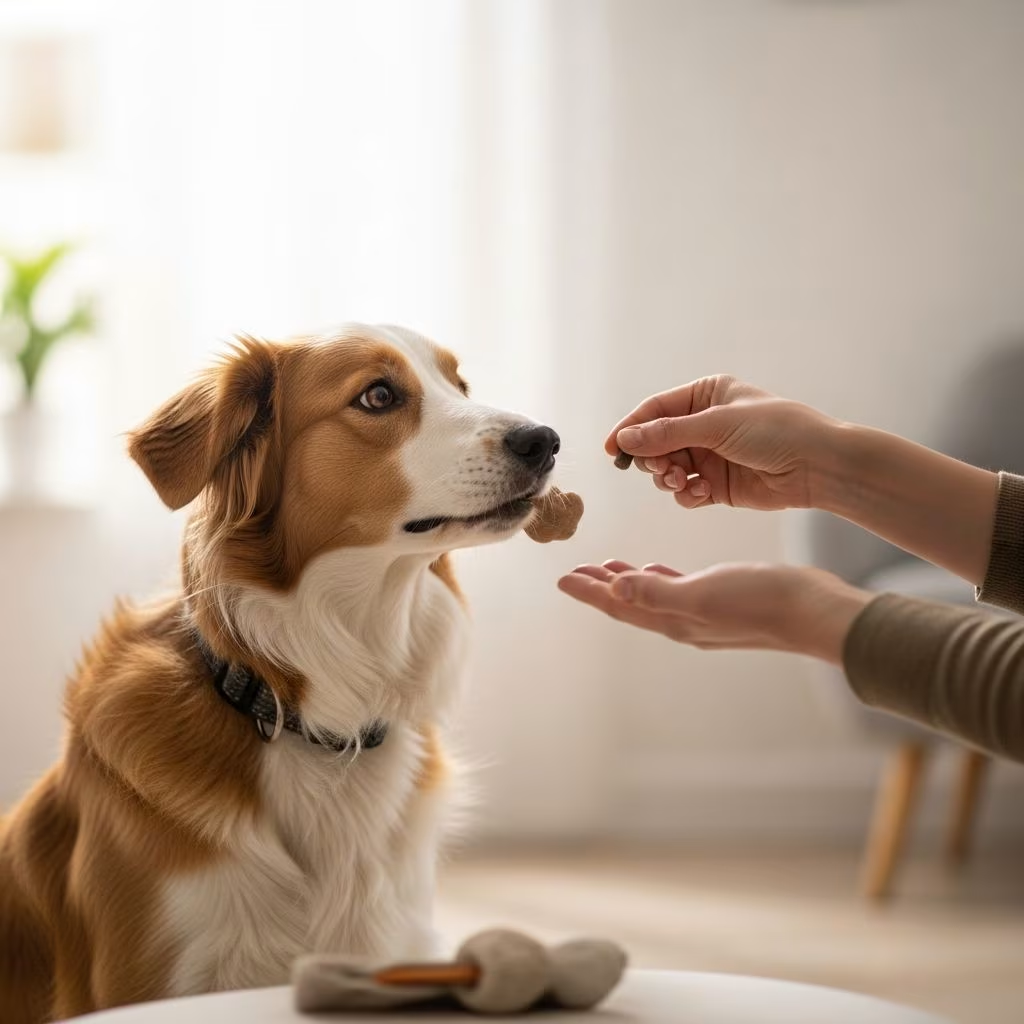
One of the most valuable skills you can teach your canine companion is the ability to willingly exchange items with you. Whether your dog picks up something potentially dangerous, a forbidden toy, or household debris, having a reliable exchange command transforms a stressful situation into a cooperative interaction. This fundamental behavior creates a foundation of trust between you and your dog while preventing dangerous situations and reducing conflict during training and daily life.
Why the Exchange Command Matters for Every Dog Owner
Dogs naturally investigate their environment by placing items in their mouths. What might seem like a simple curiosity to your dog could represent a serious safety hazard to you. Unlike the more commonly known “drop it” command, teaching your dog to exchange items creates a more nuanced understanding of cooperation. The exchange command acknowledges that your dog has something valuable and offers an even better trade, rather than simply demanding surrender.
This approach proves particularly effective because it aligns with how dogs naturally learn and think. Instead of creating confrontation or fear around giving up possessions, you establish a positive framework where your dog views interaction with forbidden items as an opportunity for reward. Dogs that understand the exchange command demonstrate less resource guarding behavior, respond more quickly to redirection, and show greater willingness to cooperate across various training scenarios.
Additionally, mastering this command prevents common behavioral problems before they develop. Dogs that learn early in life that releasing items results in positive outcomes are significantly less likely to develop serious resource guarding behaviors as they mature. This proactive approach to training creates a safer, more harmonious household for all family members.
Understanding the Foundation: Low-Value Item Introduction
The journey toward a reliable exchange command begins with simple, low-pressure scenarios. Start by presenting your dog with an object they show minimal interest in—perhaps a toy they occasionally play with but don’t favor, or a type of treat they only sometimes consume. The goal during this initial phase centers on building your dog’s understanding that accepting an item from you creates a positive exchange opportunity.
Initiate this phase by saying “Take it” in an encouraging tone and offering the low-value object. Allow your dog to take the item into their mouth. If your dog’s first instinct involves running away with the item, secure them using a leash or by tethering them to a stationary object. This prevention ensures they remain in the learning environment long enough to understand the benefits of the upcoming exchange.
The repetition frequency during this stage proves critical to success. Aim to practice this exchange sequence 10-12 times per session, or even more if your dog shows enthusiasm. Consistency at this foundational level creates neural pathways that make more challenging exchanges automatic in future scenarios. Your dog begins connecting the experience of taking an offered item with the immediate arrival of something even more desirable.
Progressive Difficulty: Advancing Through the Object Hierarchy
Once your dog confidently exchanges low-value items, gradually introduce objects with increasing appeal. This hierarchical approach prevents frustration and ensures your dog experiences consistent success throughout the training process. The progression typically follows this framework:
- Neutral objects: Items your dog shows minimal reaction to, helping establish the basic exchange pattern
- Low-interest items: Toys or objects your dog sometimes plays with but doesn’t strongly prefer
- Moderately appealing items: Objects your dog enjoys but will relinquish without excessive difficulty
- High-value items: Toys or objects your dog strongly prefers, representing the most challenging exchanges
- Food-based items: Bowls containing various qualities of food, from basic kibble to highly preferred treats
During each progression level, maintain consistency in your approach. Offer the item with an encouraging “Take it” cue, allow your dog to secure it, then immediately present an exchange option of greater value. The exchange reward should always surpass the original item’s value in your dog’s perception. Repeating this sequence 10-12 or more times at each level ensures your dog fully internalizes the exchange pattern before advancing further.
This graduated approach proves particularly important for dogs with strong resource guarding tendencies or those recovering from past experiences where possession created conflict. Moving too quickly through difficulty levels can trigger defensive behaviors, ultimately reversing training progress. Conversely, spending adequate time at each level builds confidence and creates genuinely reliable exchanges even under stress.
Mastering the Distance-Based Exchange: The “Walk Away” Command
Beyond exchanging items your dog already holds, teaching a preventative command that directs your dog away from tempting objects represents an equally valuable skill. The “walk away” command enables you to redirect your dog before they even claim possession of something potentially dangerous. This proactive behavior management technique proves especially useful in situations where immediate exchange might prove difficult or risky.
Begin teaching the “walk away” command in simplified scenarios unrelated to actual prohibited items. Call out “Walk away” in a cheerful, encouraging voice, then immediately scatter several high-value treats on the ground several feet away from you. As your dog moves toward and discovers the treats, gesture enthusiastically to help them locate each one. Point to each treat to maintain their attention on the rewarding aspect of complying with your cue.
Repeat this basic sequence 10-12 times or more until your dog responds eagerly to the “walk away” command independent of any tempting items. This establishes the command’s association with positive outcomes and builds muscle memory for the behavior you want to reinforce. Your dog learns that hearing “walk away” predicts an enjoyable treat-finding opportunity.
Introducing Temptation: Applying “Walk Away” to Objects
After your dog demonstrates reliable “walk away” responses in simple scenarios, introduce neutral objects into the training environment. Place an object on the ground that your dog shows minimal interest in—perhaps an inexpensive toy or common household item. As your dog investigates or sniffs the object, immediately say “Walk away” and scatter several high-value treats on the ground 2-4 feet away from the object.
Point enthusiastically at each treat as your dog discovers them, maintaining positive attention on the rewarding aspect of moving away from the neutral object. Repeat this sequence at least 10-12 times until your dog immediately moves away from the object upon hearing the cue. Your dog should demonstrate eager responsiveness rather than reluctant compliance, indicating they genuinely view the command as an opportunity rather than a restriction.
Gradually increase the appeal of objects used in “walk away” training. Progress from neutral items to moderately interesting toys, then to higher-value toys, and finally to high-value items your dog strongly prefers. At each difficulty level, maintain the same repetition frequency and reward consistency until your dog responds reliably before advancing further.
The Food-Based Challenge: Advanced “Walk Away” Training
Food-related situations often prove the most challenging for dogs, particularly those with tendencies toward resource guarding or protective eating behaviors. Training your dog to walk away from food bowls requires the same graduated approach applied to other items but demands even greater consistency and care regarding safety distances.
Start with a bowl containing basic kibble mixed with slightly more palatable additions, such as a small amount of canned food. Place the bowl on the ground and allow your dog to notice it. When your dog sniffs or shows interest in the bowl, say “Walk away” and scatter several highly valuable treats on the ground 2-4 feet away. If your dog shows any guarding tendencies, maintain even greater distance while pointing to the treats.
After your dog reliably walks away from mixed kibble bowls, introduce a bowl containing higher-value food such as pure canned food or meat-based preparations. Follow the identical training sequence, repeating 10-12 or more times until your dog demonstrates immediate, enthusiastic responses. This progression proves particularly important for dogs showing any signs of resource guarding around food, as it systematically demonstrates that moving away from food creates positive outcomes rather than creating competition or conflict.
Combining Commands: Creating a Comprehensive Safety Framework
While the exchange and “walk away” commands function effectively as standalone skills, combining them creates a comprehensive behavioral toolkit for various situations. Some dogs respond more reliably to one command over another depending on circumstances, anxiety levels, or the specific appeal of the forbidden item.
The exchange command proves most effective when you can safely approach your dog and offer an immediately superior trade. The “walk away” command works better in situations where immediate approach might escalate guarding behaviors or where the item presents immediate danger requiring quick redirection away from rather than approach toward your dog.
Developing fluency in both commands gives you maximum flexibility in real-world scenarios. A dog that reliably performs both behaviors demonstrates sophisticated impulse control and cooperation across varying contexts. Training both commands also provides backup options if your dog struggles with one approach, allowing you to emphasize the command they find most motivating.
Training Strategies That Support Long-Term Success
Successful training relies on more than simply repeating sequences—the quality of your training approach dramatically impacts long-term reliability. Consider these evidence-based strategies for maximizing your results:
- Reward consistency: Always reward exchanges and “walk away” responses promptly, ensuring your dog clearly connects their behavior to positive outcomes
- Reward hierarchy: Use more valuable rewards for increasingly challenging exchanges, maintaining motivation across difficulty levels
- Multiple training sessions: Conduct several short training sessions weekly rather than infrequent lengthy sessions, supporting better retention and pattern formation
- Environmental variation: Practice exchanges and “walk away” commands in different locations and contexts, preventing your dog from developing location-specific responses
- Object variation: Use diverse objects at each difficulty level to prevent your dog from learning specific items rather than generalizing the command
- Safe tethering: Use leashes or tethering strategically during early training to prevent avoidance behaviors that interrupt learning
Common Challenges and Practical Solutions
Problem: Your dog runs away with offered items before recognizing the exchange opportunity
Solution: Use a leash during initial training phases, stepping on the leash or tethering your dog to prevent flight. This containment keeps your dog in the learning environment long enough to understand that remaining present leads to better rewards than escape attempts. Gradually reduce reliance on leash control as your dog’s understanding improves.
Problem: Your dog shows more interest in the offered item than the exchange reward
Solution: Reassess your reward hierarchy. The exchange reward must exceed the original item’s value in your dog’s perception. Experiment with different reward types—some dogs prefer toys, others respond better to food, and some value social interaction or play. Match your rewards to your individual dog’s motivations.
Problem: Your dog responds inconsistently, performing exchanges reliably sometimes but ignoring commands other times
Solution: Increase training frequency and return to earlier difficulty levels to rebuild foundation reliability. Inconsistent responses often indicate insufficient repetition at particular training stages. Ensure you’re practicing 10-12 or more repetitions at each level before advancing further.
Building Lifetime Reliability Through Maintenance Training
After achieving strong exchange and “walk away” command responses, ongoing maintenance training proves essential for preserving reliability across your dog’s lifetime. Continue practicing these commands periodically, even after they’re well-established, to maintain the neural pathways supporting these behaviors.
Integrate exchange games into regular play and interaction time rather than viewing them as separate training activities. Periodically offer exchanges during casual play sessions, keeping your dog’s skills sharp while making training feel like natural interaction rather than formal instruction.
This lifelong approach ensures your dog maintains reliable responses when it matters most—those critical moments when a forgotten toy, dangerous item, or prohibited food requires immediate redirection. The investment in ongoing practice pays dividends in your dog’s safety and your peace of mind throughout their life.
References
- Teach Your Dog to Trade Items With You – And Why It’s Important — American Kennel Club. https://www.akc.org/expert-advice/training/teach-dog-to-trade-items-with-you/
- How to Teach Your Dog to Trade — Whole Dog Journal. https://www.whole-dog-journal.com/training/how-to-teach-your-dog-to-trade/
- The Trade Game — Wisconsin Humane Society. https://www.wihumane.org/behavior/ask-the-experts/dogs/the-trade-game
- 12 Dog Training Methods Explained: A Science-Backed Guide — QC Pet Studies. 2025. https://www.qcpetstudies.com/blog/2025/10/12-dog-training-methods-explained-science-backed-guide
- 5 Tips for Successful Dog Training — Virginia Tech College of Veterinary Medicine. 2023. https://vetmed.vt.edu/news/2023/dog-training-tips.html



