Teach Your Dog to Talk with Buttons
Unlock your dog's voice: Step-by-step guide to training communication buttons for better understanding and bonding.
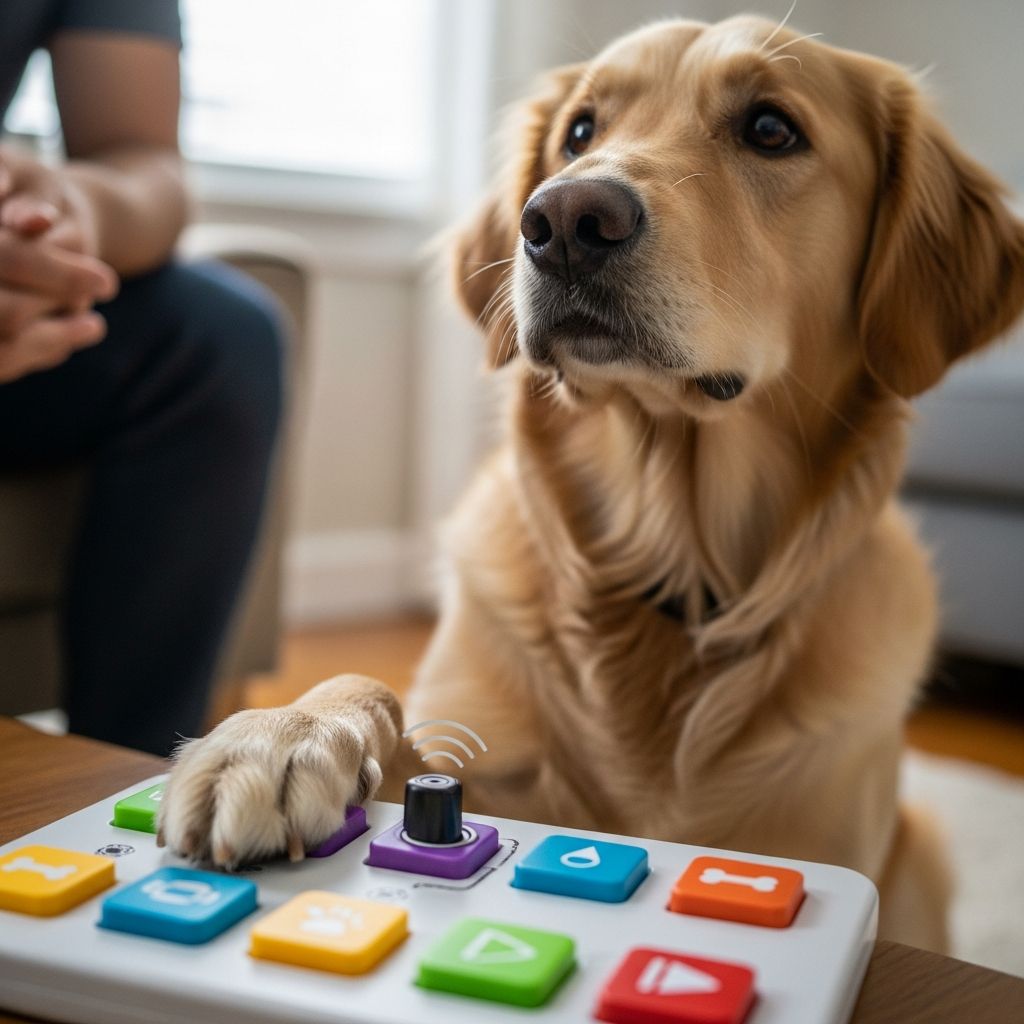
Dogs communicate through body language, barks, and whines, but innovative tools like recordable soundboard buttons allow them to express needs and desires using human words. This guide covers foundational training techniques building to button use, supported by recent research confirming dogs’ deliberate comprehension of button words.
Can Dogs Talk?
Dogs naturally use body language and vocalizations to convey emotions—barking when frustrated or lip-licking when unsure—but they also understand human words, enabling reciprocal communication via nose or paw targeting. A recent study reveals dogs use buttons intentionally, not by imitation, even forming two-word combinations like ‘outside now’.
While dogs lack human vocal anatomy, button devices bridge this gap by letting owners record words like ‘outside’ or ‘play,’ associating presses with outcomes. Research from UC San Diego confirms dogs produce contextually appropriate responses to button words, demonstrating comprehension. This potential for enhanced dialogue strengthens the human-canine bond, reducing misunderstandings.
How to Train a Dog to Talk
Training progresses through layered behaviors: verbal cues, hand signals, targeting, bell ringing, and finally buttons. Consistency, positive reinforcement, and patience are key, as dogs can learn unlimited cues if training remains enjoyable.
Teach Verbal Cues
Verbal cues form the foundation. Follow these steps:
- Get your dog’s attention.
- Lure with a treat to perform the behavior (e.g., sit).
- Reward success.
- Lure again while saying the cue (e.g., ‘sit’).
- Reward.
- Fade the lure, using only the cue.
- Repeat for consistency.
Dogs thrive on this lure-reward-fade method, building reliable responses.
Teach Hand Signals
Pair visuals with words for versatility:
- Get attention.
- Lure behavior with treat.
- Reward.
- Display hand signal, then lure.
- Reward.
- Fade lure, use signal only.
- Pair with verbal cue.
- Repeat.
This dual training enhances communication in noisy environments.
Teach Targeting (Touch)
Nose targeting transfers to objects:
- Present hand palm-up; reward nose touches (start with sniffs).
- Reinforce strong touches.
- Increase distance.
- Add ‘touch’ command.
- Transfer to objects: Present near dog, say ‘touch,’ reward approach.
Mastery here preps for bells and buttons.
Teach Bell Ringing
For ‘go outside’ requests:
- Hang accessible bell.
- Say ‘touch’; reward by opening door + treat.
- Reinforce strong touches.
- Always respond to build association.
- Praise independent rings lavishly.
My miniature poodle mastered this quickly, signaling potty needs independently.
Button Training
Soundboard buttons—recordable devices—are a modern evolution. Record words like ‘walk’ or ‘treat’; dogs press to request. Skepticism faded with studies proving intentional use, including novel combinations.
Training mirrors targeting but emphasizes association:
Step-by-Step Button Training
- Record the word (e.g., ‘ball’).
- Press button yourself, present ball immediately. Repeat 50+ times.
- Say ‘touch’; guide dog to press, then present ball.
- Respond only to presses: Deliver associated action/object.
- Expand vocabulary: Objects first, then actions (‘go outside’).
- Model in context: Press ‘outside’ while heading out.
Shaping—rewarding approximations—accelerates progress. Avoid over-treating to prevent ‘treat button’ misconceptions; use praise primarily.
Tips from Experts
- Model frequently: Press buttons in real scenarios (e.g., ‘play’ during fetch).
- Respond to exploration: If dog sniffs ‘outside,’ press and act.
- Start small: 1-3 buttons with frequent words; expand gradually.
- Use mats: Keep buttons stable for easy access.
- Clear goals: Begin with simple rewards like toys before complex phrases.
Per trainer Kizz Robinson, break complex ideas into single associations first.
What Are Dog Communication Buttons?
These are durable, recordable buttons (often on mats) playing owner-voiced words/phrases upon press. From basics (‘outside’) to affectionate (‘love you’), they enable dogs to initiate conversations. Pre-recorded options exist, but custom recording personalizes training.
Benefits include reduced frustration: Dogs request precisely, owners respond accurately. Pioneers like Christina Hunger (Hunger4Words) inspired global adoption, with her methods detailed in books and social media.
What to Know Before Getting Buttons
Choose kits with mats for stability. Assess your dog’s motivation—food/treat-driven pups excel. Commit to daily modeling (no fixed sessions; integrate naturally). Track progress; join studies via TheyCanTalk.org for data contribution.
Vocab potential: Average dogs learn 89 words; border collies exceed 1,000. Start simple to build confidence.
Communication Button Use Cases
Buttons shine in daily life:
- Potty/Outings: ‘Outside,’ ‘walk’ prevent accidents.
- Play/Feed: ‘Ball,’ ‘dinner’ clarify requests.
- Emotions: ‘Mad,’ ‘love you’ express feelings.
- Advanced: Multi-buttons form sentences (e.g., Bunny the Dog).
Inspiration abounds: Follow Parker (rapid learner), Jasper (blind cat success), or custom ‘dog computers’. Research explores cognitive depths, positioning users as interspecies communication pioneers.
Frequently Asked Questions (FAQs)
Do dog talking buttons really work?
Yes, with patience. Dogs learn via association; studies confirm understanding beyond imitation.
How many words can dogs learn?
Average: 89; exceptional dogs over 1,000, per research.
How long does button training take?
Weeks to months per word; 50 reps minimum for basics. Progress varies by dog.
Can any dog learn buttons?
Most, if motivated. Start young or with targeting-savvy dogs.
Should I use treats for button training?
Praise primarily; treats risk confusing presses with rewards.
Scientific Backing and Ongoing Research
UCSD study (2024) analyzed soundboard dogs, finding word-specific, context-fit responses. PMC review notes historical paradoxes but affirms modern evidence of referential use. IAABC Journal discusses deliberate pressing. Join studies to advance knowledge.
References
- Can You Teach a Dog to Talk? Five Training Techniques — Kinship. 2024. https://www.kinship.com/dog-behavior/teach-dog-talk-buttons
- What Are Dog Communication Buttons? And How to Use Them — Kinship. 2024. https://www.kinship.com/dog-behavior/teach-dog-to-talk-with-buttons
- Dogs Really Do Understand Speech Buttons, New Study Finds — Kinship. 2024. https://www.kinship.com/dog-behavior/dog-speech-buttons-news
- Dogs Understand Words from Soundboard Buttons, Study Reveals — UC San Diego. 2024-09-17. https://today.ucsd.edu/story/dogs-understand-words-from-soundboard-buttons-study-reveals
- Talking Dogs: Paradoxes of Soundboard Use by Dogs — PMC/NCBI. 2024. https://pmc.ncbi.nlm.nih.gov/articles/PMC11591343/
Similar Articles







Read full bio of Sneha Tete