

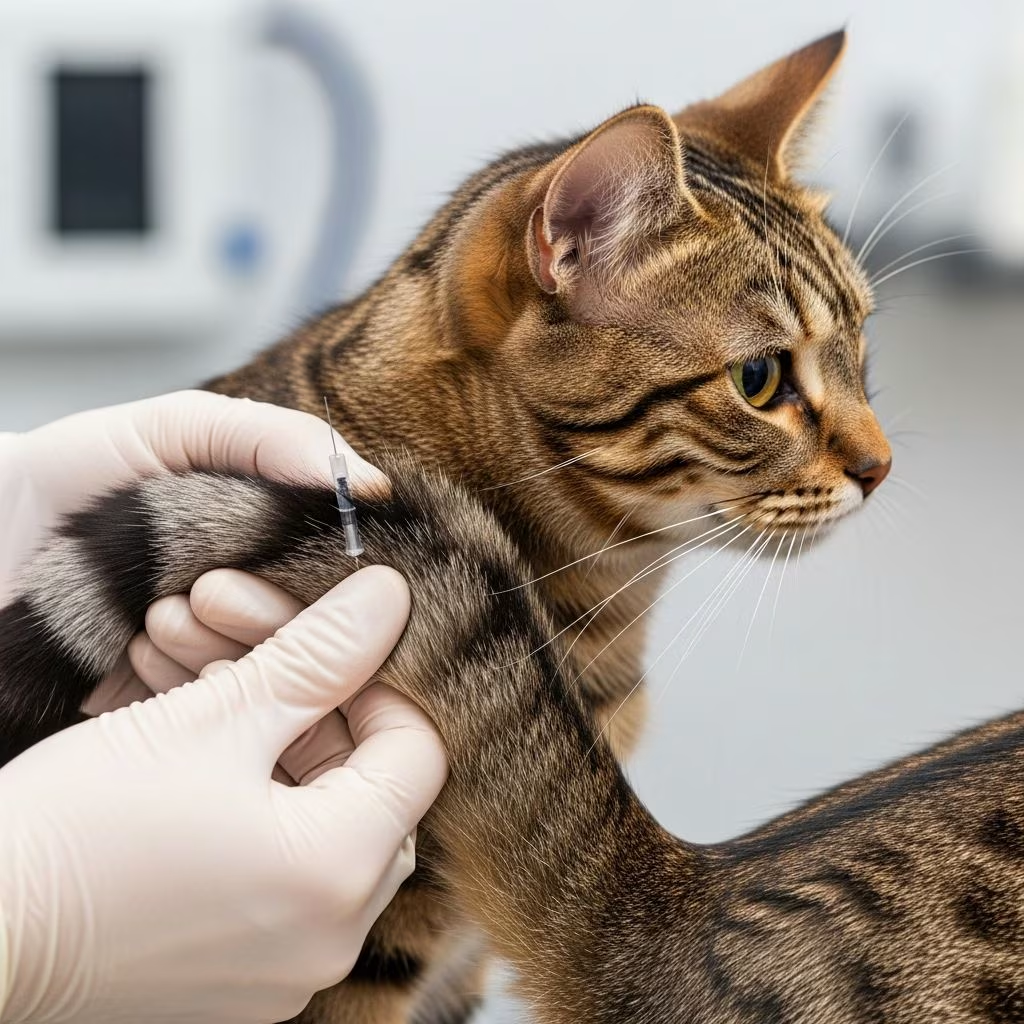
Vaccinating cats in the tail offers a promising alternative to traditional sites, providing equivalent immunity while enabling simpler amputation if rare injection-site sarcomas develop. This approach, pioneered by University of Florida researchers, addresses a serious complication of routine vaccinations known as feline injection-site sarcoma (FISS).
What Is Feline Injection-Site Sarcoma?
**Feline injection-site sarcoma (FISS)** is a rare but aggressive cancer linked to vaccinations, affecting 1–10 cats per 10,000 vaccinated. These malignant tumors, often fibrosarcomas, arise at injection sites and have high recurrence rates even after treatment.
Historically, vaccines were given in the interscapular (between the shoulder blades) region for convenience, but this led to challenges in surgical excision due to the area’s anatomy. In response, guidelines from the American Association of Feline Practitioners (AAFP) shifted recommendations to distal limbs—below the elbow or knee joints—to facilitate limb amputation if cancer develops.
Despite these changes, FISS remains deadly: conservative treatments like surgery, chemotherapy, or radiation often fail, with most cats succumbing to local recurrence or metastasis. Radical limb amputation is curative in some cases but is disfiguring, painful, expensive, and declined by many owners.
- Incidence: 1–10/10,000 vaccinated cats
- Annual U.S. cases: Thousands, due to widespread vaccination
- Current protocol: Distal limbs for easier amputation
- Challenges: Owner reluctance for invasive surgery
Why Consider Tail Vaccinations?
The tail emerges as an ideal site because **tail amputation is minor, outpatient surgery** that general practitioners can perform, unlike limb amputation requiring specialists. This could dramatically increase curative treatment rates for FISS.
Dr. Julie Levy, DVM, PhD, Maddie’s Professor of Shelter Medicine at the University of Florida College of Veterinary Medicine, led research showing tail vaccinations are as effective as limb sites. “One to 10 cats out of every 10,000 develop cancer at the vaccine site, but tail vaccination makes treatment far less traumatic,” Levy noted.
Oncology experts agree: A survey of 94 practitioners (45 medical, 37 surgical, 12 radiation oncologists) ranked the tail second (30%) after below-stifle hind limb (41%) as preferred sites based on resection ease. Surgical oncologist Julius Liptak, BVSc, emphasized: “Tail amputation is easier and less traumatic, potentially curing more cases.”
The University of Florida Pilot Study
A groundbreaking pilot study tested tail vaccination in 60 tame, healthy cats from the UF Operation Catnip trap-neuter-return program. Cats had full tails and committed caregivers for follow-up.
Researchers compared subcutaneous injections in the distal hind limb (traditional site) vs. distal tail:
| Aspect | Hind Limb (n=31) | Tail (n=29) |
|---|---|---|
| Behavioral Reaction (Likert Scale) | No significant difference | Well-tolerated |
| FPV Seroconversion (Seronegative cats) | 100% (6/6 ≥40 titer) | 100% (8/8 ≥40 titer) |
| Rabies Seroconversion (Seronegative cats) | 100% | ~97% (1/29 below 0.5 IU/ml at 36 days) |
Cats showed no significant differences in reaction to injections. All FPV-seronegative cats (14 total) achieved protective titers (≥40) post-vaccination. For rabies, all but one tail-vaccinated cat reached ≥0.5 IU/ml, comparable to prior studies.
The study, supported by Maddie’s Fund, Merial Veterinary Scholars Program, and Harold H. Morris Trust, proved tail vaccination elicits equivalent serological responses.
Benefits of Tail Vaccination
Key advantages include:
- Effective Immunity: Matches hind limb efficacy against FPV and rabies
- Easy Administration: Simple subcutaneous injection; cats tolerate well
- Simplified Cancer Treatment: Tail amputation is quick, low-cost, outpatient—no loss of function
- Increased Owner Compliance: Less disfiguring than limb removal
- Shelter-Friendly: Ideal for high-volume TNR programs
While vaccinations carry sarcoma risk, infectious diseases kill far more cats, so vaccination remains essential. Tail sites balance protection and treatability.
How to Administer Tail Vaccinations
Grasp the tail base firmly, extend it, and inject subcutaneously at the **distal third (tip)** using a fine needle. Video demonstrations from UF Shelter Medicine confirm it’s straightforward.
- Restrain cat gently, tail extended.
- Swab injection site.
- Insert needle subcutaneously at 45-degree angle.
- Aspirate to avoid vessels, inject slowly.
- Massage site; monitor for 1–2 months.
Veterinarians report high tolerability, paving the way for protocol adoption.
Expert Opinions and Future Implications
Dr. Levy’s team hopes for widespread adoption: “Tail vaccination could cure more FISS cases by making surgery accessible.” Liptak adds it must prove effective and easy for practitioners.
Though promising, this is a pilot; larger trials are needed. AAFP guidelines may evolve if confirmed. For now, discuss with your vet, especially for shelter or multi-cat households.
Frequently Asked Questions (FAQs)
What is feline injection-site sarcoma (FISS)?
A rare, aggressive cancer (1–10/10,000 cats) linked to vaccine injections, often requiring amputation for cure.
Is tail vaccination as effective as limb vaccination?
Yes, pilot study showed 100% FPV protection and near-100% rabies titers, with no tolerance differences.
Will tail vaccination become standard?
Not yet—requires more research and guideline updates, but oncologists prefer it for treatability.
Does vaccinating increase cancer risk?
Risk is low; benefits outweigh for disease prevention. Tail sites improve outcomes if cancer occurs.
Can any vet do tail amputations?
Yes, it’s minor outpatient surgery vs. complex limb amputation.
Is this safe for kittens or ferals?
Studied in healthy adults; suitable for TNR. Consult vet for individuals.
This FAQ section addresses common concerns, helping cat owners make informed decisions about vaccination protocols.
References
- Tail vaccination may lead to better cancer treatment in cats — dvm360. 2013-10-31. https://www.dvm360.com/view/tail-vaccination-may-lead-better-cancer-treatment-cats
- Tail vaccination in cats: a pilot study — PMC / NIH (Journal of Feline Medicine and Surgery). 2024. https://pmc.ncbi.nlm.nih.gov/articles/PMC11383107/
- Tail vaccination in cats effective, eases tumor removal — AVMA. 2013-12-15. https://www.avma.org/javma-news/2013-12-15/tail-vaccination-cats-effective-eases-tumor-removal
- UF researchers: Tail vaccinations in cats could save lives — University of Florida College of Veterinary Medicine. 2013-10-31. https://veterinarypage.vetmed.ufl.edu/2013/10/31/uf-researchers-tail-vaccinations-in-cats-could-save-lives/
- Tail vaccination in cats — CABI Digital Library. N/A. https://www.cabidigitallibrary.org/do/10.5555/collection-news-23453/full/



