

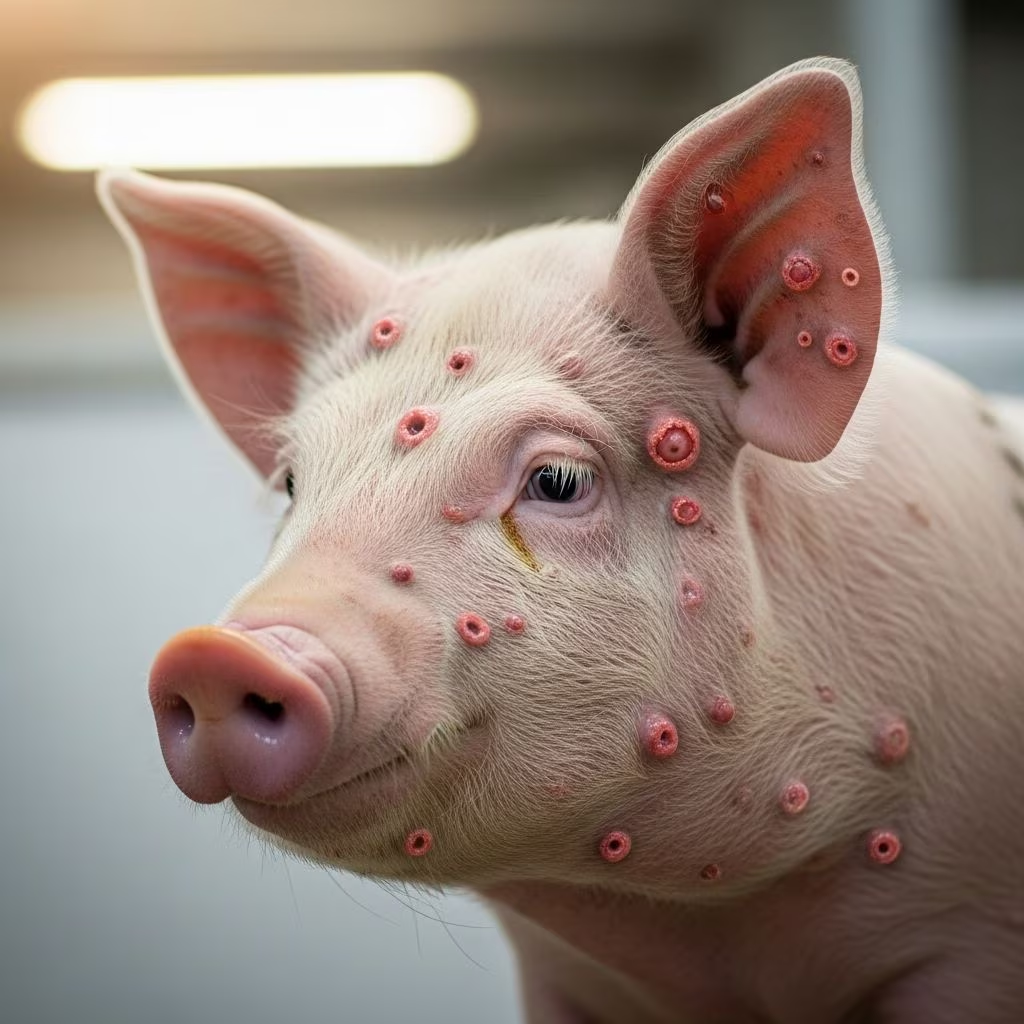
Swinepox represents a widespread viral infection exclusive to pigs, manifesting as skin abnormalities that range from mild irritation to more pronounced outbreaks, particularly in younger animals. Caused by the swinepox virus (SwPV), a member of the Poxviridae family, this condition typically resolves without severe consequences but can lead to secondary issues if not monitored. Understanding its dynamics is crucial for swine producers to maintain herd productivity and welfare.
The Nature of Swinepox Virus
SwPV is a large DNA virus classified within the Suipoxvirus genus, demonstrating high host specificity for porcine species. Unlike broader poxviruses, it does not infect other mammals or birds effectively, limiting its zoonotic potential. The virus exhibits notable environmental resilience, enduring temperatures up to 37°C for about 10 days and resisting drying for extended periods in scabs or exudates. Laboratory cultivation occurs successfully in porcine kidney cell cultures, producing characteristic cytopathic effects and intracytoplasmic inclusions, but it fails in embryonated eggs.
Genetically stable, SwPV encodes proteins that modulate host immune responses, aiding its replication in epidermal cells. Peak viral activity in cell cultures happens around 24-48 hours post-infection, with visible effects by day four. This stability has sparked interest in its use as a vector for swine vaccines, though no commercial products exist yet due to the disease’s low economic impact.
Epidemiology and Global Distribution
Swinepox occurs worldwide in both domestic herds and wild boar populations, often linked to suboptimal hygiene conditions. Piglets under four months are most susceptible, showing pronounced symptoms, while adults experience subclinical or mild cases. Congenital transmissions from viremic sows to fetuses represent the gravest form, frequently fatal for neonates.
Outbreaks correlate with warm seasons when insect vectors thrive, amplifying spread in extensive or poorly managed systems. Reports from diverse regions, including Europe and North America, confirm its sporadic nature, with higher incidence in unvaccinated or stressed populations.
Routes of Transmission
- Arthropod Vectors: Primary spread occurs mechanically via the hog louse (Hematopinus suis), stable flies (Stomoxys calcitrans), and black flies (Simuliidae). Insects transfer virus from lesions through bites or contact.
- Direct Contact: Pig-to-pig transmission happens via abraded skin or mucosal surfaces, especially in crowded pens.
- Vertical Transmission: Low-level viremia in pregnant sows can infect fetuses in utero, leading to disseminated lesions at birth.
- Environmental Persistence: Virus survives in scabs, bedding, and fomites, facilitating indirect spread in contaminated facilities.
Clinical Manifestations in Affected Pigs
The incubation period spans 3-14 days, averaging 3-6 days. Initial signs include mild fever (up to 40°C), reduced appetite, and lethargy. Skin changes begin as erythematous macules on the abdomen, inner thighs, ears, and occasionally the face or snout, progressing through distinct stages.
| Stage | Description | Duration |
|---|---|---|
| Macule | Red, flat spots (1 cm diameter) | Initial 1-2 days |
| Papule | Raised, firm elevations | Day 2-4 |
| Vesicle | Fluid-filled blisters | Day 4-6 |
| Pustule | Pus-filled with inflamed halo | Day 6-8 |
| Crust/Scab | Dark, umbilicated scabs (1-2 cm) | 1-3 weeks, then slough |
Lesions appear in crops, creating a speckled look. Facial vesicles may rupture, causing conjunctivitis or secondary wetting. Adults rarely show systemic signs beyond regional lymphadenitis. Congenital cases feature widespread eruptions on extremities and mouth, impairing nursing and mobility, often culminating in death.
Pathological Changes and Histology
Postmortem exams reveal ballooning degeneration in keratinocytes of the stratum spinosum, with pathognomonic eosinophilic intracytoplasmic inclusions showing central clearing. Intercellular edema leads to vesicle formation, followed by pustule development from inflammatory influx. Necrosis affects lesion centers, and mild lymph node changes may occur. Oral and esophageal epithelia can harbor inclusions in severe instances, though systemic involvement remains rare.
Experimental scarification in gnotobiotic piglets confirms progression: vesicles by day 6, pustules by day 8, resolution by day 21. Secondary bacterial invasions exacerbate dermatitis, prolonging healing.
Laboratory Diagnosis
Diagnosis combines clinical observation with confirmatory tests:
- Viral Culture: Growth in porcine cells yields CPE and inclusions.
- Electron Microscopy: Identifies poxvirus morphology.
- PCR and Sequencing: Detects SwPV DNA, differentiates from vaccinia.
- Histopathology: Inclusion bodies in biopsies are diagnostic.
- Immunofluorescence: Targets viral antigens in lesions.
Differential diagnoses include bacterial dermatitis, ringworm, and other pox-like conditions; early sampling clarifies etiology.
Differential Diagnosis Table
| Condition | Key Features | Distinguishing Test |
|---|---|---|
| Bacterial Dermatitis | Purulent, no inclusions | Culture for bacteria |
| Ringworm | Circular alopecia, fungal | KOH prep, fungal culture |
| Vaccinia (Rare) | Similar lesions, cross-protection absent | PCR genotyping |
| Erysipelas | Rhomboid lesions, systemic | Serology/blood culture |
Management and Treatment Approaches
Treatment focuses on supportive care and complication prevention, as no antivirals target SwPV specifically. Isolate affected pigs, apply topical antiseptics to lesions, and administer antibiotics for secondary infections. Anti-inflammatory drugs alleviate discomfort. Most cases heal without scarring in 2-4 weeks.
Prevention and Control Strategies
Proactive measures emphasize biosecurity:
- Parasite Control: Routine insecticide treatments for lice and flies.
- Hygiene: Frequent cleaning, disinfection of pens and equipment.
- Stocking Density: Avoid overcrowding to minimize contact.
- Monitoring: Quarantine new introductions, screen for insects.
- Vaccination: None commercially available; research explores recombinant uses.
In outbreak scenarios, separate age groups, as piglets drive morbidity. Wild boar contact in free-range systems heightens risk.
Immune Response and Future Research
Cell-mediated immunity drives clearance, evidenced by pustule formation via chemotaxis. No herd immunity threshold established due to vector role. Gaps include congenital pathogenesis, viremia mechanisms, and vector efficacy. Recent studies on wild strains highlight genetic uniformity, supporting vector control primacy.
Frequently Asked Questions (FAQs)
What is the most common age for swinepox outbreaks?
Piglets up to four months old are primarily affected, with milder cases in adults.
Can humans catch swinepox from pigs?
No, SwPV is host-restricted to pigs with no zoonotic reports.
How long do swinepox lesions take to heal?
Typically 1-3 weeks per crop, full resolution in 2-4 weeks without complications.
Is there a vaccine for swinepox?
No licensed vaccines exist due to low mortality, but research continues.
What insects spread swinepox?
Hog lice, stable flies, and black flies are key mechanical vectors.
Key Takeaways for Swine Producers
- Prioritize insect control and sanitation to curb transmission.
- Monitor young pigs closely for early intervention.
- Leverage diagnostic tools for accurate differentiation.
- Focus on supportive care; uncomplicated cases rarely fatal.
References
- Swinepox Virus Factsheet — Center for Food Security and Public Health, Iowa State University. 2023. https://www.cfsph.iastate.edu/pdf/shic-factsheet-swinepox-virus
- Swinepox – Integumentary System — Merck Veterinary Manual. 2024. https://www.merckvetmanual.com/integumentary-system/pox-diseases/swinepox
- Swinepox – Integumentary System — MSD Veterinary Manual. 2024. https://www.msdvetmanual.com/integumentary-system/pox-diseases/swinepox
- Swinepox Virus Strains Isolated from Domestic Pigs and Wild Boar — PMC (NCBI). 2021-10-20. https://pmc.ncbi.nlm.nih.gov/articles/PMC8538704/
- Swinepox — USDA Agricultural Research Service. 2019. https://www.ars.usda.gov/research/publications/publication/?seqNo115=184770



