

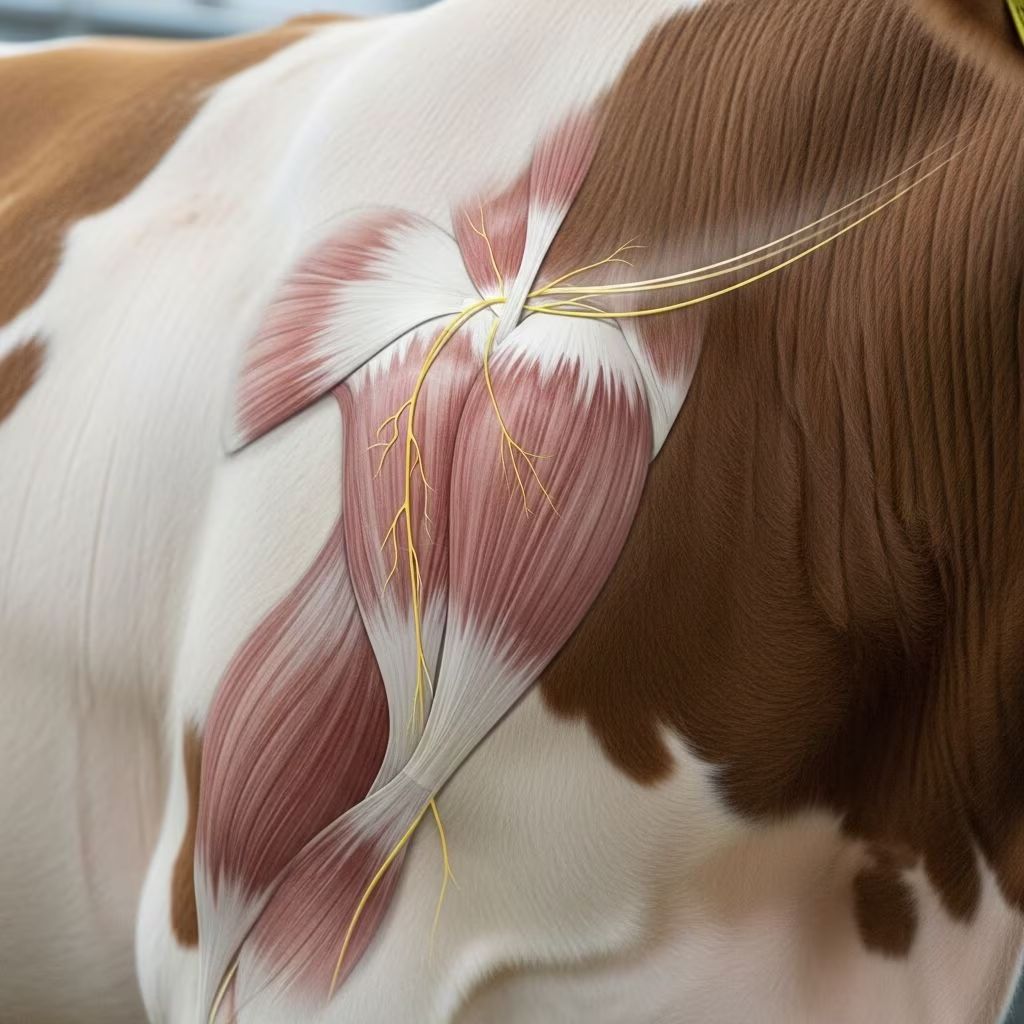
The suprascapular nerve plays a critical role in shoulder stability for cattle, innervating key muscles that support weight-bearing and movement. Injury to this nerve, often from physical trauma, leads to significant lameness and potential long-term disability in affected animals. This condition, while not the most common cause of bovine lameness, demands prompt recognition to mitigate welfare issues and economic impacts on livestock operations.
Anatomy and Function of the Suprascapular Nerve
Originating from the brachial plexus at spinal segments C6 and C7, the suprascapular nerve provides motor supply to the supraspinatus and infraspinatus muscles. These muscles are essential for extending the shoulder joint and stabilizing the scapula during locomotion. In cattle, robust shoulder function is vital for grazing, walking, and handling in farm environments.
- Supraspinatus muscle: Supports forward limb movement and shock absorption.
- Infraspinatus muscle: Aids in lateral stability and rotation of the humerus.
Damage disrupts these functions, causing instability and altered gait patterns unique to forelimb neuropathy.
Primary Causes of Injury
Trauma to the prescapular region is the leading trigger, frequently occurring when cattle struggle against restraints like head gates during routine procedures such as dehorning or examination. Acute forces compress or stretch the nerve, initiating immediate neurological deficits.
| Cause | Description | Common Scenarios |
|---|---|---|
| Direct Trauma | Blunt force or compression | Head gate resistance, falls |
| Inflammatory | Focal meningitis or abscess | Infections near vertebrae |
| Compressive | Nerve entrapment | Fractures, tumors (rare) |
Rarely, vertebral issues like abscesses or fractures contribute, detectable via imaging. Unlike calving-related hindlimb neuropathies, suprascapular issues predominantly affect forelimbs.
Recognizing Clinical Signs
Initial symptoms manifest as nonspecific ataxia right after injury, with the animal showing poor coordination and reluctance to bear weight on the affected forelimb. Within days, neurogenic atrophy becomes evident in the supraspinatus and infraspinatus, creating a visible ‘winging’ of the scapula.
- Acute phase: Ataxia, limb dragging, shoulder drop.
- Subacute phase: Muscle wasting, lateral shoulder rotation.
- Chronic phase: Persistent paresis, hoof scuffing.
In severe cases, complete plegia occurs, though partial recovery is more typical if inflammation resolves. Differentiate from radial nerve paralysis, which affects elbow extension more profoundly.
Diagnostic Approaches
Veterinary assessment begins with history-taking, focusing on recent handling events. Physical exams reveal atrophy and gait abnormalities, confirmed by palpation of wasted muscles.
- Neurological evaluation for sensory deficits.
- Radiography to rule out fractures or abscesses.
- Electromyography (advanced) for nerve conduction.
Atrophy specificity to supraspinatus/infraspinatus strongly implicates suprascapular involvement. Exclude systemic lameness causes like joint trauma.
Treatment Strategies
Address underlying trauma first; for isolated nerve injury, anti-inflammatory therapy like corticosteroids reduces swelling and promotes regeneration. Supportive care includes stall rest and slinging to prevent further damage.
- Medical: Dexamethasone or flunixin meglumine.
- Supportive: Anti-inflammatories, physiotherapy.
- Surgical (rare): Decompression in compressive cases.
Prognosis varies: mild cases recover in weeks, while severe atrophy signals permanency.
Prevention in Farm Settings
Minimize risks by padding head gates, training handlers for gentle restraint, and monitoring high-risk animals. Regular facility checks prevent slips on slick surfaces, indirectly reducing nerve strains.
Implementing these reduces incidence, as 90% of lameness ties to preventable musculoskeletal issues.
Prognosis and Long-Term Management
Early intervention yields 70-80% functional recovery in non-atrophied cases. Chronic cases may require culling to avoid welfare concerns and productivity losses. Monitor for secondary infections in recumbent animals.
Related Nerve Injuries in Cattle
Suprascapular damage parallels other bovine neuropathies:
| Nerve | Affected Limb | Key Signs | Common Cause |
|---|---|---|---|
| Obturator | Hind | Adductor paresis | Calving traction |
| Peroneal | Hind | Hock flexion | Recumbency |
| Radial (calf) | Fore | Dropped elbow | Excessive pull |
Hindlimb issues from calving contrast forelimb trauma.
FAQs
What causes suprascapular nerve injury in cattle?
Primarily trauma from head gates or falls compressing the nerve in the shoulder region.
How quickly does muscle atrophy appear?
Within several days post-injury, signaling potential permanency.
Is surgical treatment common?
Rare; medical anti-inflammatories are first-line.
Can affected cattle fully recover?
Yes, if treated early before atrophy sets in.
How to differentiate from other lameness?
Specific shoulder muscle wasting and ataxia distinguish it.
References
- Suprascapular Nerve Injury in Cattle — Merck Veterinary Manual. 2025. https://www.merckvetmanual.com/musculoskeletal-system/lameness-in-cattle/suprascapular-nerve-injury-in-cattle
- Calving Part 3 – Nerve Damage — NADIS. Accessed 2026. https://www.nadis.org.uk/disease-a-z/cattle/calving-module/calving-part-3-nerve-damage/
- Limb Paralysis in Animals — MSD Veterinary Manual. 2025. https://www.msdvetmanual.com/nervous-system/limb-paralysis/limb-paralysis-in-animals
- Lameness in Cattle: Causes Associated With Injury — SDSU Extension. Accessed 2026. https://extension.sdstate.edu/lameness-cattle-causes-associated-injury
- Suprascapular nerve decompression for treatment of neuropathy — Mississippi State University College of Veterinary Medicine. 2017-11-17. https://www.vetmed.msstate.edu/sites/www.vetmed.msstate.edu/files/presentations/111717_2.PDF



