
Strange Worms: 7 Bizarre Species That Defy Nature
Discover the bizarre adaptations, habitats, and survival strategies of the planet's most unusual worm species, from ocean depths to hidden soils.
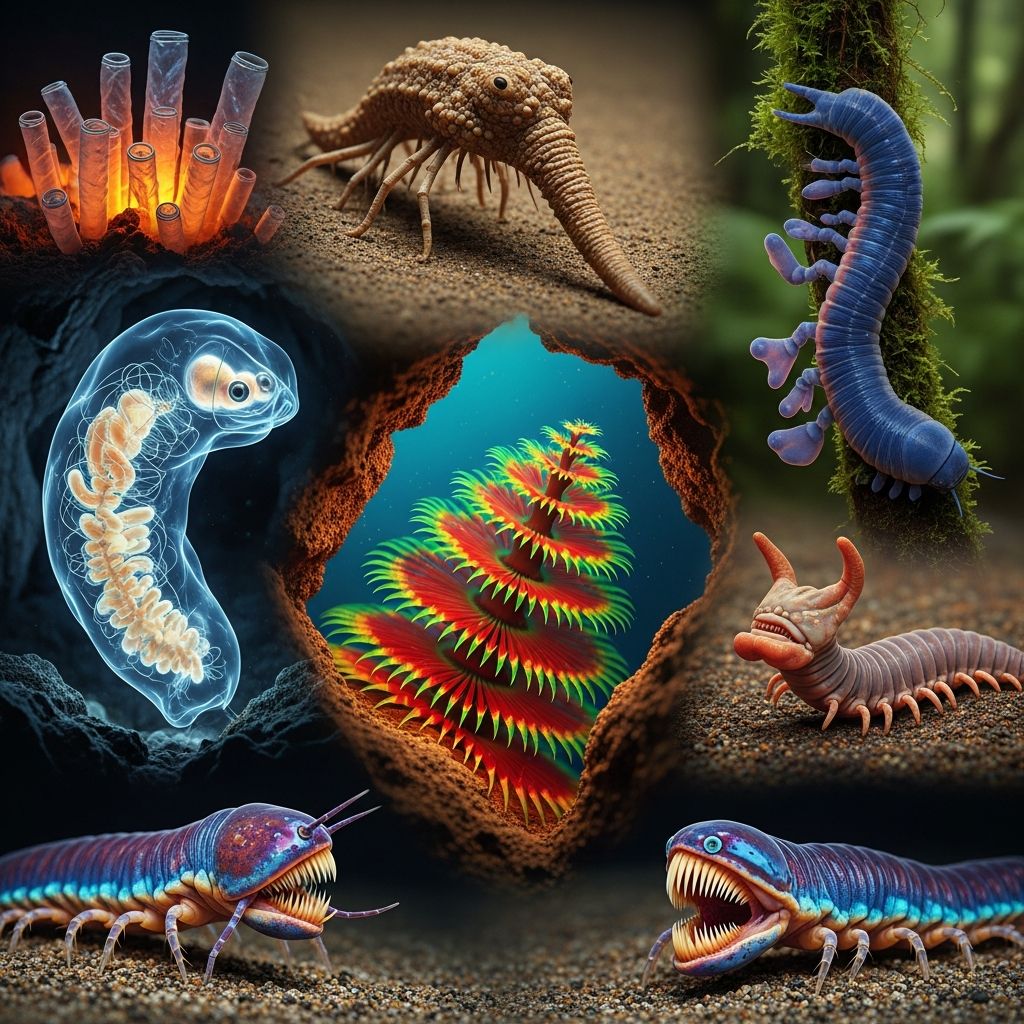
Worms represent some of nature’s most intriguing and often overlooked creatures. Far from the simple garden dwellers we imagine, many species exhibit astonishing adaptations that enable them to thrive in extreme environments, from the crushing pressures of ocean trenches to the humid underbelly of rainforests. These elongated invertebrates challenge conventional notions of animal behavior, reproduction, and survival, boasting features like bioluminescent lures, root-like nutrient extractors, and proboscises longer than a blue whale. This article delves into a selection of these peculiar annelids, flatworms, and related phyla, highlighting their biology, ecology, and the scientific discoveries that unveiled them.
Deep-Sea Marvels: Polychaete Wonders
In the vast, lightless expanses of the ocean’s midwater zone, polychaete worms dominate as one of the most diverse and bizarre groups. With approximately 8,000 described species, these segmented animals feature paddle-like parapodia on each body segment, aiding propulsion through water, and chaetae—bristled structures—for defense, locomotion, or swimming. Unlike their seafloor relatives that burrow in mud or colonize hydrothermal vents, midwater polychaetes like those in the genera Flota and Swima undulate gracefully while beating their appendages to navigate the open water column.
These worms face constant predation with nowhere to hide, prompting evolutionary innovations such as sharp protective spines and photophores—glowing organs that emit light to startle or distract predators. Another standout is the mucus-net builder, resembling a drifting web-spinner at around 1,000 meters depth. Scientists at the Monterey Bay Aquarium Research Institute identified Chaetopterus pugaporcinus, a species so morphologically unique that genetic analysis was required for classification. Its posterior end, dubbed ‘rump of a pig’ in Latin, balloons distinctively.
Similarly, Poeobius deploys a transparent mucus net to capture drifting particles, its segment-less body blending seamlessly into the water. Predatory tomopterids, with their see-through forms, ambush prey and unleash brilliant yellow bioluminescence for evasion. These adaptations underscore the polychaetes’ dominance in pelagic ecosystems, where constant motion and deception are keys to survival.
Bone-Devouring Specialists: Osedax’s Macabre Feast
At abyssal depths exceeding 9,400 feet, explorers in 2002 stumbled upon whale falls—sunken carcasses fostering unique ecosystems. Dominating these sites were vibrant red-plumed worms of the genus Osedax, now numbering over a dozen species. Females anchor via root-like plumes that penetrate bone, absorbing lipids and nutrients without a mouth or gut. This symbiotic relationship with bone-digesting bacteria allows them to thrive on organic-rich skeletons long after flesh decomposes.
Males, microscopic and stunted, dwell as perpetual larvae inside females, providing sperm in a parasitic dwarf state. This dimorphism ensures reproduction in nutrient-scarce depths. Osedax’s discovery revolutionized understanding of deep-sea scavenging, revealing how these worms recycle massive vertebrate remains into biomass for other organisms.
Gigantic Land Dwellers: Earth’s Colossal Burrowers
On land, some worms attain sizes rivaling snakes. Australia’s Giant Gippsland earthworm (Megascolides australis) stretches over 9 feet, producing eerie underground gurgling sounds as it tunnels through clay-rich soils. Similarly, Terriswalkeris terraereginae gleams Prussian blue and reaches 2 meters, a standout even in Australia’s odd fauna.
In North America, the Palouse earthworm (Driloleirus americanus) burrows 15 feet deep in Washington’s Palouse region, growing to 3 feet. Thought extinct since the 1980s after its 1897 description, rare sightings confirm its persistence amid habitat loss. These megafaunal annelids aerate soil, process organic matter, and signal ecosystem health, though their fragility demands conservation.
| Species | Max Length | Habitat | Notable Trait |
|---|---|---|---|
| Megascolides australis | 9+ feet | Australia | Gurgling movement sounds |
| Terriswalkeris terraereginae | 2 meters | Australia | Prussian blue color |
| Driloleirus americanus | 3 feet | USA (Palouse) | Deep burrowing, rare |
Minimalist Extremes: Organless Enigmas
Xenoturbella bocki epitomizes simplicity among worms, lacking a mouth, gut, brain, or organs. This flatworm-shaped primitive bilaterian relies on a statocyst for orientation, its body absorbing nutrients osmotically. Initial DNA links to mollusks puzzled researchers, later attributed to dietary contamination sans ingestion apparatus. Its existence probes the roots of animal evolution, bridging simple and complex body plans.
Proboscis Predators: Ribbon Worms’ Deadly Reach
Nemerteans, or ribbon worms, claim the title of longest animals, with ocean species surpassing blue whales in length. They deploy an eversible proboscis—a venomous, spaghetti-like tube—that ensnares prey like fish or crustaceans. Baseodiscus species, documented from Saudi Arabia to Guam, showcase colorful bands and formidable hunting prowess. With 1,400 species, their predatory efficiency stems from hydrostatic extension, wrapping victims in toxic coils.
Sticky Hunters: Velvet Worms’ Nocturnal Ambush
Onychophorans, known as velvet worms, resemble velvety caterpillars with 14-43 pairs of clawed legs. Their papillae-covered skin repels water and senses via tiny hairs, ideal for humid microhabitats like leaf litter. Nocturnal and photonegative, they breathe through tracheae and propel via hydraulic leg action. Hunting involves jetting sticky mucus from oral glands to immobilize arthropods, followed by external digestion. As ‘living fossils’ linking arthropods and annelids, velvet worms offer evolutionary insights.
Invasive and Parasitic Oddities
Hammerhead worms (Bipalium spp.) invade gardens worldwide, growing to a foot with shovel heads. These flatworm predators devour earthworms and slugs, injecting toxins and consuming via pharynx. Leucochloridium paradoxum, the zombie snail parasite, invades gastropod eyestalks, pulsating broodsacs to mimic caterpillars, luring birds for transmission. Horsehair worms (Nematomorpha) hijack insect hosts’ behavior, compelling water-seeking for aquatic emergence.
Ecological Roles and Conservation Challenges
These strange worms underpin ecosystems: polychaetes cycle nutrients, Osedax decompose megafauna, earthworms enrich soils, and predators control populations. Yet threats loom—habitat destruction endangers Palouse worms, overcollection impacts velvet worms, invasives disrupt natives. Protecting these underappreciated species preserves biodiversity’s hidden architects.
Frequently Asked Questions (FAQs)
- What is the longest worm species? Ribbon worms (Nemertea) can exceed blue whale lengths in oceanic varieties.
- How do bone-eating worms feed without mouths? Osedax uses root plumes hosting bacteria to extract bone nutrients.
- Are giant earthworms dangerous? No, species like Megascolides australis are harmless soil engineers.
- Why do velvet worms shoot slime? To ensnare prey with sticky mucus jets from head glands.
- Can parasitic worms control hosts? Yes, like Leucochloridium making snails bird bait.
References
- Weird and wonderful deep-sea worms — MBARI (Monterey Bay Aquarium Research Institute). 2015-07-01. https://www.youtube.com/watch?v=cdr1kWmSiiE
- 6 Really Weird Worms — Mental Floss. N/A. https://www.mentalfloss.com/article/20833/6-really-weird-worms
- 6 terrifying, spine-chilling worms — Discover Wildlife. N/A. https://www.discoverwildlife.com/animal-facts/insects-invertebrates/terrifying-worms
- Velvet worm — The Australian Museum (.edu.au equivalent credibility). N/A. https://australian.museum/learn/animals/worms/velvet-worm/
- Ribbon Worms – Rare, Beautiful & Fascinating — Florida Museum (.edu). N/A. https://www.floridamuseum.ufl.edu/100-years/object/ribbon-worms/
Similar Articles








Read full bio of Sneha Tete


