

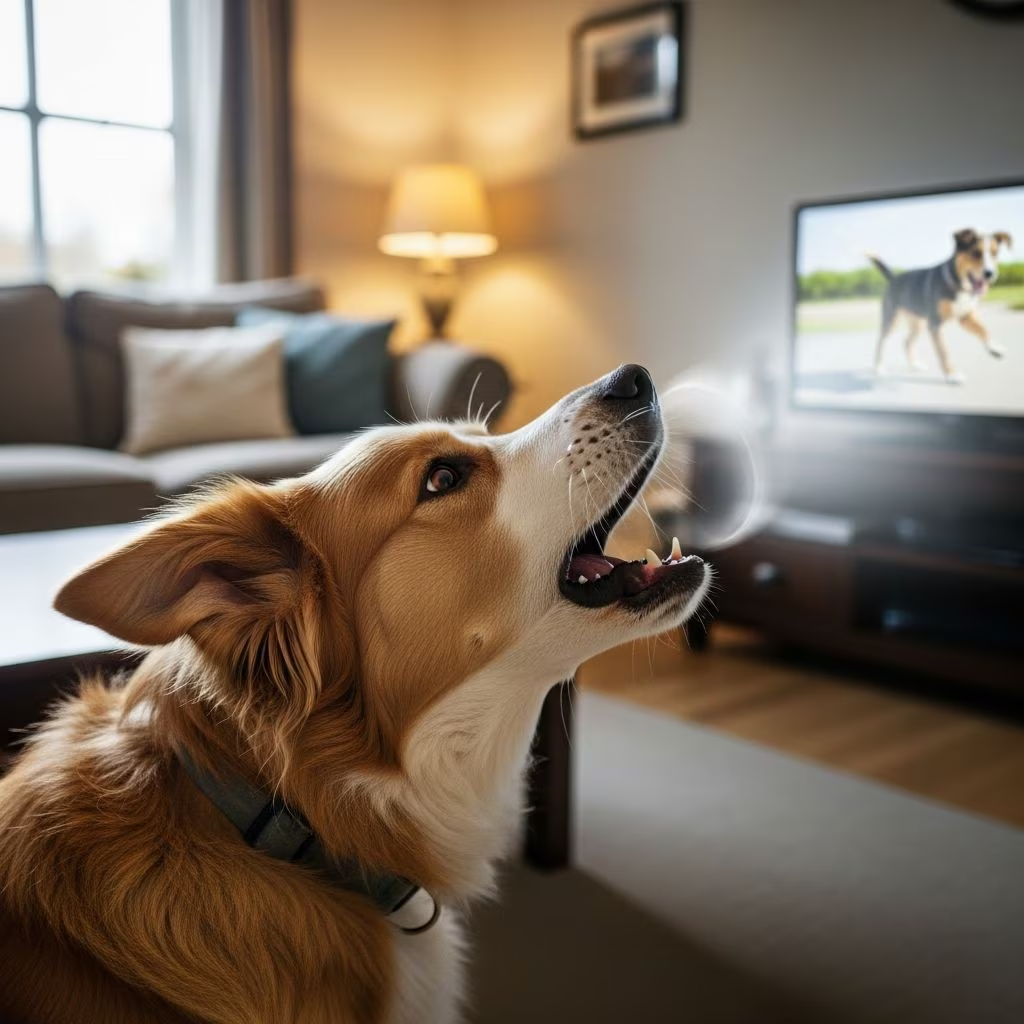
Sharing a movie night with your dog can be cozy and fun—until your pup starts barking at every animal, person, or sudden sound on the screen. Persistent barking at the TV is stressful, disruptive, and can be a sign that your dog is overwhelmed, confused, or anxious. The good news: with patience and a clear plan, you can significantly reduce TV-related barking and help your dog feel calmer and safer at home.
Why Do Dogs Bark at the TV?
To change your dog’s behavior, you first need to understand what’s driving it. Dogs rarely bark “for no reason”—their vocalizations are usually a response to something they see, hear, or feel. Modern TVs present fast-moving images, bright lights, and complex soundscapes that many dogs find confusing or overstimulating.
Excitement or Overstimulation
Dogs perceive visual and sound information differently than humans. They have a higher flicker fusion frequency, which means they are more likely to see a rapid series of images rather than the smooth motion we perceive. Loud, high-pitched noises or animal vocalizations can also trigger instinctive reactions like alerting, chasing, or guarding. For some dogs, TV time becomes an intense, exciting event that easily tips into barking.
- Fast motion on screen can resemble prey or sudden movement outdoors.
- High-pitched or sudden sounds (sirens, barking, squeals) may trigger an alert response.
- Quick scene changes and bright flashes can feel chaotic and unpredictable.
In these cases, barking is often a mix of excitement, confusion, and instinctive reaction to movement and sound.
Territorial Behavior
Many dogs bark to protect their home and family. When they see or hear other dogs, people, or knocking sounds on the TV, they may interpret them as intruders, even if there’s no associated smell or real presence. Just like some dogs bark from the car when they see strangers outside, they may react to TV images as if those figures are right in their space.
- Dogs who already bark at people or dogs they see through windows are more likely to bark at similar images on TV.
- Low growls or stiff body language in front of the TV can indicate a guarding or territorial response.
Confusion and Perceived Threats
Some dogs simply cannot make sense of the TV. They see or hear something that resembles a real-life trigger but lack the additional context (such as smell or distance cues) to understand that it isn’t truly present. That mismatch can feel threatening and create confusion.
- A dog fearful of men may bark at male figures on the screen, especially if they move toward the camera.
- Dogs sensitive to loud voices or arguments may react to shouting in movies as if it is happening in the room.
In these situations, barking is your dog’s attempt to keep themselves safe or to alert you to a potential danger they don’t fully understand.
Attention-Seeking Barking
Sometimes barking starts with confusion or excitement, but quickly turns into a reliable way to get your attention. If every time your dog barks at the TV you look at them, talk to them, or even scold them, they may learn that barking reliably gets a response.
- Dogs who look back and forth between you and the TV may be checking whether their barking is “working.”
- If barking stops the moment you engage (even to say “quiet”), attention-seeking is likely part of the pattern.
In this case, any attention—positive or negative—can reinforce the barking.
Learned Associations
Dogs quickly form associations between experiences and cues in their environment. A dog who routinely barks at other dogs outside may begin barking at dogs on TV because the images and sounds feel similar to their real-life triggers.
- Repeated pairing of certain sounds (doorbells, barking, footsteps) with excitement or fear can prime a dog to respond whenever those sounds occur, even through speakers.
- Over time, the TV itself can become a cue for arousal or anxiety if barking is allowed to continue unchecked.
| Possible Cause | Typical Signs |
|---|---|
| Excitement / overstimulation | Play bows, wagging tail, jumping at screen, fast repetitive barks |
| Territorial response | Stiff posture, deep barks, blocking front of TV, hackles raised |
| Fear / confusion | Tucked tail, pacing away and back, whining, barking then retreating |
| Attention-seeking | Barking while looking at you, stopping when you respond, restarting if ignored |
| Learned association | Stronger reaction to specific triggers (other dogs, doorbells, men) |
How to Stop Your Dog from Barking at the TV
Once you identify why your dog is barking, you can choose strategies that match the root cause. Behavior professionals often divide solutions into two broad categories:
- Management: Short-term changes to your dog’s environment to prevent or reduce barking.
- Training: Long-term behavior change through teaching new responses and changing emotional associations.
Management: Set Your Dog Up for Success
Management is about reducing the intensity of your dog’s triggers so that they can stay calm enough to learn. Think of it as a safety net while you work on training.
- Limit TV exposure: Shorten viewing sessions, avoid marathons, and give your dog breaks in another room if they start to get wound up.
- Adjust the environment: Lower the volume, dim the screen, or position your dog’s bed so that they face away from the TV.
- Use barriers when needed: Baby gates, exercise pens, or closing a door can temporarily block view of the TV during particularly intense shows.
- Choose calmer content: Avoid programs with frequent barking, sirens, explosions, or fast chase scenes if these set your dog off.
Training: Change Emotions and Teach New Habits
Training targets the underlying emotion and behavior. Two key science-based techniques are particularly helpful:
- Classical conditioning: Changing how your dog feels about a trigger (TV sights and sounds) by consistently pairing it with something they love (treats, play).
- Operant conditioning: Teaching your dog that calm behaviors—looking away from the TV, going to a mat, checking in with you—are the ones that earn rewards.
Step-by-Step: Calm TV Training Plan
- Start at a low intensity. Turn the TV on at a very low volume with neutral content. Position your dog at a comfortable distance where they notice the TV but are not barking.
- Reward calm glances. Each time your dog looks at the TV and then looks away or stays relaxed, quietly mark (with a word like “yes”) and offer a treat on the floor away from the screen.
- Teach an alternate behavior. Train a reliable cue such as “go to your bed” or “settle” away from TV time. Once it’s solid, use it during TV sessions and reward your dog for relaxing on their bed with chews or treats.
- Gradually increase difficulty. Very slowly raise the TV volume or choose slightly more stimulating shows, always staying below the level that triggers barking. If barking starts, you’ve raised intensity too quickly—return to an easier level.
- Stay consistent. Consistent practice in short sessions (5–10 minutes) is more effective than occasional long attempts.
Using the “Thank You” Approach for Alert Barking
For dogs who bark to alert you to something they’ve noticed—like noises from the TV that mimic real-life sounds—a structured “Thank You” approach can be effective. This method acknowledges your dog’s communication, then guides them into a calmer state.
- Your dog barks at a sound from the TV.
- You look at the TV briefly, then calmly say a consistent phrase such as “Thank you” or “Got it.”
- Turn back to your dog, use a calm cue such as “all done” or “settle,” and reward them when they stop barking or move back to their bed.
This approach works by confirming that you’ve “received the message,” which allows many dogs to relax because their job is done. It is most appropriate for alert-style barking, not for barking rooted in severe fear or aggression.
What Not to Do
- Do not yell or punish. Shouting often sounds like you are joining in the barking and can increase arousal or fear.
- Avoid harsh tools. Devices that cause pain or fear (shock collars, spray collars) can worsen anxiety and create new behavior problems.
- Do not force your dog to confront triggers. Holding them in front of the TV or preventing them from moving away can heighten stress and damage trust.
Is Barking at the TV a Sign of a Deeper Issue?
Occasional excited woofs at a favorite animal show may be harmless. However, intense, frequent, or escalating barking at the TV can point to underlying issues that deserve attention.
Anxiety or Fear
If your dog already has fear around certain people, animals, or sounds, similar images and sounds on the TV can trigger the same emotional response.
- Watch for additional signs like trembling, panting when not hot, pacing, or hiding.
- Dogs with generalized anxiety may react to many unrelated TV cues, not just one type of trigger.
Research shows that chronic anxiety in dogs is associated with increased stress hormones and can negatively affect welfare if not addressed.
Health-Related Issues
In some cases, barking at the TV may be aggravated by medical factors. Hearing changes, cognitive decline in older dogs, or pain can lower a dog’s tolerance for stimulation and make them more reactive.
- Sudden changes in barking behavior, especially in senior dogs, warrant a veterinary check-up.
- Cognitive dysfunction (canine dementia) can cause disorientation and altered responses to sights and sounds, including the TV.
Behavioral Disorders
When barking is frequent, intense, and difficult to interrupt, it may be part of a broader behavior problem such as compulsive behaviors, severe noise sensitivity, or entrenched demand barking.
- Dogs who bark excessively at many triggers (doorbells, outside noises, TV, visitors) may need a comprehensive behavior plan.
- Early intervention with a certified behavior professional reduces the risk of worsening patterns.
Supporting Your Dog’s Overall Wellbeing
While overall lifestyle changes cannot replace behavior-specific training, they do make it easier for your dog to cope with TV triggers. A well-exercised, mentally stimulated dog with predictable routines is less likely to be constantly “on edge.”
Establish a Predictable Evening Routine
If you usually watch TV at a set time, you can turn that into a cue for calm relaxation.
- Give your dog a chew, stuffed food toy, or snuffle mat right before you start the TV.
- Lead them to a cozy bed or mat away from the screen and reward them for settling.
- Repeat this pattern consistently so that “TV time” predicts rest, not excitement.
Enrichment and Exercise
Daily physical exercise and mental enrichment help reduce excess energy and stress, which can fuel reactivity and barking.
- Physical exercise: Walks, play sessions, or appropriate off-leash time for your dog’s age and health.
- Mental enrichment: Training games, scent work, puzzle feeders, and problem-solving toys.
Studies show that dogs given regular enrichment opportunities exhibit fewer stress-related behaviors and show improved welfare indicators.
When to Seek Professional Help
Consult your veterinarian or a credentialed behavior professional (such as a veterinary behaviorist or certified behavior consultant) if:
- The barking is extreme, escalating, or accompanied by aggression (lunging, snapping toward people or the TV).
- Your dog shows signs of significant anxiety or distress around TV time.
- There are sudden changes in behavior, especially in older dogs.
Professionals can design a tailored plan and, when necessary, collaborate with your vet on medical interventions to reduce anxiety.
Frequently Asked Questions (FAQs)
Q: Is it bad for my dog to watch TV?
A: Watching TV is not inherently harmful for most dogs, but content that is very loud, fast, or full of triggering sounds (like barking or sirens) can cause stress or overexcitement in sensitive dogs. If your dog seems agitated, it is best to limit exposure and focus on calm, low-stimulation activities instead.
Q: Will my dog grow out of barking at the TV?
A: Some dogs naturally react less over time, but many do not “grow out of it” without guidance. Because barking can be self-reinforcing and attention-getting, it often becomes a habit. Proactive management and training make it more likely that your dog will improve.
Q: Should I ignore my dog when they bark at the TV?
A: Ignoring can reduce purely attention-seeking barking, but it is not enough when fear, confusion, or territorial feelings are involved. In those cases, you need to address the underlying emotion with training and, if needed, professional support.
Q: Are some breeds more likely to bark at the TV?
A: Dogs bred for guarding or alerting, and those with naturally vigilant or noise-sensitive temperaments, may be more prone to reacting to TV sights and sounds. However, individual personality and learning history matter more than breed alone.
Q: Can background TV help with separation anxiety?
A: Background sound can sometimes mask outside noises, but TV alone does not treat separation anxiety and may even introduce new triggers if your dog reacts to what they see or hear. Evidence-based treatment for separation anxiety focuses on carefully graded absences and emotional safety, ideally under professional guidance.
References
- Understanding dog behavior problems — American Veterinary Medical Association. 2023-06-01. https://www.avma.org/resources/pet-owners/petcare/behavior-resources-dog-owners
- How dogs learn — American College of Veterinary Behaviorists. 2020-09-15. https://www.dacvb.org/page/HowDogsLearn
- Canine behavior problems: barking, howling, and whining — American Kennel Club. 2022-02-10. https://www.akc.org/expert-advice/health/dog-barking-howling-whining/
- Television exposure and behavioral responses in dogs — Dogs Trust / University of Lincoln summary. 2017-03-01. https://www.dogstrust.org.uk/news-events/blog/dogs-tv
- Behaviour problems in dogs: a review of the literature — Tiira K, Lohi H. Applied Animal Behaviour Science. 2015-01-01. https://doi.org/10.1016/j.applanim.2014.11.005



