

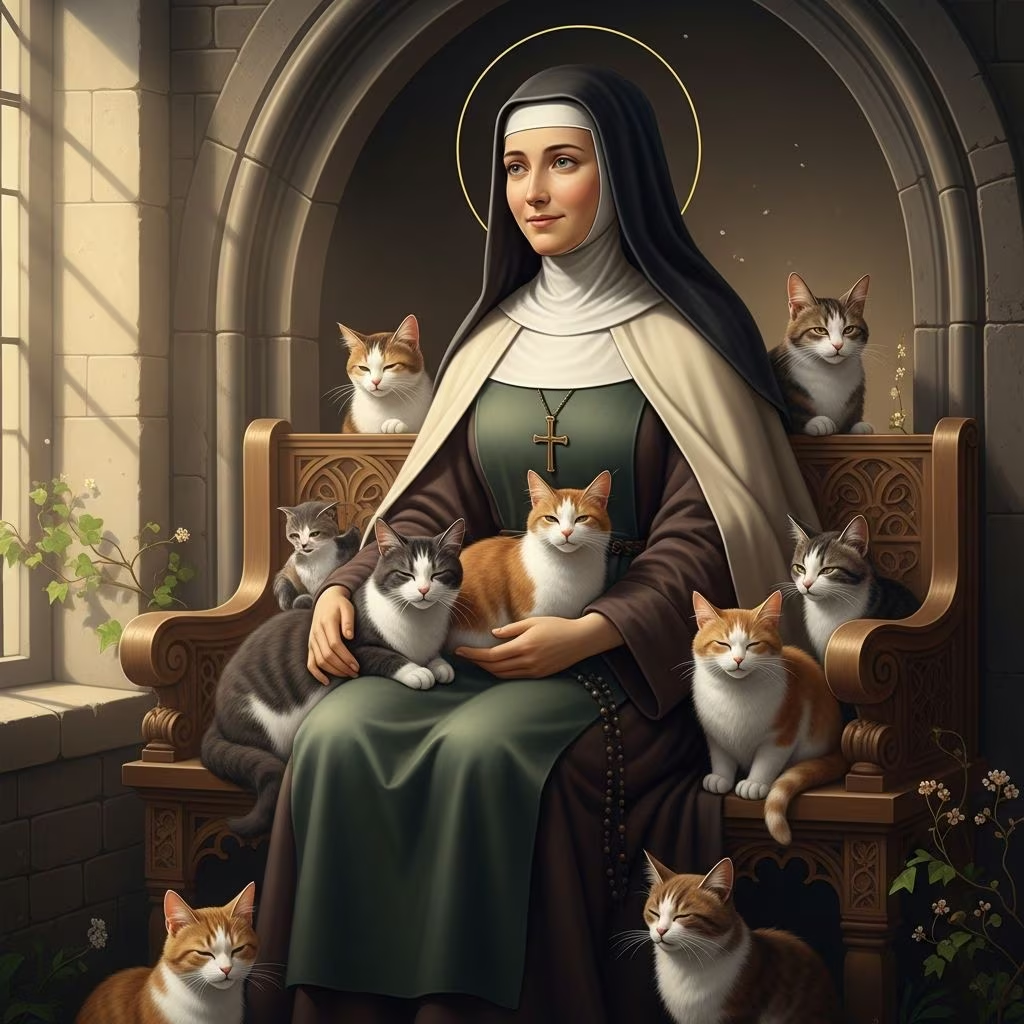
In the landscape of Catholic saints, few figures capture the imagination of modern cat enthusiasts quite like St. Gertrude of Nivelles. Known today as the patron saint of cats, this medieval nun has become an unexpected symbol of feline devotion. Yet the story of how a 7th-century religious figure became associated with cats is far more intriguing than many realize, involving medieval superstitions, theological history, and a remarkable coincidence of spiritual patronage.
The Life and Legacy of a Medieval Abbess
St. Gertrude of Nivelles was born around 628 into a noble family during a period of significant religious transformation in Europe. Living during the early medieval period, Gertrude dedicated her life to spiritual pursuits and charitable work. Her journey into religious life was shaped by the cultural and spiritual climate of 7th-century Christian Europe, where monasticism served as a beacon of learning, charity, and devotion.
Gertrude’s most significant contribution to religious life came through her administration of the Abbey of Nivelles, a monastic community that had been founded by her mother. Originally established as a convent for nuns, the monastery eventually evolved into a double monastery, housing both female religious and Irish monks who sought spiritual fellowship. This arrangement was relatively uncommon for the period and reflected Gertrude’s progressive approach to monastic life.
Rather than focusing solely on administrative bureaucracy, Gertrude delegated much of the institutional management to others, allowing her to concentrate on what she considered her true calling: direct service to the vulnerable and marginalized. She dedicated countless hours to caring for the poor, the sick, and the elderly within her community and beyond its walls. Her compassionate approach extended to building infrastructure that would benefit those in need—she established hospices, erected churches, and founded additional monasteries throughout the region.
Diverse Patronages and Spiritual Recognition
The Catholic Church recognized Gertrude’s exceptional piety and charitable work relatively quickly after her death at age 33. Churches were erected in her honor, and numerous miracles became attributed to her intercession. Beyond the feline association for which she is now famous, Gertrude holds several official patronages that reflect her life’s work and the spiritual needs of medieval communities.
The traditional patronages of St. Gertrude include:
- Travelers and Pilgrims: Recognition of her spiritual guidance for those on journeys
- Gardeners: Associated with her feast day on March 17, a date traditionally marked by favorable weather
- Widows: Her compassionate work with those in difficult circumstances
- Mental Health: Invocation for those struggling with psychological afflictions
- Protection from Rodents: Her most ancient non-feline patronage, addressing a pressing medieval concern
One of the most compelling miracles attributed to Gertrude demonstrates her spiritual power and protective reach. According to medieval chronicles, a group of monks who had been her friends embarked on a perilous ocean voyage. During their journey, they encountered both a violent storm and a terrifying sea creature simultaneously threatening their vessel. In their desperation, the monks invoked Gertrude’s name and protection. According to the account, both the storm and the monster vanished instantly, allowing the ship and its crew to survive the ordeal.
The Medieval Crisis of Rodent-Borne Disease
To understand why medieval Europeans sought Gertrude’s protection from mice and rats, one must recognize the catastrophic impact these rodents had on medieval life. The Black Death, which devastated Europe during the 14th century, arrived via ships carrying infected rats and fleas. Long before germ theory existed, communities understood that rodent infestations preceded illness and death in their populations.
St. Gertrude became an essential spiritual resource during this period of crisis. Artistic depictions from the Middle Ages consistently showed the saint surrounded by rodents, with mice and rats scurrying around her feet or climbing the ceremonial staff of her crozier. These visual representations were not meant to celebrate rodent companionship but rather to illustrate Gertrude’s power to banish these disease-carrying pests. Her intercession was believed to protect homes, grain stores, and communities from the ravages of rodent infestation.
The association became so established that by the 15th century, veneration of St. Gertrude as a protector against rodent-borne illness and vermin had spread across much of continental Europe, including southwestern Germany, the Netherlands, and Catalonia. Religious communities and secular populations alike called upon her name, seeking protection from creatures that threatened their survival.
How a Medieval Saint Became a Feline Patron
The transformation of St. Gertrude from a medieval rodent-fighter into a modern cat patron represents one of the more amusing and unexpected developments in Catholic hagiography. Despite centuries of association with rats and mice, the explicit designation of Gertrude as the patron saint of cats did not occur until remarkably recent times.
Historical documentation pinpoints the emergence of this association to the 1980s. The first recorded mention appears in a catalog published by the Metropolitan Museum of Art in New York around 1981-1982, which featured the saint in a discussion of cats in art and culture. This was not an official Church declaration but rather a curatorial observation connecting Gertrude to feline imagery.
The logic behind this modern association, while not historically documented in traditional sources, follows a straightforward line of reasoning. Those who championed Gertrude as a cat patron recognized a complementary relationship: if Gertrude provided protection against rodents, and if cats are the animals most naturally associated with rodent hunting, then it became a logical extension to view her as a protector of cats themselves. The medieval image of St. Gertrude surrounded by rodents was reinterpreted through a modern lens as evidence of her affinity for the animals that naturally preyed upon such pests.
What makes this association particularly intriguing is that it lacks the historical depth of Gertrude’s other patronages. Unlike her well-documented medieval veneration as a protector against disease-carrying rodents, the cat patronage is essentially a modern invention, born from a combination of metaphorical association and cat-lover enthusiasm. Yet this newness has not diminished the genuine affection cat devotees feel toward St. Gertrude.
Christianity’s Complex Relationship with Felines
To fully appreciate why St. Gertrude remained unassociated with cats for over 1,300 years, one must examine Christianity’s historically complicated relationship with felines. This tension provides crucial context for understanding why a cat patronage for Gertrude only emerged in modern times.
In ancient Egypt, cats held a sacred and exalted position in religious and domestic life. Egyptians domesticated cats, integrated them into their spiritual practices, and protected them legally. By the 5th century BCE, Phoenician traders had introduced these valued animals to Europe, where Greeks and Romans recognized their utility in managing vermin populations. Early Christians largely inherited this tolerant, practical view of cats, valuing them for their pest-control abilities without deep spiritual attachment.
However, the medieval period witnessed a dramatic deterioration in the Church’s attitude toward felines. Cats became entangled with medieval superstitions, particularly associations with witchcraft, paganism, and demonic forces. This prejudicial shift led to systematic abuse and killing of cats across Europe, as religious authorities conflated feline characteristics with heretical practices.
Public festivals celebrated this anti-feline sentiment in disturbing ways. In Denmark, the Fastelavn festival involved placing black cats in barrels and beating them with sticks until the terrified animal escaped, symbolically banishing evil spirits from the village. Similarly, the Kattenstoet festival in Ypres, Belgium, maintained cruel traditions targeting cats. (Modern versions of these festivals have replaced actual cats with symbolic representations or candy-filled barrels, but the medieval versions reflected genuine violence.)
Given the Church’s medieval hostility toward cats, it would have been theologically inconsistent for religious authorities to designate any saint as a feline patron during the Middle Ages. The modern rehabilitation of cats in both secular culture and religious consciousness has only occurred as prejudices have faded and understanding of animals has evolved.
Potential Historical Confusion: Gertrude and Nordic Mythology
Some scholars have suggested an alternative explanation for Gertrude’s eventual cat association: confusion with pre-Christian traditions. Frigg, a Germanic goddess from Nordic mythology, was sometimes depicted as riding a great cat or being accompanied by felines in sacred imagery. Some 20th-century folklore studies have speculated that modern associations between Gertrude and cats may partly derive from a blending of the saint with this ancient goddess figure, particularly in regions where both Germanic and Christian traditions coexisted.
This theory suggests that folk memory may have conflated different female figures—the medieval saint and the ancient goddess—into a composite protective figure. However, this remains speculation rather than documented history, as no clear evidence directly links Gertrude’s hagiography to Nordic goddess imagery in medieval sources.
Modern Devotion and Contemporary Significance
Regardless of how the association originated, St. Gertrude of Nivelles has become a beloved figure among modern cat enthusiasts. Prayer cards, religious artwork, and devotional objects featuring the saint have proliferated, particularly in contemporary markets catering to spiritually-minded pet lovers. The phenomenon represents a fascinating intersection of traditional Catholic devotion and modern pet culture.
It is important to clarify that Gertrude was never formally designated as the patron saint of cats by Church authorities. Instead, she became informally adopted by cat lovers who recognized in her patronage over rodents a metaphorical connection to feline protection. This represents a genuine grassroots development in religious practice, where laypeople created spiritual meaning through creative association.
The modern embrace of St. Gertrude as a feline patron also speaks to a broader cultural shift in how we value animals. Where medieval Christianity viewed cats with suspicion and cruelty, contemporary spirituality seeks to honor and protect them. In choosing Gertrude as their patron saint, cat lovers have essentially created a new tradition that reflects contemporary values while maintaining connection to authentic medieval history.
Frequently Asked Questions
Is St. Gertrude officially recognized as the patron saint of cats?
No, St. Gertrude has not received an official Church designation as patron of cats. The association emerged informally in the 1980s among cat enthusiasts who made the connection between her established patronage over rodents and the cats that naturally hunt them.
When was St. Gertrude of Nivelles born?
Historical records indicate Gertrude was born around 628 CE in what would become Belgium. She lived during the early medieval period of Christian Europe.
What are St. Gertrude’s official patronages?
St. Gertrude is officially recognized as the patron of travelers, gardeners, widows, those suffering from mental illness, and protection against rodent-borne diseases. Her feast day is celebrated on March 17.
Why do medieval paintings show St. Gertrude with rodents?
Medieval artistic traditions depicted saints with symbols related to their spiritual patronages. Rodents surrounding Gertrude represented her power to protect communities from rodent-borne disease, a critical concern during the medieval period.
Could St. Gertrude have been confused with a goddess?
Some scholars suggest possible confusion or blending with Frigg, a Germanic goddess sometimes depicted with cats in Norse mythology. However, this remains speculation without definitive historical evidence.
Conclusion: A Saint for Modern Times
St. Gertrude of Nivelles represents a remarkable example of how historical figures can gain new significance in contemporary culture. While she never explicitly interacted with cats or held an official feline patronage, her medieval role as a protector against rodents provided the conceptual bridge for modern cat lovers to claim her as their spiritual advocate.
The story of Gertrude also illuminates the evolution of human attitudes toward animals. Medieval Europeans feared and persecuted cats, yet sought Gertrude’s protection from the rodents that cats naturally controlled. Modern culture has reversed this perspective, celebrating cats as beloved companions and seeking spiritual protectors for them.
Whether one views St. Gertrude’s feline patronage as a charming modern invention or a creative reinterpretation of her authentic medieval legacy, her adoption by cat enthusiasts demonstrates the living nature of religious tradition. Saints continue to gain new meanings and relevance as communities find ways to connect their spiritual heritage to their contemporary values and passions.
References
- How St. Gertrude of Nivelles Became the Cat Lady of the Catholic Church — U.S. Catholic Magazine. 2020. https://uscatholic.org/articles/202003/how-st-gertrude-of-nivelles-became-the-cat-lady-of-the-catholic-church/
- Who Exactly is Gertrude of Nivelles, Better Known as The Patron Saint of Cats? — Cole and Marmalade. 2025-03-17. https://coleandmarmalade.com/2025/03/17/who-exactly-is-gertrude-of-nivelles-better-know-as-the-patron-saint-of-cats-you-may-be-surprised/
- St. Gertrude, The Patron Saint of Cats: Facts & History Explained — Catster. https://www.catster.com/lifestyle/st-gertrude-patron-saint-of-cats/
- Saint Gertrude of Nivelles: Patron Saint Of Cats — CatGenie. https://www.catgenie.com/blogs/catgazette/saint-gertrude-of-nivelles-patron-saint-of-cats
- Saint Gertrude of Nivelles Day — Aboite Animal Clinic. https://www.aboitevet.com/blog/1098557-saint-gertrude-of-nivelles-day



