

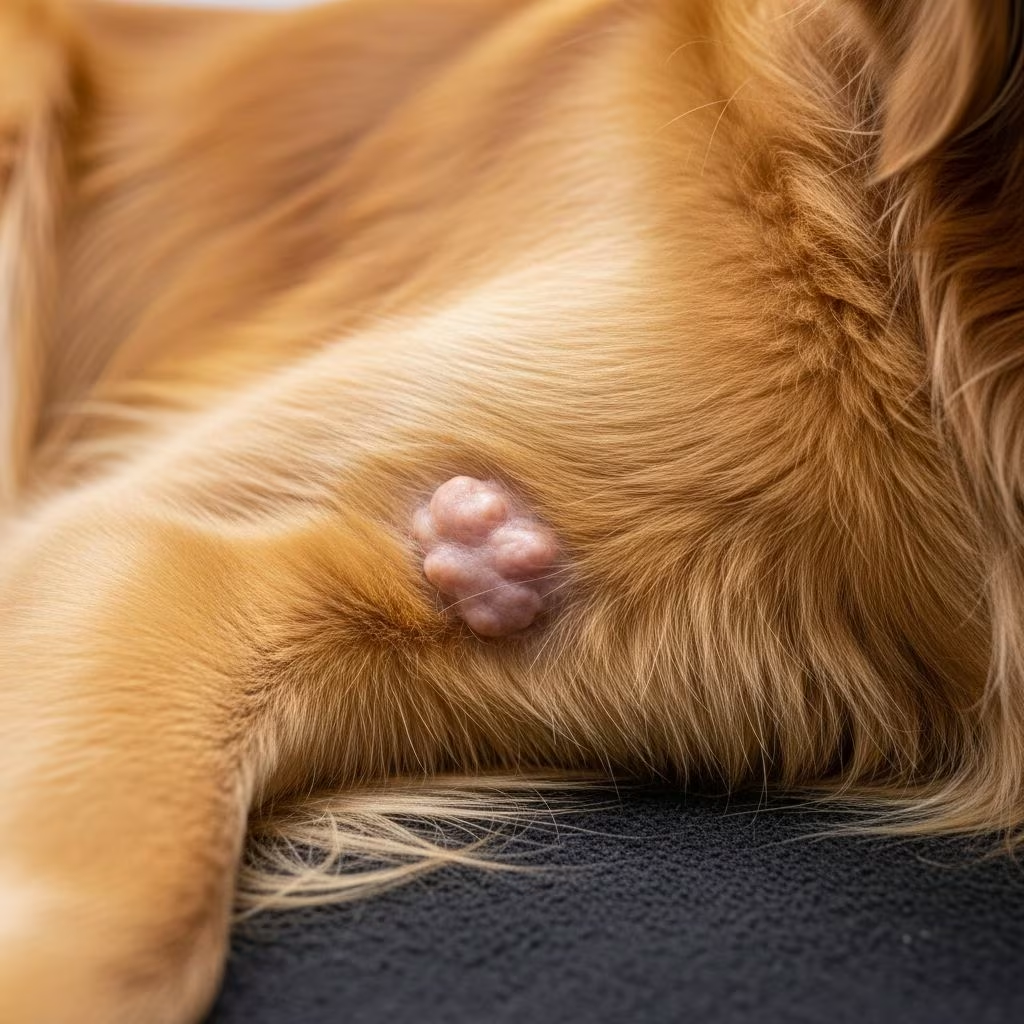
Spindle cell sarcomas represent a category of malignant tumors arising from connective tissues in dogs, often appearing as firm lumps beneath the skin. These cancers, also known as soft tissue sarcomas or fibrosarcomas, are locally invasive but metastasize infrequently, making early intervention crucial for better management.
Understanding the Nature of Spindle Cell Sarcomas
These tumors originate from fibroblasts or other mesenchymal cells, exhibiting elongated, spindle-shaped cells under microscopic examination. They comprise up to 15% of canine skin tumors and display varied appearances, from soft to firm masses fixed to underlying tissues. Unlike more aggressive cancers, spindle cell sarcomas prioritize local invasion over distant spread, with metastasis rates near zero for low-grade forms.
Key characteristics include slow initial growth followed by deeper tissue penetration, potentially involving muscle or bone. While diverse histologically, they share similar biological behaviors, distinguishing them from histiocytic or hemangiosarcomas.
Risk Factors and Common Presentations
Large breeds such as Irish Wolfhounds, Golden Retrievers, Doberman Pinschers, and Irish Setters face elevated risks, particularly in middle-aged to senior dogs averaging 10 years old. Males show higher incidence for oral or nasal variants. Emerging evidence links some cases to injection sites, akin to feline vaccine-associated sarcomas.
Masses typically manifest on the trunk, limbs, or head, feeling firm and non-painful initially. Owners may notice asymmetry or mobility restrictions as tumors enlarge. Rarely, young dogs under one year develop aggressive juvenile forms with poorer prognoses.
- Large breeds predisposed: Golden Retrievers, Dobermans, Wolfhounds
- Peak age: 10 years, but possible in puppies
- Common sites: Limbs (distal to elbow/stifle ideal for treatment), trunk, head
- Potential trigger: Injection-site inflammation
Diagnostic Approaches for Accurate Identification
Veterinarians detect these tumors during routine exams, prompting history review and symptom assessment. Imaging like X-rays or CT scans evaluates bone involvement or tumor extent.
Fine needle aspiration (FNA) collects cells but often yields inconclusive results due to poor cell shedding from the solid matrix. Biopsy—incisional for large masses or excisional for small ones—provides definitive diagnosis via histopathology, assessing grade based on cell appearance and mitotic index.
Staging involves bloodwork, urinalysis, chest radiographs, abdominal ultrasound, and lymph node evaluation to rule out spread.
| Method | Purpose | Effectiveness for STS |
|---|---|---|
| Fine Needle Aspiration | Cell collection | Often inconclusive |
| Biopsy (Incisional/Excisional) | Tissue analysis | Gold standard |
| Imaging (X-ray/CT) | Tumor extent/bone involvement | Essential for planning |
| Staging Tests | Metastasis check | Three-view chest rads key |
Grading and Its Impact on Behavior
Tumor grade—low, intermediate, or high—predicts aggressiveness. Low-grade tumors, especially on extremities distal to elbow/stifle, recur locally in only 10.8% post-marginal excision, with no metastasis. High-grade ones, marked by elevated mitotic index, risk distant spread, demanding multimodal therapy.
Histologic evaluation determines margins (clean, close, dirty) and mitotic rate, guiding treatment intensity.
Treatment Strategies: Prioritizing Local Control
Surgery remains the cornerstone, aiming for wide margins (3 cm) to excise the tumor and surrounding tissue. For accessible low-grade distal limb tumors, marginal excision suffices, yielding mean disease-free intervals over 697 days. Limb amputation may apply for proximal high-grade cases.
Radiation therapy complements incomplete resections, shrinking tumors pre-surgery or preventing regrowth post-op. Delivered in fractions, it enhances local control when surgery falls short.
Chemotherapy targets high-grade or metastatic disease, with doxorubicin-based protocols standard. Metronomic regimens—low-dose daily cyclophosphamide or chlorambucil plus NSAIDs—delay recurrence in incompletely excised cases, per small studies.
- Surgery: Wide margins primary; marginal for low-grade limbs
- Radiation: Adjuvant for clean margins or pre-op shrinkage
- Chemo: Doxorubicin for high-grade; metronomic for maintenance
Prognosis and Long-Term Management
Outcomes hinge on grade, location, and excision completeness. Low/intermediate-grade tumors with local control boast good prognoses; high-grade ones are guarded but benefit from aggressive plans. Median survival exceeds 700 days for marginally excised low-grade cases, with low recurrence.
Monitor surgically treated dogs vigilantly for regrowth at the site, as sarcomas recur locally rather than metastasize widely. Regular exams, imaging, and owner vigilance sustain quality of life.
Favorable factors: Low grade, complete excision, extremity location. Adverse: High mitotic index, incomplete margins, axial sites.
Preventive Measures and Owner Education
No proven prevention exists, but minimizing unnecessary injections and monitoring lumps promptly aids early detection. Routine veterinary check-ups for at-risk breeds facilitate intervention before invasion.
Educate owners on mass changes: rapid growth, fixation, ulceration signal urgency. Post-treatment, adhere to follow-ups to catch recurrences early.
Frequently Asked Questions (FAQs)
What is the most common location for spindle cell sarcomas in dogs?
They frequently appear on the limbs, trunk, and head, with distal extremities responding best to conservative surgery.
Can spindle cell sarcomas be cured?
While not always fully curative, wide excision achieves long-term control in low-grade cases; high-grade requires ongoing management.
Is chemotherapy effective for these tumors?
It excels against microscopic disease in high-grade tumors; metronomic protocols show promise for recurrence prevention.
How often do these tumors metastasize?
Rarely, especially low-grade (0% in some studies); high-grade pose higher risk.
What breeds are most susceptible?
Large breeds like Golden Retrievers, Dobermans, and Irish Wolfhounds.
Advanced Considerations for Veterinary Professionals
For practitioners, initial workup mandates three-view thoracic rads sans anesthesia to avoid atelectasis masking mets. Refer complex cases to oncologists for CT-guided planning or specialist surgery.
Research underscores marginal excision viability for low-grade extremity sarcomas, challenging radical approaches and preserving function. Ongoing trials explore immunotherapy and targeted therapies.
References
- Fibrosarcomas and Spindle Cell Tumors in Dogs — VCA Animal Hospitals. Accessed 2026. https://vcahospitals.com/know-your-pet/fibrosarcoma-and-spindle-cell-tumors-in-dogs
- Marginal excision of low-grade spindle cell sarcoma of the extremities in dogs — PubMed (Veterinary Surgery). 2008-11-01. https://pubmed.ncbi.nlm.nih.gov/18986313/
- Soft Tissue Sarcomas in Dogs — Cornell University College of Veterinary Medicine. Accessed 2026. https://www.vet.cornell.edu/departments-centers-and-institutes/riney-canine-health-center/canine-health-information/soft-tissue-sarcomas-dogs
- Canine Soft-Tissue Sarcomas — dvm360. Accessed 2026. https://www.dvm360.com/view/canine-soft-tissue-sarcomas
- Medical Oncology: Canine Soft Tissue Sarcoma — NC State Veterinary Hospital. Accessed 2026. https://hospital.cvm.ncsu.edu/services/small-animals/cancer-oncology/oncology/canine-soft-tissue-sarcoma/



