
Spinal Tumors In Animals: 4 Treatment Options And Prognosis
Comprehensive guide to spinal column and cord tumors in pets, covering detection, types, and care strategies for better outcomes.
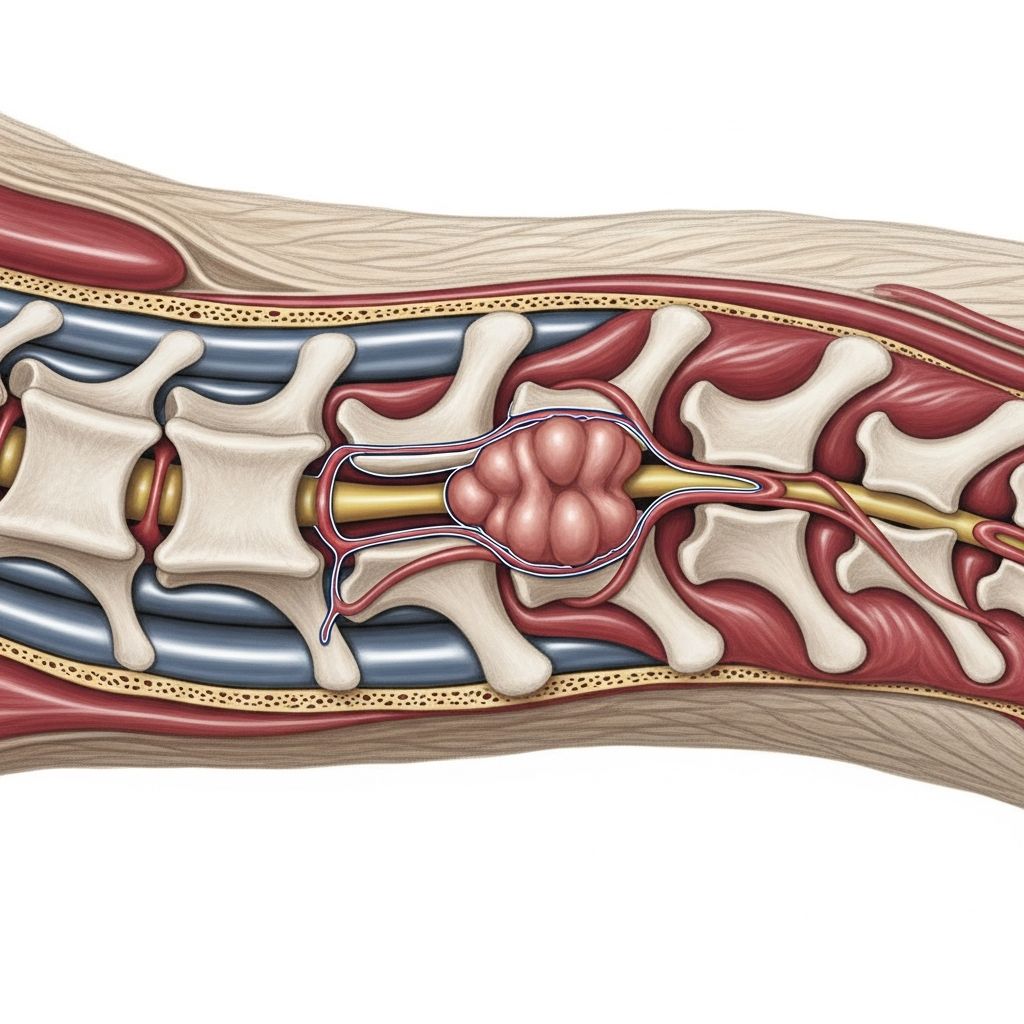
Spinal tumors represent a significant challenge in veterinary medicine, affecting the spinal column and cord in dogs and cats, leading to pain, mobility issues, and neurological deficits. These neoplasms can originate within the spinal structures or spread from elsewhere, requiring precise diagnosis for effective intervention.
Understanding the Impact of Spinal Neoplasia
Tumors in the spinal region disrupt normal nerve function, causing progressive weakness, ataxia, and pain. In dogs, large breeds over 30 kg are commonly affected, with median onset ages between 6 and 10 years. Cats also experience these issues, though less frequently documented. Early recognition is crucial as advanced imaging like MRI and CT has improved detection rates, allowing for targeted therapies that extend life quality.
The spinal cord’s vulnerability stems from its enclosure in the vertebral column, where tumors can compress or infiltrate tissues. Primary tumors arise directly from spinal elements, while secondary ones metastasize from distant sites, complicating prognosis.
Classifications of Spinal Tumors
Spinal neoplasms are categorized by location and cell type: extradural (outside the dura), intradural-extramedullary (within dura but outside cord), and intramedullary (within the cord). Each type presents unique challenges.
- Extradural tumors: Most common, often involving bone or surrounding tissues. They account for a large portion of cases in dogs and cats.
- Intradural-extramedullary: Typically meningiomas or schwannomas, more frequent in certain breeds.
- Intramedullary: Rare, comprising about 16% of spinal tumors in dogs, with primary neuroepithelial origins dominant.
By histology, tumors divide into mesenchymal (e.g., osteosarcoma, chondrosarcoma), round cell (e.g., lymphoma), epithelial (e.g., carcinomas), and neuroendocrine types. In a study of 60 dogs and 7 cats, mesenchymal tumors affected 48% of dogs, round cell 35%, and epithelial 12%; cats showed 71% round cell predominance.
Prevalent Tumor Types by Species
| Tumor Class | Dogs (%) | Cats (%) | Common Examples |
|---|---|---|---|
| Mesenchymal | 48.3 | 14 | Osteosarcoma, Fibrosarcoma, PNST |
| Round Cell | 35 | 71 | Lymphoma, Plasma Cell Tumors |
| Epithelial | 11.7 | 14 | Adenocarcinoma, Metastatic Carcinoma |
| Other | 5 | 0 | Neuroendocrine, Benign |
Data derived from MRI-confirmed cases, highlighting species differences.
Symptoms and Clinical Presentation
Owners often notice gradual or acute onset of back pain, reluctance to jump, hindlimb weakness, or urinary incontinence. Pain is a hallmark, especially with extradural lesions. Neurolocalization guides suspicion: cervical signs suggest C1-C5 involvement, while thoracolumbar issues point to T3-L3, the most affected region in dogs (36/79 regions).
Intramedullary tumors in dogs frequently localize to T3-L3 (52.8%), with primary ones more common in cervical areas of younger animals. Metastatic cases present faster, with shorter sign duration but similar survival to primaries. Cats mirror this, with L4-S3 most impacted.
- Progressive ataxia and paresis
- Palpation-induced pain
- Loss of deep pain sensation (poor prognosis indicator)
- Lateralized signs in T10-L2 lesions
Advanced Diagnostic Approaches
Diagnosis begins with history and neurology exam, followed by imaging. Survey radiographs may show vertebral lysis or sclerosis, but advanced modalities are essential.
MRI Features: Critical for differentiation. Round cell tumors show vertebral shape preservation, bone-centered lesions, homogeneous enhancement, and cortical sparing (84% predictive). Mesenchymal types exhibit shape alteration, heterogeneous enhancement, paraspinal centering, cortical lysis, and cavitary masses (73% predictive). Epithelial and mesenchymal share lysis and larger masses.
Other tools include CSF analysis (albuminocytologic dissociation possible), CT for bone detail, and biopsy for confirmation. Histopathology/cytology confirmed 83% of cases in one series: 33% necropsy, 27% cytology, 24% surgical biopsy.
Regional Distribution Insights
| Spinal Region | Dogs (Affected Regions) | Cats (Affected Regions) |
|---|---|---|
| C1-C5 | 12/79 | 1/9 |
| C6-T2 | 11/79 | 0/9 |
| T3-L3 | 36/79 | 3/9 |
| L4-S3 | 20/79 | 5/9 |
Multifocal in 17 dogs, 2 cats.
Treatment Modalities
Options range from palliative to aggressive, based on tumor type, location, and owner goals. Surgery decompresses and cytoreduces; radiation and chemotherapy target residuals.
- Surgery: Laminectomy, vertebrectomy for accessible lesions. Cats with nonlymphoid tumors improved maximally within 1 week post-cytoreduction (25/26 cases). Dogs with benign tumors achieve long-term survival (>3 years).
- Radiation: Adjunct for incomplete resections, improving survival (MST 240 days overall; 1410 for benign).
- Chemotherapy: For round cell like lymphoma; combined with surgery/radiation.
- Palliative: Corticosteroids for pain/inflammation.
Nephroblastoma-like tumors respond well to excision ± radiation. Secondary tumors (adenocarcinomas, hemangiosarcomas) demand systemic evaluation.
Prognosis and Outcomes
Prognosis varies: guarded-good for intradural-extramedullary post-resection; 56% meningioma dogs alive >6 months. Malignant MST 180 days; benign far longer. Primary intramedullary tumors in young dogs have protracted courses vs. metastatic in elders.
56% of dogs with spinal meningiomas survive beyond 6 months. Surgical access and stability assessment are key; stabilization rarely needed post-resection, with many returning to normalcy (follow-up 9 months-2+ years).
FAQs
What are the first signs of spinal tumors in pets?
Back pain, wobbling gait, hindlimb dragging, or hesitation to climb stairs signal potential issues.
How does MRI help differentiate tumor types?
Enhancement patterns, bone involvement, and lesion centering distinguish round cell from mesenchymal tumors accurately.
Is surgery always possible for spinal tumors?
No, depends on location and extent; advanced imaging guides feasibility.
Can cats recover fully from spinal neoplasia?
Many do post-surgery, especially nonlymphoid types, with rapid improvement.
What breeds are at higher risk?
Large dogs (≥30kg); no strong breed predisposition noted otherwise.
Preventive Monitoring and Future Directions
Regular vet checks for at-risk pets aid early detection. Ongoing research in immunotherapy and targeted therapies promises better outcomes. Cross-sectional imaging’s rise has transformed management, emphasizing multidisciplinary approaches.
References
- Magnetic Resonance Imaging Features of Extradural Spinal Neoplasia in Dogs and Cats — Frontiers in Veterinary Science. 2021-01-21. https://www.frontiersin.org/journals/veterinary-science/articles/10.3389/fvets.2020.610490/full
- Intramedullary spinal cord neoplasia in 53 dogs (1990-2010) — PubMed (J Vet Intern Med). 2013-09. https://pubmed.ncbi.nlm.nih.gov/24010541/
- Spinal Neoplasia — Veterian Key. N/A. https://veteriankey.com/spinal-neoplasia/
- Spinal Cord Tumor Canine — Veterinary Society of Surgical Oncology. N/A. https://vsso.org/spinal-cord-tumor-canine
- Spinal Cord Neoplasia — National Canine Cancer Foundation. N/A. https://wearethecure.org/learn-more-about-canine-cancer/canine-cancer-library/spinal-cord-neoplasia/
Similar Articles








Read full bio of medha deb


