

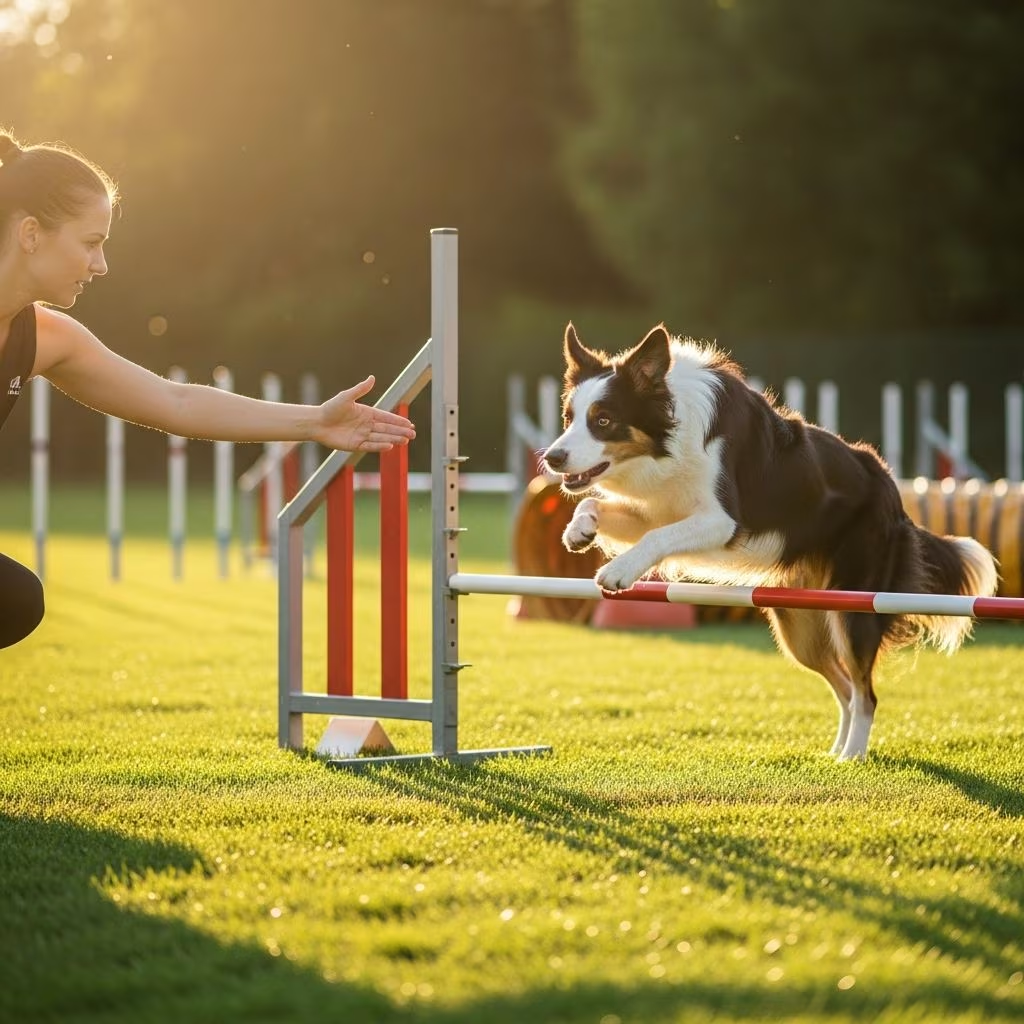
Specialized dog training elevates basic commands to targeted skills suited for particular roles, environments, or challenges. These methods build on foundational obedience to develop precision, reliability, and adaptability in dogs, whether for everyday companionship, competitive sports, or professional duties. By selecting the right approach, owners can address unique needs like high-energy herding instincts or service tasks.
Core Principles of Effective Dog Training
Successful training hinges on understanding behavioral science and tailoring methods to a dog’s breed, age, and temperament. Modern approaches prioritize welfare, using evidence-based strategies that foster trust and motivation over fear. Key elements include consistency, timing of rewards or cues, and progressive challenges to ensure skills transfer to real-world scenarios.
Owners should assess their dog’s learning style—some thrive on food rewards, others on play—while incorporating short sessions to maintain engagement. Professional guidance from certified trainers enhances outcomes, especially for complex behaviors.
Positive Reinforcement: Building Behaviors Through Rewards
**Positive reinforcement** stands as the cornerstone of humane, science-backed training. It involves delivering desirable stimuli—like treats, toys, or verbal praise—immediately after a desired action, increasing the likelihood of repetition. This method avoids punishment, redirecting unwanted behaviors instead.
For everyday applications, teach \”sit\” by luring with a treat above the nose, rewarding the moment the hindquarters touch the ground. Gradually fade the lure, using a verbal cue. Studies show this builds confident, eager learners, reducing stress hormones compared to aversive techniques.
- Pros: Strengthens owner-dog bond, versatile for all ages, supported by operant conditioning research.
- Cons: Demands precise timing; over-reliance on treats may slow fading.
- Best for: Puppies, fearful dogs, skill-building.
Clicker Training: Precision Marking for Complex Skills
Clicker training refines positive reinforcement with a distinct sound from a handheld device, signaling the exact instant of correct behavior, followed by a reward. Pioneered by marine mammal trainers, it excels in shaping intricate actions like agility weaves or trick sequences.
Charge the clicker first by pairing its sound with treats repeatedly. Then, for \”spin,\” click subtle head turns in the desired direction, rewarding approximations until the full circle emerges. Introduce the \”3Ds\”—duration, distance, distraction—to proof behaviors.
| Step | Description | Tip |
|---|---|---|
| 1. Charge | Click and treat 20-30 times | No commands yet |
| 2. Shape | Click small steps toward goal | Sessions under 5 minutes |
| 3. Add Cue | Say command before behavior | Fade clicker over time |
| 4. Proof | Vary environments | Use high-value rewards |
Relationship-Based Training: Personalizing for Strong Bonds
This method emphasizes observing canine body language and customizing sessions to the individual’s emotional state, needs, and motivations. It fosters mutual understanding, ideal for agility or herding where teamwork is paramount.
Begin by reading signals: relaxed ears signal readiness, while lip-licking indicates stress—pause and soothe. Tailor rewards; a retriever might prefer fetch over food. This approach reduces frustration, promoting joyful learning.
Dominance and Alpha Methods: Traditional Pack Leadership
Dominance training posits humans as pack leaders, using subordinate positioning—like eating first or door precedence—to establish control. Alpha rolls or leash corrections enforce compliance.
While rooted in outdated wolf pack myths, some use it for stubborn breeds, making dogs wait for meals or enter last. Critics note it risks fear-based responses; modern views favor reward systems.
- Pros: Quick structure for hierarchy-focused dogs.
- Cons: Can erode trust, increase aggression if misapplied.
Balanced and E-Collar Approaches: Structured Corrections
Balanced training blends rewards with fair corrections, like leash pops or e-collar vibrations/shocks for errors. E-collars provide remote feedback, customizable from tone to low stim.
Start low: pair vibration with \”sit\” violations, escalating only if needed. Best for off-leash reliability in working dogs, under professional supervision to avoid overuse.
Vocational and Working Dog Programs
Vocational training equips dogs for careers in detection, herding, or protection. Search-and-rescue canines learn scent discrimination; police K9s master apprehension.
Programs build drive through toy rewards, then task-specific drills. Herding uses whistles for directional control; therapy dogs practice calm in crowds. Certification from bodies like the American Kennel Club validates skills.
Agility and Sport-Specific Conditioning
Agility demands speed, focus, and obstacle navigation via numbered courses. Training progresses from tunnels to seesaws, using handler cues like \”tunnel\” or hand signals.
Incorporate fitness: weave poles build coordination; A-frame climbs strengthen hindquarters. Competitions via USDAA highlight top performers.
Advanced Obedience: Mastery Under Distraction
Beyond basics, advanced obedience includes heeling off-lead, distance stays, and recalls amid chaos. Use long lines initially, marking successes with clickers.
Place training sends dogs to beds remotely; backups create space. These instill purpose, vital for urban living or trials.
Trick Training: Mental Stimulation and Fun
Tricks like \”take a bow\” or toy cleanup engage intellect, combating boredom. Shaping rewards micro-progresses; chaining links tricks into routines.
Benefits include impulse control and confidence; share videos for socialization proof.
Choosing the Right Method for Your Dog
Match methods to goals: reinforcement for novices, vocational for pros. Consult vets for health checks; track progress journals.
| Goal | Recommended Method | Breed Examples |
|---|---|---|
| Obedience | Positive/Clicker | Labrador, Border Collie |
| Protection | Balanced/Vocational | German Shepherd, Malinois |
| Agility | Relationship-Based | Australian Shepherd, Shetland Sheepdog |
| Therapy | Positive Reinforcement | Golden Retriever, Cavalier |
Common Challenges and Solutions
- Distractions: Start low, build gradually with high rewards.
- Stubbornness: Boost motivation via play; rule out medical issues.
- Fear: Desensitize slowly, never force.
FAQs
What is the most effective dog training method?
Positive reinforcement tops expert consensus for its humane efficacy, trust-building, and research support.
Is clicker training suitable for all dogs?
Yes, adaptable for most, excelling in precision tasks like tricks or sports.
How long to see results in specialized training?
Weeks for basics, months for advanced; consistency accelerates progress.
Can older dogs learn new specialized skills?
Absolutely—mature dogs leverage experience, thriving with patient, reward-focused methods.
Should I hire a professional for vocational training?
Essential for safety and certification in working roles.
References
- The Different Types of Specialized Dog Training — Julius-K9 LLC. 2023. https://usa.juliusk9.com/blogs/news/the-different-types-of-specialized-dog-training
- 8 Types of Specialized Dog Training: Facts & Pictures — Dogster. 2024. https://www.dogster.com/dog-training/types-of-specialized-dog-training
- Advanced Training Techniques for Experienced Dogs — Gingr. 2024. https://www.gingrapp.com/blog/advanced-training-techniques-for-experienced-dogs
- Dog Training Methods — Keene Kanine. 2023. https://www.keenekanine.com/dog-training-methods
- 12 Dog Training Methods Explained: A Science-Backed Guide — QC Pet Studies. 2025-10-12. https://www.qcpetstudies.com/blog/2025/10/12-dog-training-methods-explained-science-backed-guide



