
Solomon Islands Eclectus: Pet Birds Care & Characteristics
Discover the stunning Solomon Islands Eclectus parrot: care, personality, diet, and what makes this vibrant bird an exceptional pet.
Solomon Islands Eclectus: The Jewel of Rainforest Parrots
The Solomon Islands Eclectus parrot (Eclectus roratus solomonensis) stands as one of the most visually striking and captivating parrot species available to pet owners today. These remarkable birds, native to the lush rainforests of the Solomon Islands and surrounding regions, have earned their reputation as prized companions due to their exceptional appearance and outstanding pet qualities. What makes the Solomon Islands Eclectus particularly special is how easily recognizable they are once encountered—their fur-like plumage and day-glow coloration create an astounding visual effect that few other bird species can match.
The most commonly found Eclectus subspecies in captivity, the Solomon Island variety represents the perfect combination of aesthetic beauty and behavioral compatibility with human households. While somewhat harder to find than certain other parrots of similar size, their distinctive characteristics and personality traits make them well worth the search for those seeking a truly unique feathered companion.
Physical Appearance and Sexual Dimorphism
One of the most fascinating aspects of the Solomon Islands Eclectus is their dramatic sexual dimorphism—the striking visual differences between males and females. These birds possess feathers with a fur-like appearance that gives them an utterly unique quality compared to other parrot species. Rather than having feathers with distinct outlines, Eclectus parrots appear to be covered with fine fur, and combined with their brilliant day-glow colors, the overall effect is truly astounding.
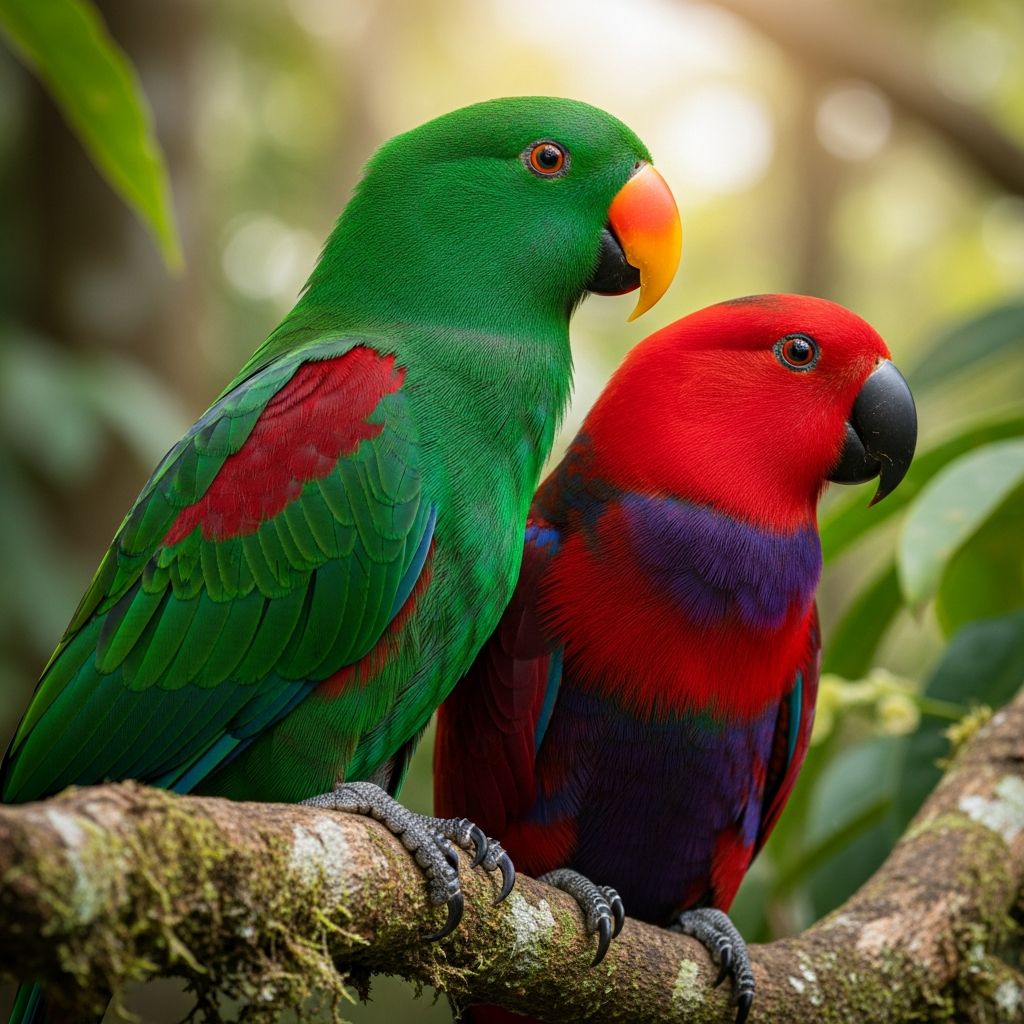
Male Eclectus Characteristics: Males display a vibrant bright green coloration throughout their body, complemented by a distinctive horn or candy-corn colored beak. Their wings feature splashes of bright blue on the wing coverts, while their underwings display a striking bright red. This unique coloration pattern serves an important evolutionary purpose—the green provides camouflage while the male forages for food in the rainforest canopy, protecting him from predators such as peregrine falcons.
Female Eclectus Characteristics: Females present a completely different visual experience, adorned in stunning bright red plumage with a deep violet or royal blue belly. Their beak is entirely black, creating a sharp contrast with their vibrant red head and body. The bright red coloration serves multiple evolutionary functions: it makes females highly visible to potential mates when standing outside their nest cavities, while paradoxically blending into darkness when inside their nests.
The sexual dimorphism is so dramatic that ornithologists and breeders were once completely fooled by these birds. Male and female Eclectus parrots were believed to be two entirely separate species for many years. It wasn’t until a couple of decades ago that someone realized the green birds were males and the red birds were females. This discovery revolutionized breeding programs, as breeders had previously been attempting to pair males with males and females with females, resulting in breeding failures.
Size and Physical Specifications
Solomon Island Eclectus parrots are classified as medium-sized parrots, measuring approximately 12 inches in length and weighing between 375 to 400 grams. They possess a distinctive body structure characterized by a proportionally large head and relatively short tail, which contributes to their unique silhouette compared to other parrot species. This compact build makes them manageable for home environments while still providing the substantial personality and presence expected from larger parrots.
Native Habitat and Geographic Distribution
The Solomon Islands Eclectus originates from the lush lowland rainforests of the Solomon Islands, New Guinea, Indonesia, northeastern Australia, and the Moluccas. These birds prefer the middle to upper levels of the forest canopy, where sunlight filters through the leaves and fruiting trees offer a rich, plant-based diet. They are endemic to rainforest regions, with populations in different geographic areas representing distinct subspecies.
While Eclectus parrots inhabit areas across a wide geographic range, interestingly, those living in Papua New Guinea and on the Cape York Peninsula of Australia are relatively isolated from each other. Despite these areas appearing geographically close together, the 70-mile distance between mainland Papua New Guinea and the peninsula is too great for these birds to cross, resulting in separate populations that have evolved some subspecific differences.
Personality and Behavioral Traits
Solomon Islands Eclectus parrots are renowned for their exceptional personality characteristics that make them ideal family pets for the right household. These birds are intelligent, gentle, and remarkably tranquil in nature, qualities that make them welcome members of the family. Their calm demeanor and thoughtful disposition distinguish them from many other parrot species that may be more demanding or volatile.
Social and Emotional Sensitivity: Eclectus parrots are introverted thinking birds that internalize everything around them. They are notably more emotionally and environmentally sensitive than most other parrot species. These birds do not respond well to stressful or chaotic household environments, and they require owners who understand and respect their need for calm, stable surroundings. They don’t like frantic activity or constant disturbing noise, making them better suited to quieter households.
Interaction with Children: While Eclectus parrots are generally good with children, it’s crucial to understand their limitations. They will not tolerate frantic activity or constant noise from young children. Rather than attempting to train the bird to tolerate children’s behavior, it’s far more important to teach children how to behave appropriately around the bird. This means establishing quiet, calm interactions and respecting the bird’s need for peaceful environments.
Female-Specific Behaviors: Female Eclectus parrots exhibit particularly strong nesting instincts, even when kept as single pets. These females may be inclined to seek out nest sites in dark and enclosed areas around the home, such as in cupboards, under furniture, or in dark boxes. Females can be quite territorial, especially during breeding season. If you maintain a male and female pair, the female will typically be the more dominant of the two.
Behavioral Sensitivity: If an Eclectus becomes overly distressed or anxious, it can develop neurotic behaviors and unhealthy habits such as feather picking and excessive screaming. This sensitivity underscores the importance of providing a calm, stable, and predictable environment where these birds can thrive emotionally and psychologically.
Vocalization and Communication
Solomon Islands Eclectus parrots are highly vocal communicators that excel as mimics of human speech. These intelligent birds can produce a wide range of sounds beyond simple speech, including distinctive tones, coos, whistles, and laughs. With sufficient socialization and training, they become excellent at imitating words and household sounds, adding an interactive dimension to the pet-owner relationship.
Natural Diet in the Wild
In their native rainforest habitat, Eclectus parrots subsist primarily on a fruit-based diet that reflects the abundance of their native environment. Their natural food sources include pomegranates, papayas, figs, flowers, leaf buds, and various seeds. Understanding their natural diet provides important insights for creating appropriate nutrition plans for captive birds, as their dietary needs have evolved to match their native foods.
Lifespan and Longevity
Solomon Islands Eclectus parrots are long-lived companions that can survive up to 30 years in captivity with proper care. This extended lifespan means that acquiring an Eclectus represents a multi-decade commitment to the bird’s wellbeing and happiness. Prospective owners must carefully consider whether they are prepared for such a lengthy commitment before bringing one of these magnificent birds into their home.
Breeding Behaviors and Reproduction
Eclectus parrots display fascinating and complex breeding behaviors that reflect their evolutionary adaptation to rainforest life. These birds are primarily polyandrous, meaning females often mate with multiple males. In some populations, they also exhibit polygynandrous behavior, where both males and females have multiple partners. This unusual breeding system ensures reproductive success in their natural habitat.
During breeding season, cooperative breeding behaviors emerge. While the female incubates the eggs, multiple males may bring her food and provide protection. This cooperative system is essential to their reproductive strategy, as females remain in their nest hollows for extended periods, relying entirely on males for sustenance. The female is responsible for incubating the eggs, which typically hatch after approximately 26 to 28 days. Clutch sizes generally range from 1 to 3 eggs, with relatively low breeding success rates, averaging around two eggs per season in captivity. After hatching, Eclectus chicks take approximately six months to become independent and three years to reach sexual maturity.
Housing in the Wild
In their natural environment, Eclectus parrots make their nests high in tree cavities that run deep into the trunk. These elevated, protected nesting sites are crucial to their reproductive success, providing safety from ground predators and security for incubating females. During incubation, the female sits almost continuously on the nest while the male brings her food. Once chicks hatch, the male shares rearing duties with the female, foraging for the chicks or watching the nest at night.
Handling and Care Considerations
While Solomon Islands Eclectus parrots are generally stable, easy-going, calm, peaceful, and quiet birds, there are important tricks to handling them, particularly females. Their wild behavior patterns can influence captive behavior in significant ways. In the wild, females sitting on eggs rarely leave their nests, relying entirely on their mates for food. This extended confinement creates a tendency toward daydreaming.
If startled while daydreaming or caught off guard on a perch, female Eclectus can attack viciously to defend themselves—a behavior that evolved to protect their nests from predatory snakes in the wild. Female Eclectus parrots will ferociously defend any area they perceive as a potential nest site, including dark carriers, under-bed spaces, boxes, or dark closets. To prevent aggressive defensive behaviors, it’s essential to keep your female Eclectus away from cozy dark places she might interpret as nest sites. When startled or defending, a female can bite extremely hard and may not release her grip immediately.
Frequently Asked Questions
Q: How can you tell the difference between male and female Solomon Islands Eclectus parrots?
A: Males are bright green with a horn-colored beak, bright blue on the wings, and bright red underwings. Females are stunning bright red with a deep violet belly and entirely black beak. The color differences are so dramatic that they were once thought to be separate species.
Q: Are Eclectus parrots good pets for families with small children?
A: While Eclectus parrots can be good with children, they do better in households without very small children. They are sensitive to frantic activity and constant noise. Children must be taught to interact calmly and respectfully with the bird.
Q: How long do Solomon Islands Eclectus parrots live?
A: These birds can live up to 30 years in captivity with proper care, making them a significant long-term commitment for pet owners.
Q: What should I feed my Solomon Islands Eclectus parrot?
A: A diet based primarily on fruits—similar to their wild diet of pomegranates, papayas, figs, flowers, and seeds—supplemented with specialized parrot food formulated to meet their nutritional needs in captivity.
Q: Why do female Eclectus parrots sometimes become aggressive?
A: Female Eclectus have strong nesting instincts and will defensively guard dark, enclosed spaces they perceive as nest sites. They can also become aggressive if startled while daydreaming. Keeping them away from cozy dark areas helps prevent this behavior.
Q: Can Eclectus parrots talk and mimic sounds?
A: Yes, Eclectus parrots are excellent mimics of human speech and can imitate words and household sounds. They also produce a wide range of other vocalizations including tones, coos, whistles, and laughs with proper socialization.
Q: What makes Solomon Islands Eclectus different from other Eclectus subspecies?
A: The Solomon Island Eclectus is the most commonly found subspecies in captivity. While other subspecies like the Grand Eclectus and Vosmaeri exist, the Solomon Island variety is prized for its stunning appearance and availability as a pet.
References
- Eclectus Parrot – Pet Birds by Lafeber Company — Lafeber Co. Accessed November 28, 2025. https://lafeber.com/pet-birds/species/solomon-islands-eclectus/
- Eclectus — Wikipedia. Accessed November 28, 2025. https://en.wikipedia.org/wiki/Eclectus
- Grand Eclectus Parrot Facts and Information — United Parks & Resorts (SeaWorld). Accessed November 28, 2025. https://seaworld.org/animals/facts/birds/grand-eclectus-parrot/
- What to Know About the Eclectus Parrot — WebMD Pets. Accessed November 28, 2025. https://www.webmd.com/pets/what-to-know-about-the-eclectus-parrot
- Eclectus Parrot – Saginaw Children’s Zoo — Saginaw Children’s Zoo. Accessed November 28, 2025. https://www.saginawzoo.com/eclectus-parrot/
- Eclectus Parrot – Specialized Care for Avian & Exotic Pets — Buffalo Bird Nerd. PDF Document. Accessed November 28, 2025. https://www.buffalobirdnerd.com/storage/app/media/PSPEclectusParrots2016.pdf
Similar Articles








Read full bio of medha deb


