

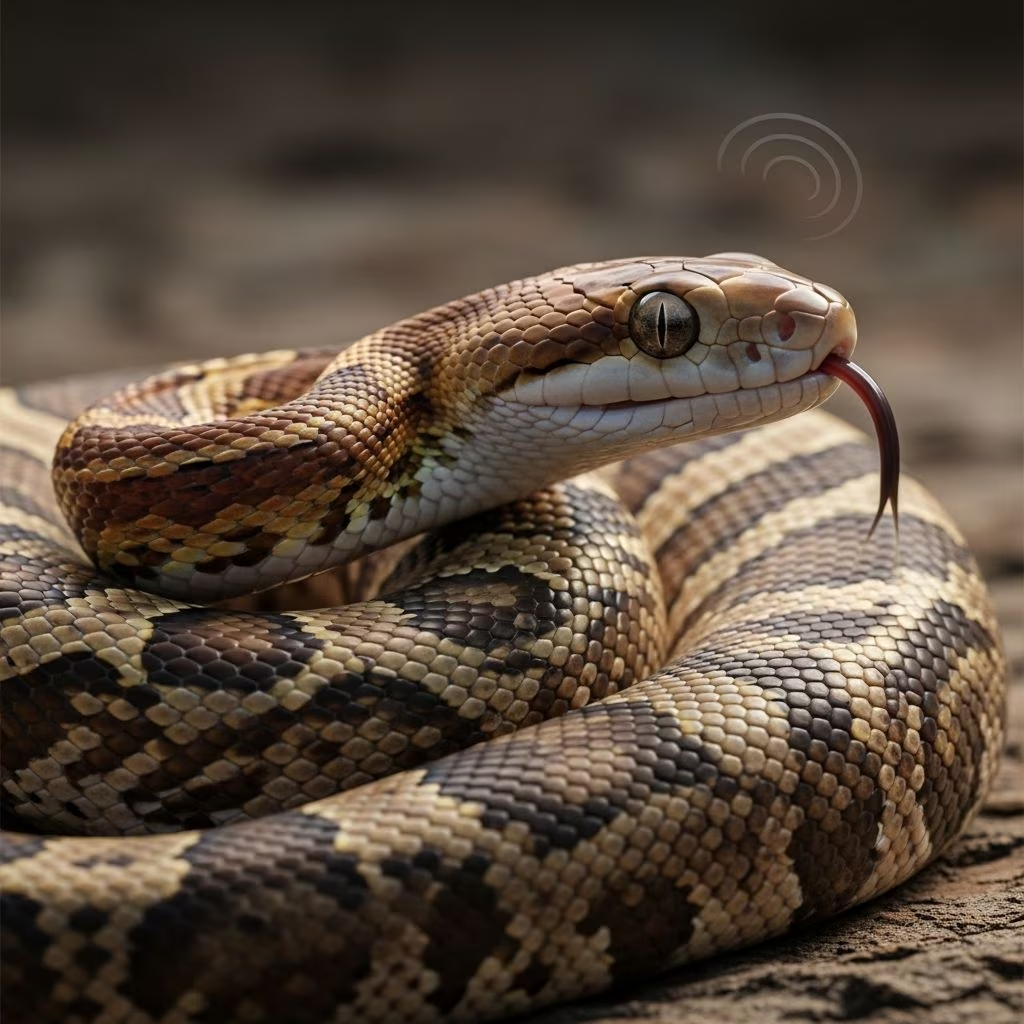
Snakes occupy a fascinating position in the animal kingdom when it comes to hearing. Unlike mammals with prominent external ears, snakes lack visible ear structures entirely, yet they are far from deaf. The question of whether snakes react to loud sounds requires understanding their unique auditory system and how they perceive the world through vibrations and low-frequency sound waves.
The Unique Architecture of Snake Hearing
To understand whether snakes respond to loud noises, it is essential to first examine how their hearing mechanism operates. Snakes detect sound through bone conduction rather than through external ear structures. When sound waves reach a snake’s head, they stimulate vibrations in specialized bones called the quadrate and columella—bones that are directly attached to the jawbone.
These vibrations travel through the columella to the inner ear, where they interact with fluid in the cochlear duct. This process allows the inner ear to process sound information and relay signals to the brain. This mechanism differs fundamentally from human hearing, which relies on external ears, a tympanum (eardrum), and a chain of small bones in the middle ear.
The transmission of sound in snakes occurs through two primary pathways:
- Ground vibrations picked up through the snake’s belly and body contact with surfaces
- Airborne sound waves that transmit through the skin and reach the inner ear structures
Research demonstrates that snakes can perceive both types of sound transmission, though their sensitivity varies depending on the frequency range and the specific species.
Frequency Sensitivity: Where Snakes Excel and Struggle
Snakes hear best at low frequencies, typically between 40 and 500 Hz, with peak sensitivity varying by species. For context, this range is dramatically different from human hearing capabilities. Humans achieve their best hearing performance at frequencies between 2,000 and 8,000 Hz—more than ten times higher than snakes’ optimal range.
Different snake species demonstrate varying frequency preferences:
- Rattlesnakes respond most strongly to airborne sounds between 200 and 400 Hz
- Sea snakes exhibit peak sensitivity at 60 Hz and 500 Hz when exposed to underwater sound
- Royal pythons show greatest sensitivity to substrate vibration and sound pressure at 80–160 Hz
- Australian snake species respond to frequencies ranging from 0 to 450 Hz across different genera
The reason snakes evolved sensitivity to these lower frequencies likely relates to their ecological niche. Large animals moving through vegetation and across ground surfaces produce sounds primarily in this lower frequency range. A snake’s ability to detect these vibrations provides early warning of potential predators or prey movements.
Do Loud Noises Actually Bother Snakes?
The simple answer is: not as much as one might assume. While snakes can detect loud sounds, particularly within their sensitive frequency ranges, extremely loud noises do not necessarily disturb them in the way they might affect humans or other animals with more acute hearing.
A critical distinction exists between detecting sound and being bothered by sound. Research indicates that human screaming, which produces approximately 85 decibels of sound pressure at distances beyond 1.5 meters, falls well outside what would typically occur between predator and prey in natural snake habitats. In other words, most snakes in captive settings are unlikely to encounter sound levels that constitute a genuine acoustic threat.
Behavioral studies using controlled frequency ranges reveal that snakes do respond to sounds, but their reactions are nuanced and species-dependent. Different species exhibit distinct behavioral patterns when exposed to various frequencies:
- Some species freeze in place when exposed to certain frequencies
- Others raise their heads in a behavior called “periscoping”
- Certain species increase hissing and jaw-dropping displays
- Some snakes attempt to move away from sound sources
Behavioral Responses to Different Sound Frequencies
Research involving controlled experiments with multiple Australian snake species provides insight into how different snakes respond to varying sound frequencies. Scientists exposed snakes to three distinct frequency bands: 0–150 Hz, 150–300 Hz, and 300–450 Hz.
The behavioral data revealed fascinating patterns. As frequency increased, the likelihood of snakes freezing increased, while behaviors such as periscoping and hissing decreased. This suggests that snakes perceive and discriminate between different frequency ranges, adapting their defensive or investigative behaviors accordingly.
Death adders, for example, moved far away from speakers emitting lower frequencies (0–300 Hz), possibly because their flattened jaw structure provides superior sensitivity to ground vibrations in that range. Other species showed different thresholds for moving away or investigating sound sources.
The Limited Range of Snake Hearing
It is important to recognize that while snakes can hear, their overall auditory range is severely limited compared to most mammals. Snakes can hear frequencies below approximately 1,000 Hz, whereas humans can detect sounds up to 20,000 Hz. This dramatic difference explains why snakes remain largely indifferent to many ambient sounds that humans find noticeable.
The auditory sensitivity also differs substantially. Animals with external and middle ears can detect a broader frequency range and experience approximately 40 decibels greater hearing sensitivity than snakes. This fundamental limitation means that sounds audible and bothersome to humans may be completely imperceptible to snakes, or perceived only as muted vibrations.
Researchers note that snake hearing might be described as “muffled” compared to human perception. This muffled quality reflects the anatomical differences in their auditory system and frequency sensitivity. For a sound to meaningfully register with a snake, it typically must occur within their optimal frequency range and at sufficient amplitude.
Practical Implications for Snake Owners and Handlers
Understanding snake hearing has practical applications for people who keep snakes as pets or work with snakes professionally. The question of whether to worry about loud household noises becomes easier to answer with this knowledge.
Most household sounds—television, music, conversation at normal volumes, household appliances—occur at frequencies and volumes well outside the range that would meaningfully disturb a snake. Dogs barking, music with strong bass components, or heavy machinery might register more clearly because they produce lower-frequency vibrations.
However, snakes do respond when sounds do fall within their perceptual range. A research participant observed that “if you talk loud enough, a snake can hear you,” suggesting that volume and frequency combination matter. This indicates that while typical conversation might not register, raising one’s voice or producing sudden loud sounds in the lower frequency range could potentially capture a snake’s attention.
Sensory Hierarchy in Snakes
It is worth considering that hearing may not be the primary sensory modality for snakes, even for the sounds they can detect. Snakes rely heavily on other sensory systems that may be more important for survival:
- Thermal sensing through pits along their bodies (in pit viper and boa species)
- Chemical sensing through the vomeronasal organ and tongue-flicking behavior
- Visual detection, particularly of movement
- Tactile sensitivity to ground vibrations and direct contact
This sensory hierarchy suggests that while snakes can process auditory information, they do not depend on hearing to the extent that humans do. A snake’s survival and behavioral decisions likely depend more on heat, chemical cues, and vibrations than on airborne sound alone.
Evolutionary Perspective on Snake Audition
The limited nature of snake hearing likely reflects evolutionary pressures. Unlike mammals that evolved in environments where acute hearing provided significant survival advantages, snakes evolved in ecological niches where other sensory modalities were more critical. The relaxed selection pressure for expanded hearing capabilities in snakes across their evolutionary history resulted in the narrow frequency range and reduced sensitivity characteristic of modern snake species.
This evolutionary perspective helps explain why snakes never developed external ears or the sophisticated middle ear structures found in mammals. Their ecological success over hundreds of millions of years demonstrates that acute hearing simply was not necessary for their survival and reproduction.
FAQ Section
Q: Can snakes hear human voices?
A: Yes, snakes can detect human voices if they are loud enough. Normal conversation typically occurs at frequencies (100–250 Hz) within the snake’s hearing range, but the volume and distance matter. Shouting or raised voices are more likely to register with a snake than quiet conversation.
Q: Do loud noises stress snakes?
A: While snakes can detect loud noises within their frequency range, whether they experience stress depends on the specific sound and the individual snake’s temperament. Sudden sounds might trigger defensive behaviors like freezing or hissing, but chronic exposure to loud noise does not appear to cause the same stress responses seen in mammals.
Q: Should I keep my pet snake away from noisy areas?
A: Most household noise will not significantly bother a snake. However, keeping snakes in quieter environments is generally advisable to minimize any potential disturbance from low-frequency sounds and to maintain a calm, stable environment that reduces overall stress.
Q: How do snakes communicate if they can’t hear well?
A: Snakes primarily communicate through chemical signals (pheromones), visual displays (body postures and colors), and vibrations. Sound plays a limited role in snake communication, though hissing and rattling (in rattlesnakes) do serve defensive functions.
Conclusion: Sound Sensitivity Without Acute Hearing
Snakes react to loud sounds when those sounds fall within their narrow hearing range and reach sufficient amplitude. However, the limited frequency sensitivity and reduced overall hearing capability mean that most loud noises in human environments do not meaningfully bother snakes. While snakes are far from deaf and can detect vibrations and low-frequency sounds, their auditory system reflects millions of years of evolution in ecological niches where other sensory modalities took precedence.
For snake owners and handlers, this understanding provides reassurance that typical household noise levels are unlikely to cause problems. Simultaneously, it highlights the importance of recognizing that snakes perceive their world differently than humans do, relying on a different sensory hierarchy in which hearing plays a supporting rather than starring role.
References
- Sound garden: How snakes respond to airborne and groundborne sounds — National Center for Biotechnology Information (NCBI/PMC). 2023. https://pmc.ncbi.nlh.nih.gov/articles/PMC9928108/
- Yes, Snakes Can Hear Sound — Discover Magazine. 2023. https://www.discovermagazine.com/yes-snakes-can-hear-sound-44656
- Snakes can hear sound and react to it — this may help prevent snakebites — Down to Earth. 2023. https://www.downtoearth.org.in/wildlife-biodiversity/snakes-can-hear-sound-and-react-to-it-this-may-help-prevent-snakebites-87959
- Snakes react to airborne sound — Physics Today. 2023. https://physicstoday.aip.org/news/snakes-react-to-airborne-sound
- Shhh! The snake may hear you — Anapsid.org. https://www.anapsid.org/torrey.html



