

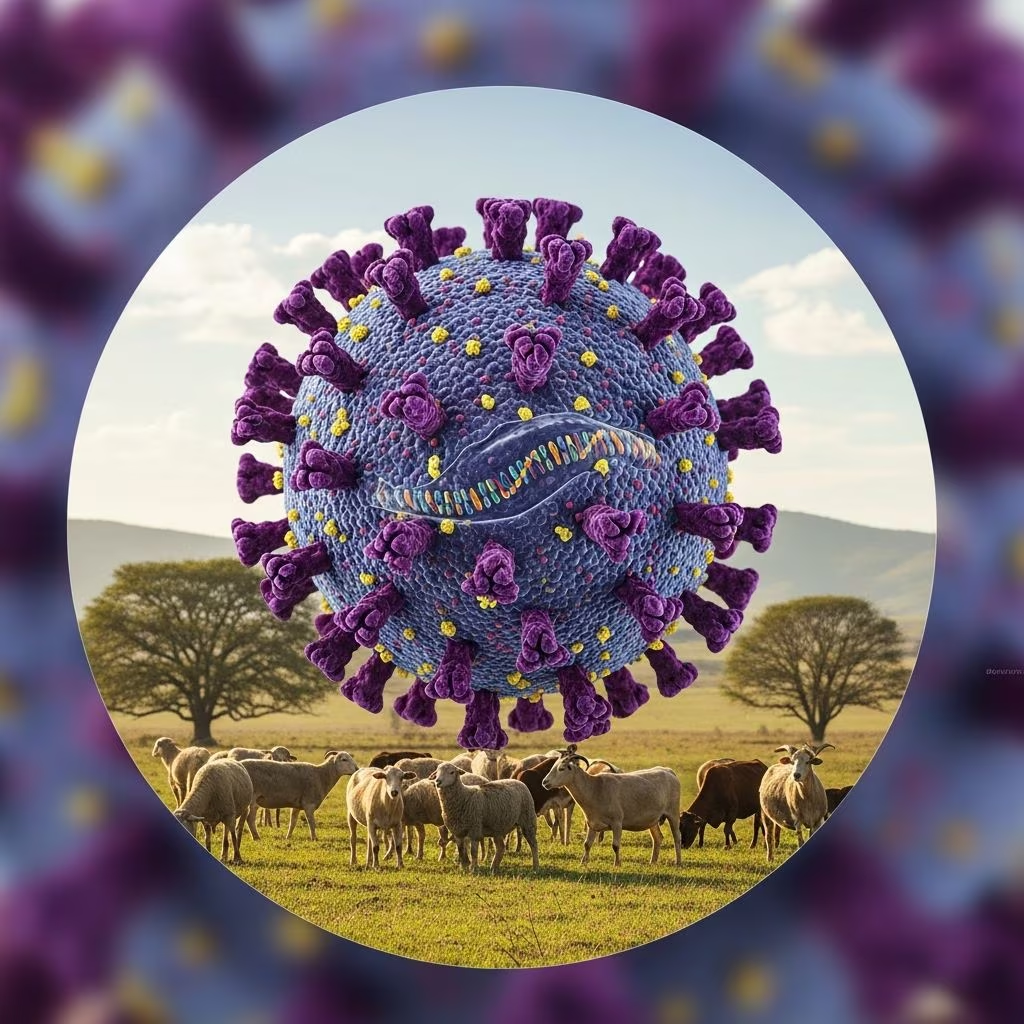
Insect-transmitted viruses from the Simbu serogroup pose significant threats to ruminant livestock worldwide, primarily through inducing devastating congenital malformations in offspring. These pathogens, notably Akabane and Schmallenberg viruses, exploit specific gestational windows to disrupt fetal development, leading to economic losses in cattle, sheep, and goat industries.
Overview of Key Pathogens
The Simbu serogroup belongs to the Orthobunyavirus genus and includes several viruses affecting ruminants. Akabane virus (AKAV) has been documented in regions like Australia, Japan, Israel, and Korea, often at the edges of endemic zones. Schmallenberg virus (SBV) emerged dramatically in Europe in 2011, causing widespread outbreaks of birth defects. Other members, such as Aino and Shamonda viruses, produce similar though less frequent effects.
These viruses target pregnant animals, crossing the placenta to infect developing fetuses without causing overt illness in adults. Ruminants do not develop persistent infections or shed the virus long-term, limiting direct animal-to-animal spread.
Transmission Dynamics
Primary transmission occurs via hematophagous insects, especially Culicoides biting midges. In Australia, Culicoides brevitarsis is the key vector for AKAV, thriving in warm, humid conditions. SBV in Europe spreads through cold-tolerant Culicoides species, enabling transmission even in cooler climates.
- Viremia in infected hosts peaks 1-6 days post-infection, coinciding with peak vector activity.
- No evidence of direct contact, semen, or respiratory transmission exists.
- Outbreaks arise when naive pregnant animals encounter vectors, such as during midge range expansions or animal movements to endemic areas.
Overwintering mechanisms remain under study; vertical transmission in fetuses without malformations may play a role alongside dormant vectors.
Pathogenic Mechanisms
Infection timing dictates lesion severity. In cattle, AKAV exposure at 80-150 days gestation yields peak damage, with up to 40-80% of calves affected depending on strain virulence. Earlier or later infections cause milder or no issues. SBV induces lower rates, around 5-10%.
Sheep and goats, with shorter gestations, show defects mainly from days 28-56. Fetal tissues, especially brain and muscles, suffer cell death or impaired growth due to viral replication.
| Gestation Stage (Cattle) | Common Outcomes | Affected Species |
|---|---|---|
| Days 80-150 | Hydranencephaly, arthrogryposis | Cattle primarily |
| Days 140-210 | Microcephaly, cerebellar hypoplasia | Cattle, sheep |
| Days 28-56 (sheep/goats) | Multiple malformations, stillbirths | Sheep, goats |
Virus strains vary; some like AKAV’s Iriki cause rare postnatal encephalomyelitis.
Clinical Manifestations in Offspring
Affected neonates exhibit a spectrum of arthrogryposis-lameness-hydranencephaly (ALH) syndrome. Calves born with rigid limbs, brain liquefaction (hydranencephaly), or underdeveloped brains often cannot stand or suckle, leading to euthanasia.
- Cattle: Arthrogryposis (joint fixations), hydranencephaly, porencephaly, microphthalmia.
- Sheep/Goats: Hydranencephaly with arthrogryposis, pulmonary hypoplasia, spinal cord defects; high stillbirth rates.
- Adults: Transient fever, diarrhea (SBV initially); usually subclinical.
In synchronized herds, clustered cases amplify impacts. Recent outbreaks, like in Mughan cattle, blend AKAV and SBV seropositivity, suggesting co-infections.
Diagnostic Approaches
Diagnosis combines history, gross pathology, and lab tests. Necropsies reveal characteristic brain cavities and limb contractures.
- Serology: cELISA detects IgG/IgM in dams or offspring.
- RT-PCR: Confirms virus in tissues, aborted fetuses.
- Histopathology: Confirms CNS malformations.
Differentiate from other teratogens like bluetongue or cache valley virus via serogroup-specific tests.
Epidemiological Patterns
Endemic in vector-rich tropics/subtropics; epizootics hit immunologically naive populations. Australia’s northern expansions and Europe’s 2011 SBV wave exemplify this. Higher altitudes or seasonal midge booms trigger flares.
In endemics, early-life exposure confers lifelong immunity pre-breeding. Imported or relocated naive breeders suffer most.
Prevention and Management Strategies
No specific antivirals exist; focus on vector control and herd immunity.
- Insect repellents, stable screens during dusk/dawn peaks.
- Vaccines: Modified-live for AKAV in Australia/Japan; inactivated options emerging.
- Quarantine movements from free to endemic zones; timed breeding avoids peak vector seasons.
Surveillance via sentinel herds and vector trapping aids early warnings.
Global Distribution and Emergence
AKAV spans Asia-Pacific, Middle East; SBV Europe-centric but spreading. Climate shifts may expand vectors, risking new fronts. Co-seroprevalence in outbreaks hints at interactions needing study.
Research on N gene advances diagnostics and vaccines.
Economic and Welfare Impacts
Outbreaks devastate; 2011 SBV hit millions of ruminants, costing billions in culls and lost production. Welfare concerns arise from deformed neonates’ suffering.
FAQs
What causes Simbu serogroup infections?
Biting midges transmit viruses like AKAV and SBV to pregnant ruminants.
Which animals are most vulnerable?
Naive pregnant cattle (80-150 days), sheep/goats (28-56 days).
Can infected animals spread the virus directly?
No, only via insects; no carriers.
Is there a vaccine available?
Yes, for AKAV in some regions; SBV vaccines in development.
How to prevent outbreaks?
Vector control, avoid moving naive animals to endemic areas.
References
- Akabane Disease — The Center for Food Security and Public Health. 2008. https://www.cfsph.iastate.edu/Factsheets/pdfs/akabane.pdf
- Akabane and Related Simbu Serogroup Virus Infections in Ruminants — Merck Veterinary Manual. 2023. https://www.merckvetmanual.com/generalized-conditions/congenital-and-inherited-anomalies/akabane-and-related-simbu-serogroup-virus-infections-in-ruminants
- Akabane disease — Business Queensland. 2023. https://www.business.qld.gov.au/industries/farms-fishing-forestry/agriculture/biosecurity/animals/diseases/guide/akabane-disease
- Akabane Fast Facts — The Center for Food Security and Public Health. 2008. https://www.cfsph.iastate.edu/FastFacts/pdfs/akabane_F.pdf
- Akabane, Aino and Schmallenberg virus — Sciensano. 2017. https://www.sciensano.be/sites/default/files/2017_curr_opin_virol_akav_aino_sbv.pdf
- An outbreak of Akabane disease in a cattle herd on the Mughan — PMC. 2024. https://pmc.ncbi.nlm.nih.gov/articles/PMC11260222/
- Research progress on the N gene of Akabane virus — Frontiers in Veterinary Science. 2025. https://www.frontiersin.org/journals/veterinary-science/articles/10.3389/fvets.2025.1690905/full



