

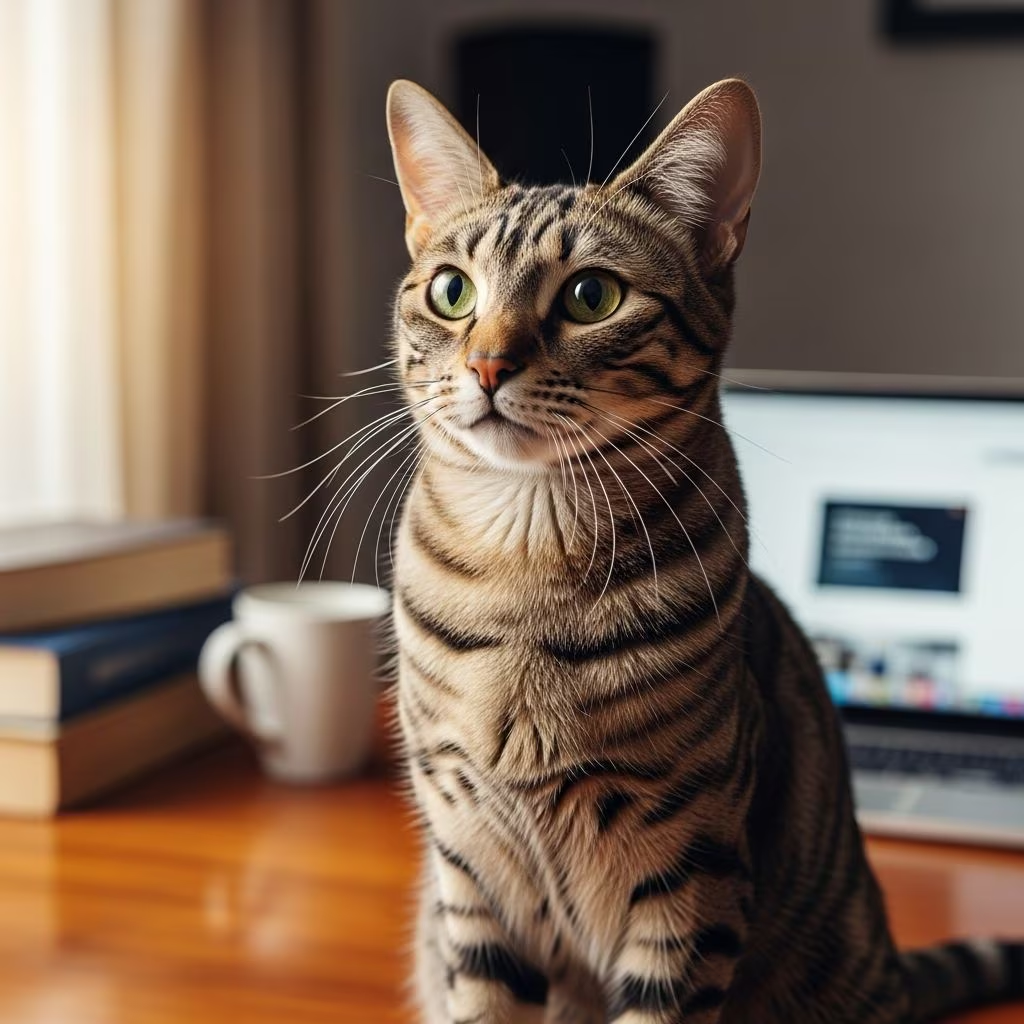
Intelligent cats exhibit behaviours that go beyond typical feline mischief, demonstrating advanced problem-solving, memory, and social awareness tailored to a human-dominated world. From mastering door handles to reading human emotions, these signs reveal a cat’s cognitive prowess, often comparable to a human toddler’s abilities.
What do we mean by cat intelligence?
Cat intelligence refers to a cat’s capacity to learn, remember, adapt, and solve problems in their environment, rather than obedience to commands like in dogs. Scientists measure it through abilities such as object permanence—understanding that hidden objects still exist—working memory for short-term tasks, sensitivity to human cues like pointing or voice recognition, and distinguishing quantities or time durations.
Studies indicate cats possess a cognitive level akin to a young child, recognising familiar voices, adjusting meows to manipulate humans (such as embedding infant-like cries in purrs to trigger caregiving responses), and using social learning by observing others. Unlike dogs, whose intelligence often shines in cooperative tasks, cats excel in independent ingenuity, navigating homes with the precision of wild ancestors exploring territories.
This feline smarts manifests in everyday adaptability: learning household routines, decoding owner moods for snacks, or strategically timing headbutts for attention. Research from institutions like Oregon State University highlights individual variation in cats, making their intelligence harder to standardise but no less impressive, with brains featuring a highly developed hippocampus for spatial memory and navigation.
Signs your cat may be smart
Observing your cat’s daily behaviours can reveal high intelligence. Look for patterns in communication, problem-solving, adaptability, and social savvy—these are lab-tested markers of feline cognition.
Strong communication skills with humans
Smart cats customise interactions to get results. They distinguish owner voices, alter meow pitch for urgency, and use gestures like paw taps or prolonged eye contact based on past responses—a form of social learning. For instance, a cat might purr with a high-pitched ‘solicitation cry’ to elicit food faster, tapping into human nurturing instincts.
These cats also read human cues effectively, following pointed fingers to hidden treats or adjusting behaviour to an owner’s mood, outperforming many species in observational learning. If your cat headbutts at mealtime or meows specifically when you’re responsive, it’s employing calculated communication.
Observing how fast they adapt to new situations
Cognitive flexibility—the ability to update mental maps amid change—is a hallmark of intelligent cats. They quickly adjust to new furniture, visitors, or feeding schedules by exploring cautiously then integrating the novelty.
Watch for trial-and-error learning: a smart cat investigates a rearranged room, learns new paths, and avoids repeated mistakes. Encourage this with gradual introductions scented by familiar items, building resilience and adaptability over time. Cats slow to adapt may simply be cautious, but quick learners show superior flexibility.
Problem-solving prowess
Cats outshine dogs in persistent puzzle-solving, manipulating levers, opening cabinets, or using tools like paws to retrieve food without seeking help. A clever cat continues working a puzzle long after others quit, demonstrating independence and spatial reasoning tied to their hunting heritage.
Test this at home: hide treats in boxes or under cups. Intelligent cats master object permanence rapidly, remembering locations and devising retrieval strategies.
Excellent memory and observational learning
Felines boast strong long-term memory for events, faces, and routines, recalling altered paths or recognising voices after years. They learn by watching—observing you open a door then mimicking the action— a advanced social learning skill.
This shines in routine mastery: knowing exact feeding times or anticipating play based on your cues.
Curiosity and play that mimics hunting
Highly intelligent cats engage in complex play, stalking toys with predatory sequences or inventing games, honing cognitive skills like strategy and agility. Curiosity drives exploration of novel objects, linking to higher adaptability.
Are some cat breeds more intelligent than others?
While intelligence varies individually, certain breeds show traits linked to perceived smarts: high curiosity, activity, and sociability. These stem from genetics influencing motivation, not raw IQ.
| Breed | Intelligent Traits | Examples of Smarts |
|---|---|---|
| Abyssinian | High curiosity, energy | Constant exploration, quick learning |
| Bengal | Energetic problem-solving | Tool use, puzzle mastery |
| Siamese | Vocal, social | Advanced communication, voice modulation |
| Sphynx | Affectionate, interactive | Responsive to training, social cues |
| Oriental Shorthair | Playful, inquisitive | Observational learning, adaptability |
Studies link these breeds to higher engagement in cognitive tasks, but any motivated cat can excel. Motivation often trumps breed in displaying intelligence.
Frequently Asked Questions (FAQs)
Are cats smarter than dogs?
No direct comparison—cats excel in independent problem-solving and observation, dogs in social cooperation. Cats persist longer on puzzles; dogs read human intent better.
How can I test my cat’s intelligence?
Use puzzles, hide treats for object permanence, or observe adaptation to changes. Track memory for routines or tricks via clicker training.
Do all cats have the same intelligence level?
No, variation exists due to genetics, environment, and personality. Enrichment boosts cognitive skills in any cat.
Can I train my cat like a dog?
Yes, with patience—clicker training works for tricks. Cats learn on their terms, motivated by food or play.
What if my cat seems less intelligent?
Shyer cats may underperform in tests but possess equal smarts. Provide enrichment to reveal potential.
Enhancing Your Cat’s Intelligence
Stimulate cognition with puzzle feeders, interactive toys, training sessions, and novel environments. Rotate toys to spark curiosity, teach tricks for confidence, and ensure a stable routine with varied challenges. Socialisation from kittenhood builds communication skills.
Health factors like diet and exercise support brain function; regular vet checks rule out issues mimicking low intelligence.
References
- Unexpected Signs Your Cat Is Smarter Than the Rest — Kinship. 2025. https://www.kinship.com/uk/cat-behaviour/signs-your-cat-is-intelligent
- Cats vs. Dogs: Exploring Feline Intelligence and Canine IQ — Kinship. 2025. https://www.kinship.com/pet-behavior/are-cats-smarter-than-dogs
- How Smart Are Cats? How to Test Your Cat’s IQ — Kinship. 2025. https://www.kinship.com/cat-behavior/how-smart-are-cats



