

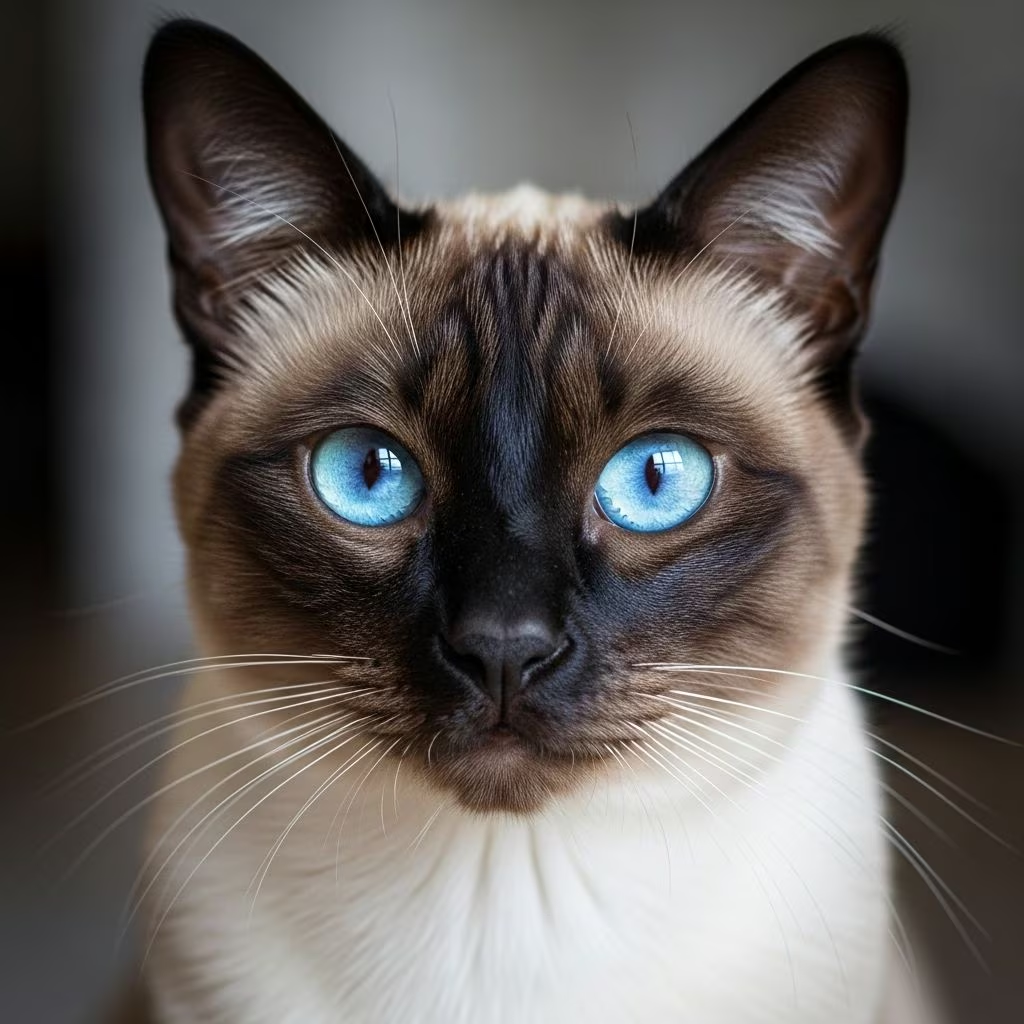
Siamese cats are renowned for their vivid **blue eyes**, a hallmark trait linked directly to their unique genetic makeup and distinctive coat patterns. This feature stems from a specific mutation affecting pigmentation, ensuring that purebred Siamese consistently display this striking ocular characteristic.
The Genetic Foundation of Siamese Traits
The captivating appearance of Siamese cats arises from a recessive mutation in the **tyrosinase (TYR) gene**, part of the albino gene complex. This alteration renders pigment production temperature-dependent, meaning melanin—the pigment responsible for color—only activates in cooler body regions. For the mutation to manifest, both parents must carry the gene, resulting in kittens inheriting it and developing the breed’s signature pointed coat: pale fur on the body with darker accents on the ears, muzzle, paws, and tail.
At birth, Siamese kittens emerge with cream or white coats because the warm uterine environment (around 101°F) suppresses melanin synthesis across their bodies. Post-birth, as extremities cool relative to the torso, pigment deposition begins, gradually forming the points over several weeks. This process parallels the eye color development, where minimal iris pigmentation leads to the blue hue via light scattering.
How Blue Eyes Form in Cats
Blue eyes in Siamese cats result not from a pigment but from the **absence of melanin in the iris**, causing structural proteins to refract shorter blue wavelengths of light back to the viewer. All kittens start with blue eyes due to initial low pigmentation; in most breeds, melanin accumulates by 7-9 weeks, shifting colors to green, yellow, or amber. Siamese retain this blue due to their genetic restriction on pigment.
This refraction mimics the sky’s blue or ocean depths, a optical illusion common in low-pigment irises. In contrast, dense melanin yields warmer tones, while complete absence in albinos can produce pinkish eyes, though rare in cats.
Variations in Siamese Coat Points and Eye Shades
While all traditional Siamese boast blue eyes, subtle differences emerge based on coat point colors, influenced by further genetic dilutions:
- Seal Point: Darkest points (near-black); eyes often deep, intense blue.
- Chocolate Point: Milk-chocolate points; blue eyes with medium depth.
- Blue Point: Grayish points from dilution; paler blue eyes.
- Lilac Point: Lightest points (frosty pinkish-gray); eyes appear lighter blue or bluish-gray.
These variations arise from modifier genes diluting base colors, yet the TYR mutation ensures blue eyes across all.
| Point Type | Point Color Description | Typical Eye Shade |
|---|---|---|
| Seal | Deep brown-black | Deep blue |
| Chocolate | Milk chocolate | Medium blue |
| Blue | Gray-blue | Pale blue |
| Lilac | Pinkish-gray | Light blue-gray |
This table illustrates how point intensity correlates with eye perception, though genetically uniform.
Beyond Purebreds: Crossbreeds and Exceptions
Not every cat resembling a Siamese has blue eyes. Crosses with non-pointed breeds may dilute the TYR gene’s expression, yielding green, yellow, or odd eyes (one blue, one not). Modern hybrids like Balinese (long-haired Siamese) or Oriental Shorthairs retain points and blue eyes if pure, but outcrosses vary.
Colorpoints in other breeds (e.g., Himalayans) share the Himalayan pattern and blue eyes, but Siamese set the standard. Rare mutations like Ojos Azules produce blue eyes independently of coat but carry health risks.
Visual Implications of the Siamese Mutation
The same gene impacting coat and eyes affects retinal pigmentation, leading to crossed eyes (strabismus) in some Siamese and misrouted visual pathways in the brain’s lateral geniculate nucleus (LGN). Discovered in the 1960s by researcher Ray Guillery, this hypopigmentation causes abnormal retinal projections, akin to issues in albino humans.
Despite this, most Siamese exhibit normal hunting and play behaviors, with nystagmus or mild vision quirks in affected individuals. Breeding standards now select against severe strabismus.
Caring for Siamese Eyes and Coat
Blue eyes heighten light sensitivity; provide shaded environments and avoid direct sun. Regular vet checks monitor for pigmentation-related issues like retinal atrophy. Maintain coat vibrancy with balanced diets supporting melanin production in points.
- Monitor for cloudiness or discharge indicating infections.
- Groom weekly to enhance point contrast.
- Ensure cool sleeping spots to accentuate patterns.
Historical and Cultural Significance
Originating in Thailand (Siam), Siamese were temple guardians, their blue eyes symbolizing mystique. Exported to the West in the 19th century, they became breeding icons, influencing countless pointed breeds. Their genetics continue fascinating researchers, bridging feline aesthetics and neuroscience.
Frequently Asked Questions
Do all Siamese cats have blue eyes?
Yes, purebred Siamese with the Himalayan pattern have blue eyes due to the TYR gene mutation.
Can Siamese kittens change eye color?
No, their eyes remain blue; unlike other kittens, pigmentation doesn’t develop in the iris.
Why do some pointed cats not have blue eyes?
Crossbreeding introduces non-pointed genes, overriding the mutation.
Are blue eyes linked to health problems in Siamese?
Possibly mild vision issues like crossed eyes from retinal hypopigmentation.
How does temperature affect Siamese coloring?
Cooler areas produce more melanin, darkening points; heat shaves or illness can lighten them.
Comparing Siamese Eye Traits with Related Breeds
| Breed | Coat Pattern | Eye Color | Genetic Basis |
|---|---|---|---|
| Siamese | Pointed | Blue | Himalayan (TYR) |
| Balinese | Long-haired Pointed | Blue | Himalayan (TYR) |
| Tonkinese | Mink (hybrid) | Turquoise/Aqua | Siamese + Burmese mix |
| Burmese | Solid | Yellow/Gold | Sepia pattern |
This comparison highlights Siamese’s unique blue-eyed profile amid pattern hybrids.
In summary, the **blue eyes of Siamese cats** encapsulate a elegant interplay of genetics, temperature, and optics, defining the breed’s allure while underscoring subtle visual adaptations.
References
- Do All Siamese Cats Have Blue Eyes? Vet-Verified Coat & Eye Facts — Catster. 2023. https://www.catster.com/lifestyle/do-all-siamese-cats-have-blue-eyes/
- The Discovery That Genes for Coat and Eye Pigment Affect the Brain — PubMed (Neuroscientist). 2005-09-30. https://pubmed.ncbi.nlm.nih.gov/16179744/
- Eye Colours — Messybeast (Feline Genetics). Accessed 2026. http://messybeast.com/eye-colours.htm
- The Discovery That Genes for Coat and Eye Pigment Affect the Brain — Oxford Academic (ILAR Journal). 2005. https://academic.oup.com/ilarjournal/article/46/4/357/656824



