

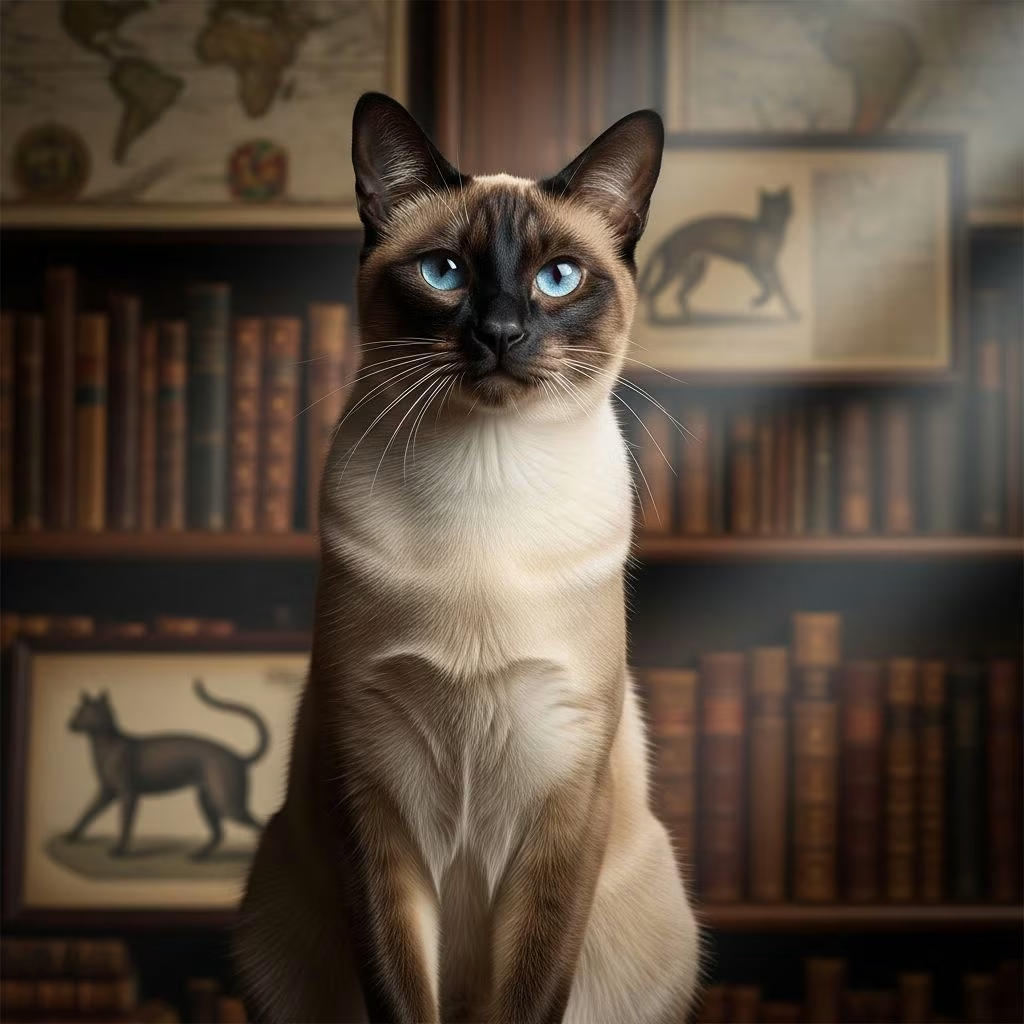
The Siamese cat, renowned for its striking blue eyes, sleek body, and color-pointed coat, traces its roots to ancient Thailand, formerly known as Siam. This breed emerged as a symbol of elegance and exclusivity, cherished by royalty and temple guardians long before captivating the world.
Ancient Beginnings in Thailand
Siamese cats, derived from the Wichianmat landrace, are among the oldest recognized Asian cat varieties. Historical manuscripts like the Tamra Maew (Cat-Book Poems), dating from the 14th to 18th centuries during the Ayutthaya Kingdom (1351–1767), first describe and illustrate these pointed cats. Preserved in institutions such as the National Library of Thailand, British Library, and National Library of Australia, these texts highlight their distinctive appearance and cultural significance.
In ancient Siam, Siamese cats held a revered status, often called the “Royal Cats of Siam” or “Royal Points.” Legends claim they were exclusive to the king and royal family, with ownership restricted to nobility. Theft of such a cat was reportedly punishable by death, underscoring their prestige. They also served as guardians of Buddhist temples and sacred sites, watching over precious artifacts with unwavering vigilance.
Early depictions note unique physical traits: crossed eyes and kinked tails. Folklore explains these as resulting from a cat’s intense gaze and tail-wrap around a royal goblet or temple vase, causing permanent changes. These features, once prized, were later bred out in Western lines for conformational standards.
Earliest Western Encounters
Western awareness of Siamese cats began in the 14th century with Italian traveler Giovanni de Marignolli’s account of a glossy-furred cat in Siam. However, substantive introductions occurred in the late 19th century. In 1871, British consul Edward Blencowe Gould gifted a pair named Pho and Mia to his sister, Lilian Jane Gould (later Veley), who co-founded the Siamese Cat Club in 1901. These cats debuted at London’s Crystal Palace Cat Show in 1885, alongside kittens Duen Ngai, Kalohom, and Khromata, drawing fascination despite the kittens’ untimely deaths.
That same year, 1871, saw Siamese at the first modern cat show in Europe. Queen Victoria received a pair from Gould, sparking aristocratic interest across Britain. By 1886, imports by Eva Forestier Walker and Ada Vyvyan bolstered the breeding pool, with most modern British Siamese descending from about eleven foundational cats. They were marketed as exotic “Royal Cats of Siam,” though evidence of organized royal breeding programs in Siam remains scant.
Arrival and Rise in America
Siamese cats reached the United States in 1878 (or 1879 per some accounts) when “Siam” was gifted to President Rutherford B. Hayes’ wife by the American consul in Bangkok. This marked the breed’s entry into the Western Hemisphere, where it quickly gained traction among cat enthusiasts.
Early American Siamese mirrored their Thai ancestors: robust builds, rounder heads, and substantial bodies. Exhibitions and breeding efforts paralleled Europe’s, with the breed’s novelty—its temperature-sensitive colorpoint pattern from partial albinism—captivating audiences. The pattern darkens on cooler body extremities like ears, face, paws, and tail.
Evolution of the Breed Standard
Original Siamese differed markedly from today’s sleek ideals. They featured larger frames, round faces, shorter thicker tails, and those signature kinks. Western breeders refined the type over decades. By the 1950s–1960s, selective breeding produced the “modern Siamese”: elongated bodies, wedge-shaped heads, large ears, and slender tails, emphasizing athleticism and angularity.
| Era | Key Traits | Notable Changes |
|---|---|---|
| Ancient Siam (pre-1800s) | Robust build, round head, kinked tail, crossed eyes | Temple/royal guardians |
| Early Western (1870s–1940s) | Substantial to slender, pointed coat novelty | Show debuts, imports |
| Modern (1950s+) | Streamlined body, angular face, long tail | Breeder preferences for elegance |
This table illustrates the breed’s transformation, driven by aesthetic ideals and show standards from organizations like The Cat Fanciers’ Association (CFA) and The International Cat Association (TICA).
Influence on Other Cat Breeds
Siamese genetics profoundly shaped modern cat fancy. Crossbreeding with Persians yielded the Himalayan (long-haired colorpoint, or Colorpoint Persian in CFA). Further interbreeding produced the Balinese (long-haired Siamese).
Other derivatives include:
- Burmese: From Wong Mau, a Burmese cat bred with Siamese in 1930s San Francisco.
- Cornish Rex, Sphynx, Peterbald: Hair-mutation breeds incorporating Siamese traits.
- Birman: Post-WWII reconstruction via Siamese crosses for pointed patterns.
Siamese’s colorpoint gene and vitality contributed to these hybrids’ popularity and hardiness.
Cultural Legacy and Legends
Beyond breeding, Siamese cats permeate culture. In Siam, they symbolized good fortune; gifting one honored recipients. Western media amplified mystique—early 20th-century books like Francis Simpson’s The Book of the Cat (1903) and Frank Townend Barton’s works chronicled their allure. Adele Locke, with her “Stockheavan Siam,” pioneered registration via the Beresford Cat Club.
Today, Siamese embody intelligence, vocality, and affection, often dubbed “people cats” for social bonds. Their legacy endures in art, literature, and homes worldwide.
Modern Siamese: Traits and Care
Contemporary Siamese boast short, fine coats in seal, chocolate, blue, lilac points, plus reds and creams. They are vocal, playful, and heat-sensitive, with points darkening in cooler areas.
Care tips:
- Provide interactive toys for their high energy.
- Monitor for dental issues and amyloidosis, common in the breed.
- Keep warm environments to preserve coat vibrancy.
Registered with CFA and TICA, they thrive as companions.
FAQs
Where did Siamese cats originate?
They hail from Thailand (ancient Siam), documented in 14th-century manuscripts.
Why do Siamese cats have blue eyes and pointed coats?
A temperature-sensitive albinism causes the colorpoint pattern and vivid blue eyes.
Were Siamese cats really royal?
Yes, legends portray them as exclusive to Siam’s royalty and temples.
How has the Siamese breed changed over time?
From robust ancients to slender moderns via Western selective breeding.
What breeds came from Siamese crosses?
Himalayan, Balinese, Burmese, Birman, and others.
References
- The History and Origin of the Siamese Cat Breed — Ministry of Cat. Accessed 2026. https://www.ministryofcat.com/blog/the-history-and-origin-of-the-siamese-cat-breed
- History & Breed Information on Siamese Cats & Kittens — Tresor Siamese Cats. Accessed 2026. http://tresorsiamesecats.com/siamesecathistory.html
- Siamese cat breed: History, personality and care — Cozy Cat Furniture. Accessed 2026. https://www.cozycatfurniture.com/blog/siamese-cat
- Siamese cat — Wikipedia (referencing Tamra Maew manuscripts, National Library of Thailand). Accessed 2026. https://en.wikipedia.org/wiki/Siamese_cat
- Siamese | Personality, Coloration & Origin — Britannica. Accessed 2026. https://www.britannica.com/animal/Siamese-breed-of-cat
- Siamese — The Cat Fanciers’ Association (CFA). Accessed 2026. https://cfa.org/breed/siamese/



