

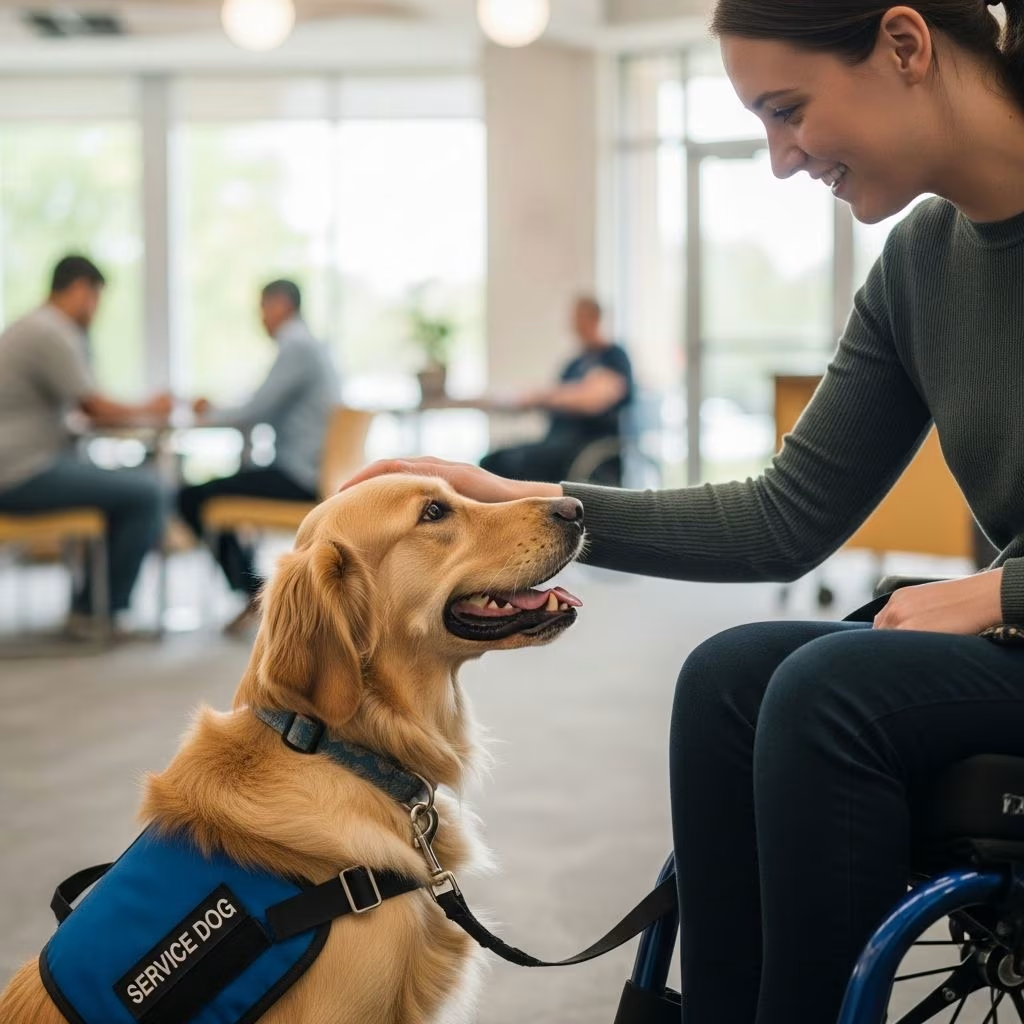
Service dogs represent a cornerstone of independence for countless individuals facing disabilities, performing specialized tasks that mitigate daily challenges. These highly trained canines go beyond companionship, acting as vital tools for enhancing quality of life across physical, sensory, and mental health spectra.
The Evolution of Assistance from Canines
The partnership between dogs and humans with disabilities traces back centuries, with early instances noted in 18th-century Europe. In 1785, a Paris institute began exploring dogs’ potential to guide visually impaired individuals, laying groundwork for formalized training. Post-World War I, demand surged as veterans returned with vision loss, prompting organized programs.
By the 1920s, the United States saw its first guide dog school, The Seeing Eye, established in 1929 by Dorothy Eustis and Morris Frank. This marked the advent of systematic training in America, initially focused on blindness but expanding thereafter. The 1970s brought innovation when Dr. Bonita Bergin coined “service dog,” recognizing applications for mobility and psychiatric needs.
Legal milestones accelerated growth. The Americans with Disabilities Act (ADA) of 1990 granted public access rights, evolving from prior protections limited to guide dogs. Today, approximately 500,000 service dogs assist Americans, reflecting a profound expansion in scope and impact.
Legal Framework Defining True Service Animals
The ADA strictly defines service animals as dogs individually trained to perform tasks benefiting people with disabilities, encompassing physical, sensory, psychiatric, intellectual, or mental impairments. This excludes emotional support animals (ESAs) or pets, emphasizing work over mere comfort.
Under ADA Titles II and III, only dogs qualify; miniature horses are permitted with modifications but not classified identically. Tasks must directly relate to the disability, such as retrieving items or alerting to medical episodes. No certification is federally required, though organizations like the AKC offer voluntary tests.
| Category | ADA Definition | Examples of Tasks |
|---|---|---|
| Guide Dogs | For visual impairments | Navigating obstacles, stopping at curbs |
| Hearing Dogs | For auditory impairments | Alerting to sounds like doorbells |
| Mobility Dogs | For physical limitations | Opening doors, steadying balance |
| Psychiatric Dogs | For mental health | Interrupting harmful behaviors, grounding during anxiety |
| Medical Alert Dogs | For conditions like seizures/diabetes | Detecting onset, summoning help |
This table outlines primary categories, highlighting task specificity required for legal recognition.
Specialized Roles in Everyday Support
Guide dogs remain iconic, safely leading visually impaired handlers through complex environments, a role refined over decades. Hearing dogs, or signal dogs, bridge auditory gaps by signaling door knocks, alarms, or approaching vehicles.
Mobility assistance dogs empower those with physical disabilities, performing feats like turning lights on/off, picking up dropped objects, or bracing for transfers from wheelchairs. Organizations like Canine Companions for Independence have placed thousands since 1975, users reporting heightened independence and security.
Psychiatric service dogs address invisible disabilities, such as PTSD or anxiety, by creating space in crowds, providing deep pressure therapy, or interrupting flashbacks—tasks increasingly vital for veterans. Medical alert dogs detect hypoglycemia in diabetics or seizure precursors, potentially life-saving.
Rigorous Training Pathways for Reliability
Service dog training demands 1-2 years, starting with puppies socialized in homes before advanced task instruction. Public access tests ensure calm behavior in diverse settings, from stores to restaurants. Accredited groups like Assistance Dogs International (ADI) and International Guide Dog Federation (IGDF) uphold standards, though owner-training is ADA-permissible if effective.
- Basic Obedience: Heel, sit, stay under distraction.
- Task-Specific Drills: Repeated practice for disability-related work.
- Public Access Certification: Ignoring food, maintaining focus amid stimuli.
- Team Bonding: Handler-dog synchronization for seamless performance.
- Ongoing Maintenance: Refresher training to sustain skills.
Breeds like Labrador Retrievers and Golden Retrievers dominate due to temperament and trainability.
Navigating Public Access Rights and Challenges
ADA mandates access to public spaces without fees, but handlers must manage control and cleanup. Businesses can inquire about tasks but not demand proof. Air travel follows DOT rules, updated in 2020 to curb pet misrepresentations as service animals.
Misuse erodes trust; fake vests proliferate, prompting state laws for verification. True teams face denial despite rights, underscoring education needs. Handlers report psychological boosts, including reduced isolation via social lubricant effects.
Health, Maintenance, and Long-Term Success
Service dogs incur costs of $20,000-$30,000, often grant-funded. Handlers ensure veterinary care, balanced nutrition, and mental stimulation to prevent burnout. Retirement at 8-10 years allows pet transitions, with success stories of extended contributions.
Research affirms benefits: increased safety, autonomy, and social engagement for mobility users. Psychiatric pairings alleviate symptoms, fostering resilience.
Future Horizons for Assistance Partnerships
Technological integrations like GPS vests and health monitors augment canine roles. Expanding psychiatric applications addresses mental health crises, particularly post-combat. Advocacy pushes enforcement amid misuse, ensuring protections for legitimate teams.
Global programs mirror U.S. models, with ADI fostering international standards. These evolutions promise broader access, solidifying dogs’ indispensable status.
Frequently Asked Questions (FAQs)
What qualifies a dog as a service dog under the ADA?
A dog individually trained to perform disability-mitigating tasks; ESAs do not qualify.
Do service dogs need certification or vests?
No federal mandate, but vests aid identification; voluntary tests exist.
Can service dogs accompany in all public places?
Yes, under ADA, excluding sterile areas or undue disruption.
What breeds make good service dogs?
Labs, Goldens, mixes with stable temperaments; no breed bans.
How can I get a service dog?
Contact accredited programs or pursue owner-training per ADA.
Are miniature horses service animals?
Allowed with modifications under Titles II/III, but not core definition.
References
- Individuals With Disabilities and Their Assistance Animals — ADA National Network. Accessed 2026. https://adata.org/legal_brief/individuals-disabilities-and-their-assistance-animals-brief-history-and-definitions
- Service Dogs and Emotional Support Animals: History, Laws, and Training — Ability Central. Accessed 2026. https://abilitycentral.org/article/service-dogs-and-emotional-support-animals-history-laws-and-training
- A Brief History of Service Dogs — BridgingApps. Accessed 2026. https://bridgingapps.org/a-brief-history-of-service-dogs-national-dog-month/
- A Brief History of Service Dogs — Paws for Purple Hearts. Accessed 2026. https://www.pawsforpurplehearts.org/blog/a-brief-history-of-service-dogs
- Service Dogs in the era of MAHA — Nursing Clio. 2025-08-06. https://nursingclio.org/2025/08/06/service-dogs-in-the-era-of-maha/
- Assistance Dogs: Historic Patterns and Roles of Dogs Placed by ADI — PMC (PubMed Central). Accessed 2026. https://pmc.ncbi.nlm.nih.gov/articles/PMC5243836/



