

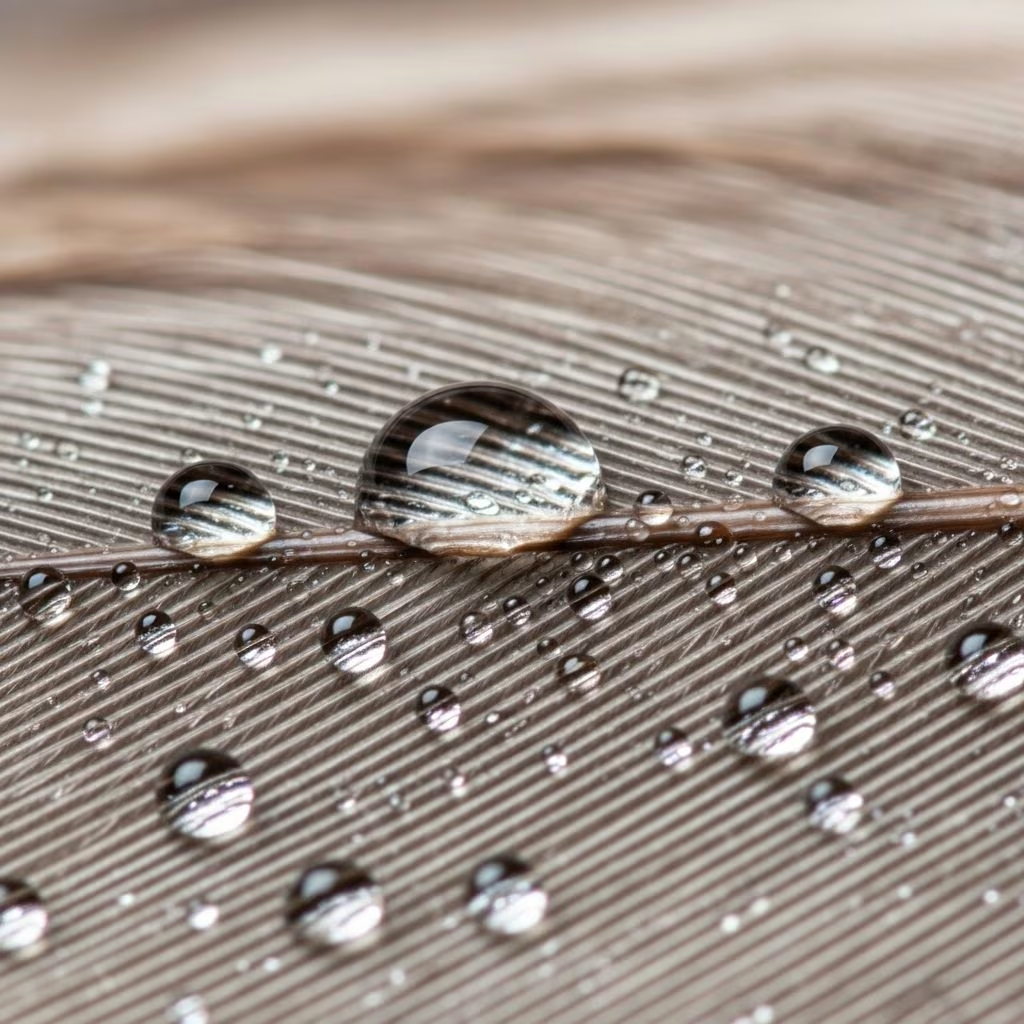
Birds exhibit extraordinary adaptations that allow them to navigate watery environments without compromising their insulation or buoyancy. Central to this ability is the waterproof nature of their feathers, achieved through a synergy of biological structures and behaviors. This article delves into the mechanisms, species-specific variations, and evolutionary insights that make avian plumage resilient to water.
The Anatomy of Water-Resistant Feathers
Feathers consist of a central shaft called the rachis, from which branch primary barbs. These barbs bear smaller barbules equipped with hooklets that interlock, forming a cohesive vane. This microstructure creates a dense, overlapping barrier that repels water, much like shingles on a roof. When intact, this structure prevents water from penetrating to the skin, maintaining body heat and flight capability.
Research demonstrates that the physical architecture, rather than solely chemical coatings, provides primary waterproofing. For instance, studies on diving birds reveal that feather barbs and barbules trap a thin air layer, known as a plastron, which insulates during submersion. Beyond shallow depths, this air layer collapses, yet feathers spontaneously shed water upon resurfacing due to reduced pressure.
Role of the Uropygial Gland in Feather Care
Located at the tail base, the uropygial gland, or preen gland, secretes a waxy oil that birds distribute via preening. This behavior involves rubbing the beak against the gland and then combing the oil across feathers. Contrary to popular belief, the oil does not primarily waterproof; instead, it conditions feathers, enhancing flexibility and preserving barbule interlocks.
The secretion offers additional benefits, including antimicrobial properties that combat feather-degrading microbes. In waterfowl like ducks and swans, active glands ensure plumage remains supple for prolonged water exposure. Damage to this gland can lead to waterlogging, impairing buoyancy.
- Ducks and geese: Highly active glands for super-waterproofing, enabling effortless floating.
- Owls: Oil prioritizes silent flight over water resistance; feathers absorb moisture readily.
- Flamingos: Use oil for plumage coloration and maintenance in saline environments.
Preening: The Daily Ritual for Protection
Preening occupies significant time in a bird’s routine, realigning feather components and applying oils or powders. This maintains the vane’s integrity, crucial for waterproofing. Birds without uropygial glands, such as pigeons or herons, rely on powder down—disintegrating specialized feathers that produce a talc-like substance for similar conditioning effects.
During preening, birds meticulously zip barbules, removing debris and parasites. This process ensures the feather surface remains smooth and non-porous, optimizing water repellency. Observations confirm that disrupted preening leads to matted feathers prone to wetting.
Diving Birds and Specialized Adaptations
Species like cormorants plunge to depths exceeding 30 meters, emerging remarkably dry. MIT research elucidates this through combined chemical and structural analysis. Feathers from diving birds, coated to isolate effects, showed that microstructure enables water ejection without evaporation—a process termed spontaneous dewetting.
Not all aquatic birds prioritize dryness. Anhingas possess reduced preen glands, allowing feathers to absorb water for streamlined underwater hunting. Post-dive, they perch with wings outstretched to evaporate moisture and thermoregulate. Double-crested cormorants similarly forgo full waterproofing to minimize air bubbles during dives.
| Bird Species | Waterproofing Level | Adaptation Purpose |
|---|---|---|
| Ducks/Swans | High | Buoyancy and insulation |
| Cormorants | Moderate (dewetting) | Deep diving efficiency |
| Anhingas | Low | Underwater propulsion |
| Owls | Low | Silent flight |
Debunking Myths About Feather Waterproofing
A widespread misconception attributes waterproofing solely to preen oil, akin to wax on a car. Experiments clarify that oil-coated feathers still wet if structurally compromised, underscoring architecture’s dominance. Simple demonstrations, like applying wax to feather replicas, illustrate beading but fail to replicate natural resilience without barbule hooks.
Understanding this distinction is vital for bird rehabilitation; treating waterlogged birds requires structural realignment over mere oiling.
Evolutionary Precision in Feather Design
Feather microstructures are finely tuned to species’ ecological niches, with minimal excess. Cormorant feathers, for example, withstand exact maximum dive pressures without overengineering, exemplifying evolutionary economy. This precision balances waterproofing, weight, and aerodynamics.
Comparative studies across taxa reveal convergent evolution: powder-down birds achieve analogous protection sans glands, highlighting diverse paths to water resistance.
Bio-Inspired Innovations from Bird Feathers
Avian waterproofing inspires engineering. Feather-like microstructures in textiles could yield breathable, water-repellent fabrics for outdoor gear. Self-cleaning surfaces mimicking preened plumage may reduce maintenance in hygiene-critical sectors.
Researchers replicate plastron effects for anti-fouling materials, drawing from diving bird studies. These applications promise sustainable technologies emulating nature’s efficiency.
Conservation Implications for Feather Health
Environmental pollutants, like oil spills, disrupt preen glands and feather integrity, leading to hypothermia in waterbirds. Rehabilitation focuses on gentle preening assistance and contaminant removal to restore natural waterproofing.
Climate-driven habitat changes challenge species reliant on wet environments, amplifying the need for gland function. Monitoring preening behaviors aids in assessing population health.
Frequently Asked Questions
What makes bird feathers waterproof?
The interlocking barbs and barbules form a primary barrier, supplemented by conditioning oils from the preen gland.
Do all birds have waterproof feathers?
No; diving specialists like anhingas intentionally allow water absorption for hunting efficiency.
How do cormorants stay dry after deep dives?
Their feathers enable spontaneous dewetting as pressure drops upon surfacing.
What happens if a bird’s preen gland fails?
Feathers lose conditioning, becoming brittle and less water-resistant, risking buoyancy loss.
Can human technology mimic bird feathers?
Yes, bio-inspired surfaces replicate microstructures for waterproof, self-cleaning materials.
References
- How cormorants emerge dry after deep dives — MIT News. 2014-06-16. https://news.mit.edu/2014/how-cormorants-emerge-dry-after-deep-dives-0616
- The Secret Behind Waterproof Feathers & More: The Preen Gland — Birdorable. N/A. https://www.birdorable.com/blog/the-secret-behind-waterproof-feathers-the-preen-gland
- Preening Waterproofs Feathers — AskNature. N/A. https://asknature.org/strategy/preening-waterproofs-feathers/
- How are birds’ feathers waterproofed? — BBC Science Focus Magazine. N/A. https://www.sciencefocus.com/nature/how-are-birds-feathers-waterproofed
- Clearing Up Misconceptions About Feather Waterproofing — International Bird Rescue. N/A. https://www.birdrescue.org/clearing-up-misconceptions-about-feather-waterproofing/



