

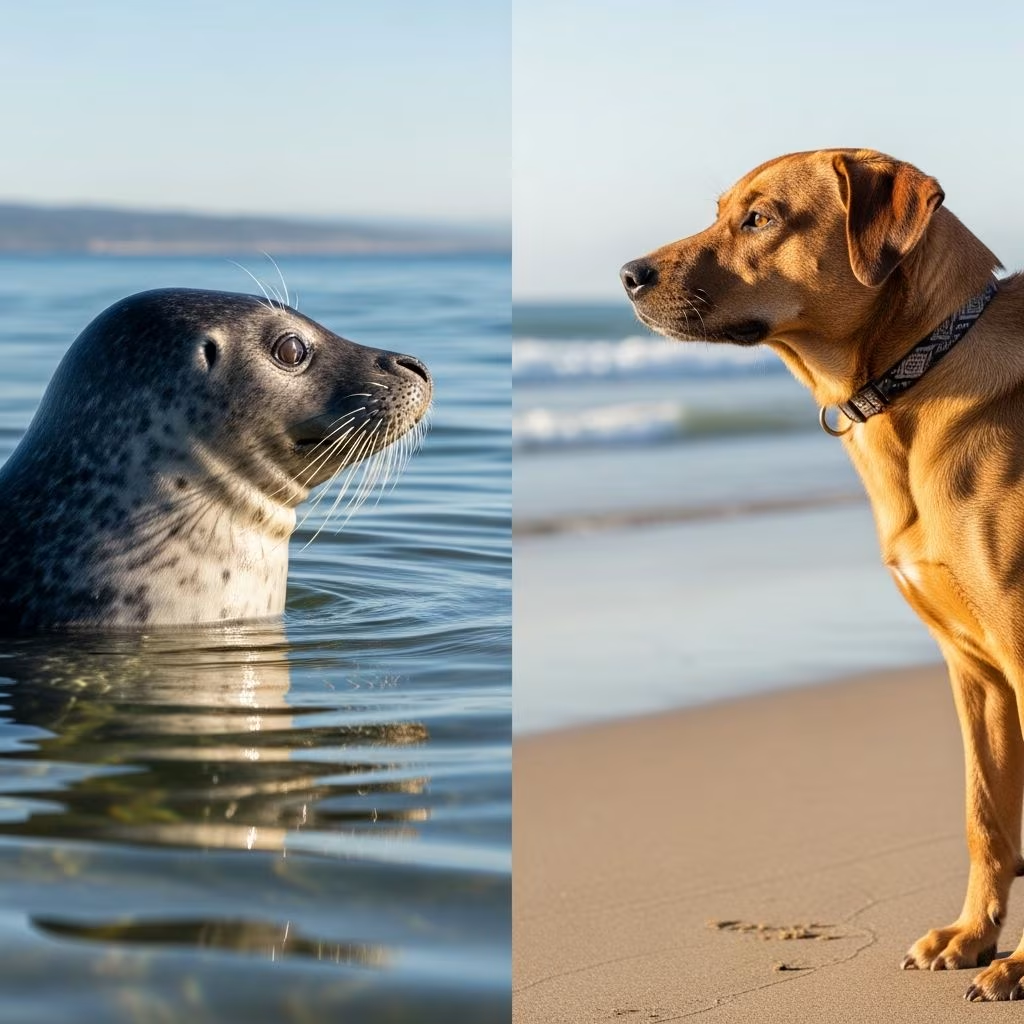
When observing a seal resting on rocky shores or gliding gracefully through ocean waves, many people are struck by its resemblance to a dog. Their expressive eyes, responsive vocalizations, and playful nature evoke comparisons to our cherished canine companions. Yet this similarity raises an intriguing biological question: are these marine mammals actually related to terrestrial dogs, or is their resemblance merely coincidental? The answer lies deep within evolutionary history and reveals a connection that spans millions of years.
The Taxonomic Framework: Understanding Animal Classification
To comprehend the relationship between seals and dogs, it is essential to understand how biologists classify living organisms. Both creatures belong to the order Carnivora, a diverse group that also encompasses bears, weasels, raccoons, and many other species. This order is further subdivided into two major branches that diverged early in carnivoran evolution.
The first branch, called Caniformia, includes dogs, seals, bears, and musteloids. The second branch, Feliformia, comprises cats, hyenas, and other feline-related carnivores. This fundamental classification system demonstrates that seals are more closely aligned with dogs than with any cat species, despite their aquatic lifestyle.
Within Caniformia, dogs occupy the family Canidae, while seals belong to a group known as pinnipeds, a term derived from Latin meaning “fin-footed.” This pinniped classification includes not only seals but also sea lions and walruses. Despite their marine adaptations, pinnipeds retain enough genetic and morphological characteristics to indicate their kinship with terrestrial carnivores.
A Shared Evolutionary Journey: Tracing Ancestral Lineages
The evolutionary narrative connecting seals and dogs begins with an ancient ancestor from the carnivore family tree. Approximately 50 million years ago, the lineage that would eventually produce modern pinnipeds diverged from the musteloid group, which includes weasels, raccoons, skunks, and red pandas. This divergence marked a critical moment in evolutionary history when ancestor populations began adapting to different environmental niches.
Fossil evidence provides compelling support for this evolutionary connection. Scientists have identified transitional forms, including the extinct species Puijila, which exhibited characteristics intermediate between terrestrial carnivores and modern seals. These fossils suggest that seal ancestors initially adapted to freshwater environments before eventually colonizing marine ecosystems. The evolutionary progression demonstrates how a single ancestral population gradually transformed over millions of years, with some populations remaining on land as canines while others became increasingly aquatic.
Around 28 to 30 million years ago, pinnipeds began their aquatic specialization along the west coast of North America. This timing is crucial because it indicates that seals and dogs have been evolving separately for tens of millions of years, allowing sufficient time for the development of their distinctive characteristics while retaining fundamental similarities rooted in their common heritage.
Comparative Physical Features: Where Similarities Emerge
Beyond their taxonomic classification, seals and dogs share numerous physical characteristics that reflect their shared ancestry. Both possess streamlined body structures optimized for efficient movement—seals through water and dogs across land. Their facial features, including rounded heads, short muzzles, and sensitive whiskers, demonstrate remarkable parallels despite their vastly different habitats.
The whisker systems, or vibrissae, present an especially instructive example of shared morphology serving different purposes. In dogs, whiskers provide tactile feedback during hunting and navigation. In seals, these same structures function as sophisticated sensory organs, detecting minute water movements and vibrations created by fish, making them invaluable for underwater hunting. This parallel development suggests that their common ancestor possessed this anatomical feature, which both lineages retained and refined according to their environmental demands.
Another striking similarity involves their skeletal structure, particularly in the limbs. While dogs retained four functional legs adapted for terrestrial locomotion, seals evolved flippers from homologous structures. This transformation represents a remarkable example of evolutionary adaptation where the same basic skeletal plan was modified to serve entirely different functions. The underlying bone structure remains fundamentally similar, betraying the common origin of both animal groups.
Behavioral Parallels: Intelligence and Social Complexity
Beyond physical characteristics, seals and dogs demonstrate remarkable behavioral similarities that further underscore their evolutionary connection. Both species display sophisticated problem-solving abilities and exhibit complex social structures within their groups. These cognitive capacities likely emerged from their shared ancestral lineage, providing both species with the mental flexibility required for survival in their respective environments.
Communication between individuals represents another compelling behavioral parallel. Seals and dogs both utilize body language extensively to convey information to group members. Mother seals recognize their offspring through distinctive vocalizations and scent markers, employing recognition mechanisms strikingly similar to those dogs use to identify human family members. This shared communication methodology suggests that the underlying neurobiological systems for social bonding evolved in their common ancestor and have been preserved across millions of years of divergent evolution.
Both species also demonstrate playfulness and curiosity, traits often associated with intelligence in mammals. In captive and wild settings, seals engage in what researchers interpret as play behavior, much like dogs do. This behavioral tendency may reflect the adaptability that allowed both lineages to thrive in diverse and challenging environments.
Physiological Adaptations: Specialization for Different Worlds
While seals and dogs share fundamental similarities, they have developed divergent physiological specializations reflecting their adaptation to distinct environmental niches. These differences highlight how evolution has molded the same basic mammalian blueprint into creatures supremely suited for their habitats.
Respiratory and Diving Capabilities: Seals have evolved extraordinary breath-holding capacities, capable of remaining submerged for up to two hours depending on the species. This remarkable ability involves specialized adaptations including increased oxygen storage in the blood and muscles, and dramatic physiological changes during dives. Dogs, by contrast, lack these adaptations and typically cannot remain underwater for extended periods without drowning.
Sensory Systems: While dogs possess an unparalleled sense of smell for terrestrial tracking, seals have developed enhanced underwater vision and sophisticated echolocation-like abilities through their whisker systems. Seals possess a specialized reflective layer in their eyes called the tapetum lucidum, which enhances vision in low-light underwater conditions—an adaptation absent in most dogs.
Temperature Regulation: Certain seal species, such as harp seals, thrive in Arctic conditions through enhanced thermoregulation, while specific dog breeds like malamutes have similarly evolved cold-weather adaptations. Both have developed mechanisms for maintaining body temperature in extreme environments, though through somewhat different physiological pathways.
Migration and Movement: Evolutionary Strategies for Resource Access
Both seals and dogs have developed migratory or highly mobile lifestyles, though expressed differently according to their environments. Many seal species undertake extensive oceanic migrations spanning thousands of miles in search of food sources or breeding grounds. Similarly, certain dog breeds, particularly huskies and other working breeds, have evolved remarkable endurance and the ability to traverse challenging terrains for extended distances.
These behavioral patterns reflect a shared ancestral tendency toward mobility and adaptability. Rather than remaining sedentary in limited territories, both lineages evolved the physiological capacity and behavioral drive to move extensively through their environments. This shared characteristic demonstrates how the same selective pressures—the need to locate dispersed resources and access optimal breeding sites—can produce superficially different but fundamentally similar solutions in geographically separated populations.
Understanding Convergent Evolution and Deep Time
It is important to recognize that while seals and dogs share a common ancestor, they also display many similarities that have emerged through convergent evolution—the independent development of similar traits in response to comparable environmental pressures. The streamlined body shape, for instance, represents an optimal solution for efficient movement through fluid mediums, whether water or across open terrain. Both seals and dogs have independently refined this body plan, resulting in superficial resemblance without direct inheritance of specific traits.
However, the fundamental similarities in skeletal structure, sensory systems, and behavior indicate genuine common descent rather than pure convergence. The distinction matters because it reveals how evolution operates across deep time—maintaining certain basic designs while allowing for dramatic specialization and adaptation.
FAQ: Common Questions About Seals and Dogs
Q: Can seals and dogs interbreed?
A: No. Despite their evolutionary relationship, seals and dogs are too genetically distant to produce viable offspring. They diverged approximately 50 million years ago, accumulating sufficient genetic differences to make interbreeding impossible.
Q: Why do people call seals “sea dogs”?
A: This colloquial term reflects the visual and behavioral similarities between these animals. With their whiskered faces, vocalizations, and playful nature, seals evoke comparisons to canines, leading to this poetic description.
Q: Are seals closer to dogs or cats evolutionarily?
A: Seals are substantially closer to dogs. Both belong to Caniformia within the order Carnivora, whereas cats belong to the separate Feliformia branch.
Q: How do we know seals and dogs are related?
A: Scientists rely on multiple lines of evidence including fossil records, comparative anatomy, molecular genetics, and shared behavioral patterns. These converging sources of evidence establish the evolutionary connection between these species.
The Broader Significance of Understanding Animal Relationships
Comprehending the relationship between seals and dogs extends beyond satisfying intellectual curiosity. Understanding evolutionary connections provides insights into how life has diversified and adapted across Earth’s history. It demonstrates the principle that seemingly disparate creatures may share deep historical connections, with all living organisms ultimately linked through common ancestry to life’s earliest forms.
This knowledge also informs conservation efforts and helps biologists predict how different species might respond to environmental changes. By understanding how seals and dogs have adapted to different ecological niches from a common ancestor, scientists can better anticipate the potential for other species to adapt, or conversely, identify which species face the greatest extinction risk in rapidly changing environments.
Furthermore, studying these relationships fosters appreciation for the remarkable creative power of evolution. The same basic mammalian body plan has been refined into countless variations—from the diminutive weasel to the massive elephant seal, from the swift greyhound to the deep-diving leopard seal. This diversity arising from common ancestry represents one of nature’s most compelling stories.
Conclusion: Two Branches of an Ancient Tree
Seals and dogs represent two magnificent branches of an evolutionary tree that extends back tens of millions of years. Though they have followed dramatically different paths, one leading to life in the ocean and the other remaining on land, they retain the unmistakable signature of shared ancestry. Their similarities in physiology, cognition, and behavior echo their kinship, while their differences showcase the extraordinary adaptability of the mammalian form. In recognizing this connection, we gain deeper appreciation for both creatures and for the processes that have shaped all life on Earth.
References
- Pinniped — Wikipedia. Accessed January 2026. https://en.wikipedia.org/wiki/Pinniped
- The Canine Connection: Why Seals Resemble Dogs — Oreate AI Blog. https://www.oreateai.com/blog/the-canine-connection-why-seals-resemble-dogs/



