

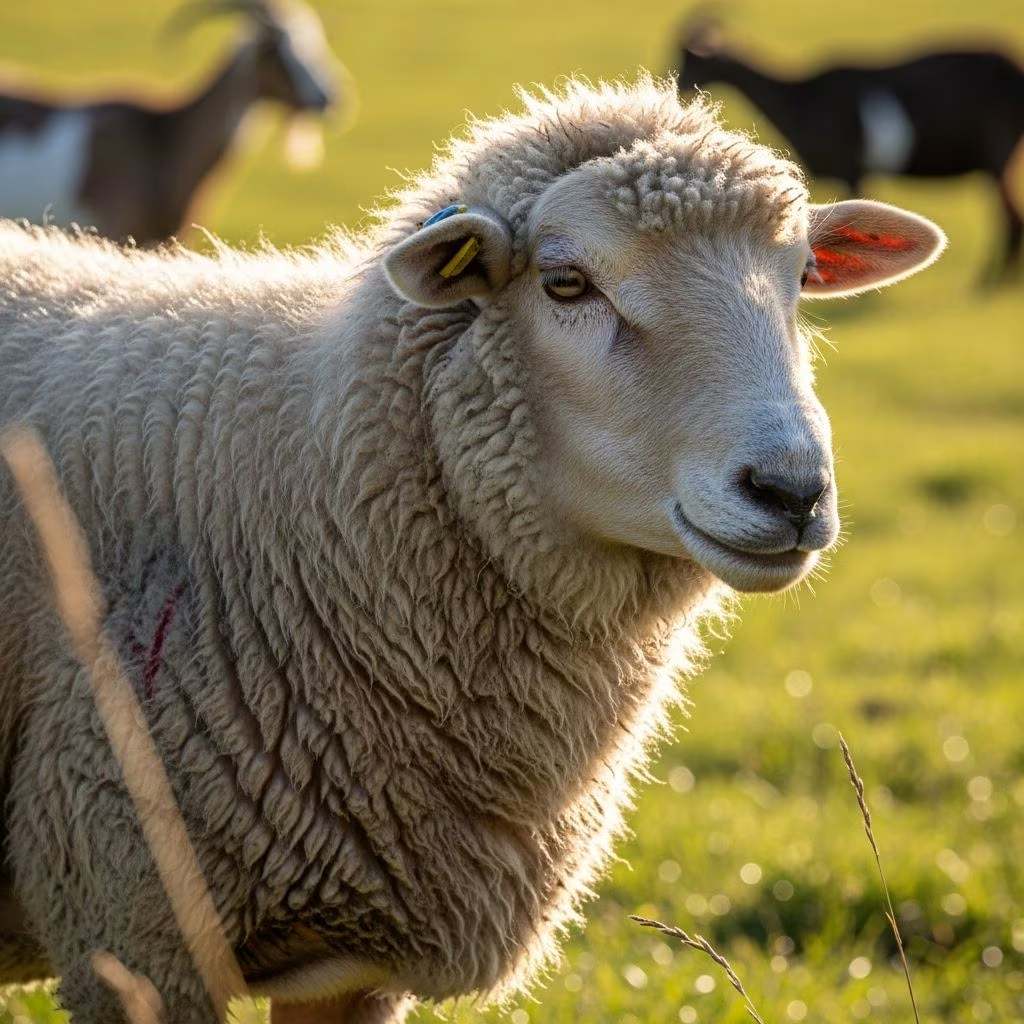
Scrapie represents one of the most persistent and devastating neurological disorders in small ruminants, primarily impacting sheep and, to a lesser extent, goats. This prion-induced condition leads to inevitable death once clinical symptoms emerge, posing significant challenges to livestock producers worldwide. Characterized by progressive degeneration of the central nervous system, scrapie has been documented for centuries, yet modern science has illuminated its molecular basis and control mechanisms.
The Nature and Cause of Scrapie
At its core, scrapie is a transmissible spongiform encephalopathy (TSE), a category of fatal neurodegenerative diseases triggered by prions—misfolded proteins that propagate by inducing normal proteins to adopt their aberrant conformation. The cellular prion protein (PrPC), encoded by the PRNP gene, undergoes transformation into the pathogenic scrapie form (PrPSc), which aggregates in neural and lymphoid tissues, causing vacuolation and neuronal loss.
Classical scrapie, the longstanding form, affects animals of various ages and spreads efficiently within flocks. In contrast, atypical scrapie, identified since the late 1990s, typically manifests in older individuals and lacks evidence of natural contagion, suggesting sporadic origins. These distinctions influence epidemiology, with classical cases driving outbreaks and atypical ones appearing isolated.
How Scrapie Spreads in Herds
Transmission of classical scrapie occurs vertically from dam to offspring, especially via placental tissues and birthing fluids, and horizontally through contaminated environments. Ingested prions enter via gut-associated lymphoid tissue, disseminating systemically before invading the nervous system after a prolonged incubation of 2–7 years. Environmental persistence exacerbates spread, as prions resist degradation, surviving in soil, feed troughs, and pasture for years. Scavengers can further disseminate them, though semen-borne transmission remains negligible.
Atypical scrapie defies this pattern, showing no confirmed natural spread, which aligns with its potential spontaneous generation in aged animals. Flock dynamics amplify risks: overcrowding, shared lambing pens, and reuse of contaminated equipment facilitate prion exchange.
Recognizing Clinical Manifestations
Signs of scrapie emerge insidiously, varying by strain, species, and host genetics. Early indicators often involve behavioral shifts—animals may isolate, show aggression, or display anxiety—followed by weight loss despite robust appetite. The hallmark pruritus (intense itching) prompts wool rubbing against fences, earning the disease its name.
Neurological deficits progress to ataxia (uncoordinated gait), high-stepping forelimbs, bunny-hopping hindlimbs, tremors, and blindness. Affected individuals weaken, become recumbent, and succumb within weeks to months. In goats, symptoms skew toward emaciation and lethargy, sometimes without overt itching. Most cases appear between 2–5 years, though subclinical carriers perpetuate transmission.
| Stage | Sheep Signs | Goat Signs |
|---|---|---|
| Early | Behavioral changes, isolation, mild weight loss | Listlessness, appetite unchanged but emaciation begins |
| Mid | Pruritus, wool loss, ataxia, tremors | Weight loss progresses, weakness |
| Late | Recumbency, blindness, death | Recumbency, death within months |
Diagnostic Approaches and Challenges
Antemortem diagnosis proves elusive due to nonspecific signs overlapping with listeriosis, rabies, or chronic infections like paratuberculosis. Definitive confirmation relies on postmortem analysis: immunohistochemistry (IHC), ELISA, or Western blot detect PrPSc in brainstem or lymphoid tissues. Historical histopathology revealed spongiform changes, but molecular assays now offer higher sensitivity.
- IHC: Gold standard for tissue localization of prions.
- ELISA/Western Blot: Rapid screening in surveillance programs.
- Genetic Testing: Identifies resistant genotypes pre-symptomatically.
Surveillance mandates slaughter checks and tracing in many nations, enabling early flock quarantine.
Genetic Factors Influencing Susceptibility
The PRNP gene’s polymorphisms dictate resistance, particularly at codons 136, 154, and 171 in sheep. Genotypes like QQ171 confer high susceptibility, while RR171 provides robust protection against classical scrapie. Goats exhibit similar but less characterized variations.
Breed predispositions exist—black-faced sheep (e.g., Suffolks) face higher risks—yet selective breeding with resistant rams has slashed incidence. Programs encourage genotyping to phase out vulnerable animals.
| Genotype (Codon 171) | Risk Level | Notes |
|---|---|---|
| High | Susceptible to most strains | |
| QR | Moderate | Partial resistance |
| RR | Low/None | Strong protection; breeding priority |
Control and Eradication Initiatives
No vaccines or treatments exist; management hinges on prevention. National programs like the U.S. Scrapie Eradication Program emphasize surveillance, genetic selection, flock certification, and depopulation of infected groups. Exposed herds face quarantine and testing.
Best practices include clean lambing areas, limiting ewe numbers per pen, and exporting only resistant stock. Internationally, WOAH guidelines promote standardized testing and trade restrictions. Success stories abound: many regions near eradication through diligent breeding.
Economic and Global Implications
Scrapie erodes profitability via culls, trade bans, and lost productivity. Infected flocks dwindle economically over years as cases accumulate. Globally, it spurred TSE research, confirming no human link despite BSE parallels. Producers must navigate regulations, investing in genotyping for certification.
Frequently Asked Questions (FAQs)
What causes scrapie in livestock?
Scrapie stems from prions, misfolded proteins that corrupt normal ones, leading to brain degeneration.
Is scrapie contagious to humans?
No evidence links scrapie to human TSEs; it poses no zoonotic risk.
How long does it take for scrapie symptoms to appear?
Incubation spans 2–7 years, with signs typically at 2–5 years.
Can scrapie be prevented through breeding?
Yes, selecting RR171 genotypes confers resistance; genetic testing is key.
What should I do if scrapie is suspected in my flock?
Report immediately, isolate suspects, and cooperate with veterinary authorities for testing and quarantine.
Practical Management Tips for Producers
- Maintain detailed ID records for tracing.
- Use low-risk genetics in breeding stock.
- Disinfect lambing barns annually with strong bleach solutions.
- Participate in surveillance submissions.
- Avoid importing from high-risk areas.
References
- Sheep and Goats – Health and Disease Considerations — Minnesota Board of Animal Health. Accessed 2026. http://www.bah.state.mn.us/sheep-goats
- BOAH: Scrapie — Indiana State Board of Animal Health. Accessed 2026. https://www.in.gov/boah/species-information/cattle-sheep-and-other-ruminants/sheep-and-goats/scrapie/
- Scrapie – Nervous System — Merck Veterinary Manual. Accessed 2026. https://www.merckvetmanual.com/nervous-system/scrapie/scrapie
- Scrapie — World Organisation for Animal Health (WOAH). Accessed 2026. https://www.woah.org/en/disease/scrapie/
- Scrapie — Oklahoma State University Extension. Accessed 2026. https://extension.okstate.edu/fact-sheets/scrapie.html
- Federal disease control — Scrapie — PMC (PubMed Central). 2003-07-01. https://pmc.ncbi.nlm.nih.gov/articles/PMC339408/
- Scrapie Factsheet — Center for Food Security and Public Health, Iowa State University. Accessed 2026. https://www.cfsph.iastate.edu/Factsheets/pdfs/scrapie.pdf



