Frog Greenness: Key Insights Into Its Science & Evolution
Discover the biological mechanisms, evolutionary advantages, and genetic secrets behind the iconic green hues of frogs worldwide.
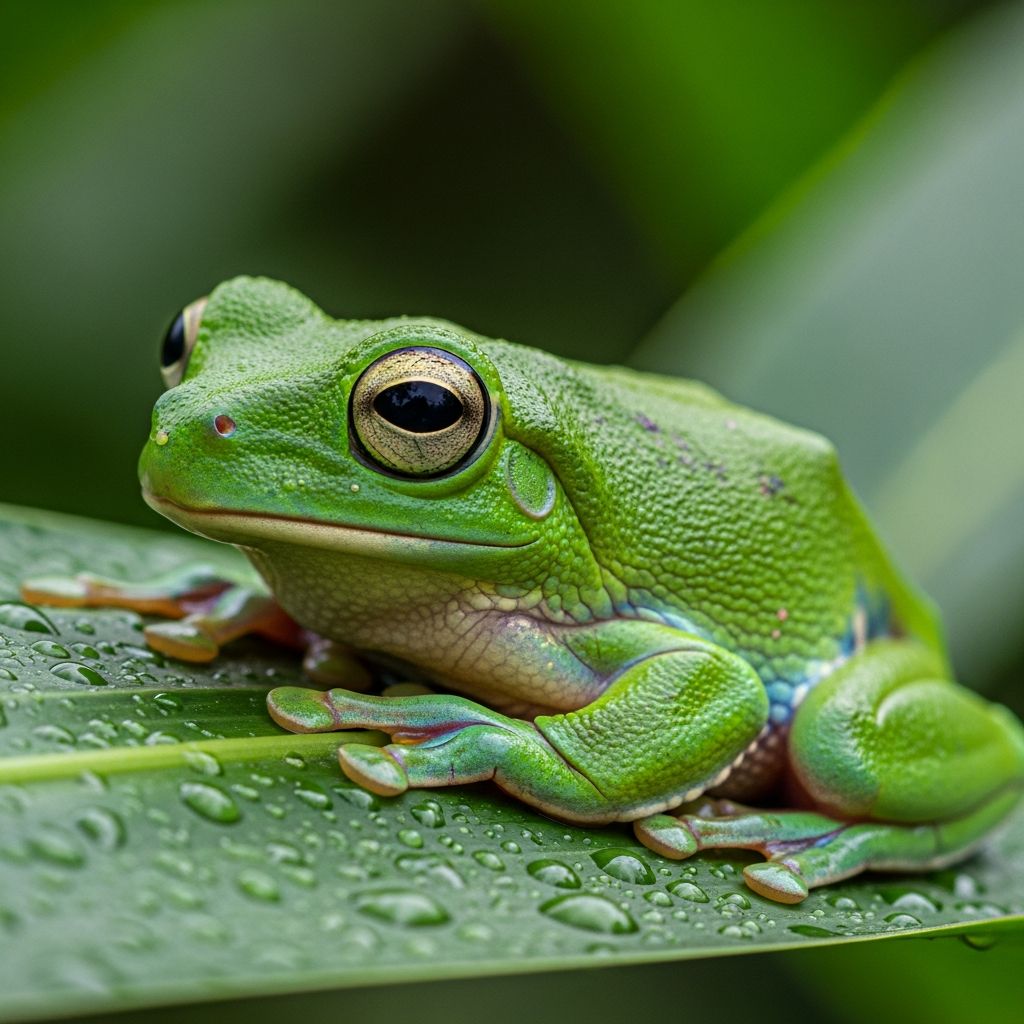
The Science of Frog Greenness
Frogs captivate observers with their vibrant green appearances, a trait that serves critical roles in survival. This coloration arises from a combination of pigments, cellular structures, and biochemical innovations that have evolved across diverse species.
Biological Foundations of Green Pigments
Green hues in frogs primarily stem from specialized skin cells called chromatophores, which house pigments and reflective structures. These cells include xanthophores containing yellow pteridine pigments and iridophores with light-scattering guanine crystals. When yellow pigments overlay blue-reflected light from iridophores, the result is green.
This pigment-structural interplay allows precise color tuning. In many species, hormonal signals trigger chromatophore expansion or contraction, enabling rapid color changes for camouflage or signaling.
Deep-Tissue Coloration: Beyond the Skin
Some frogs exhibit green not just on the surface but throughout their bodies, including lymphatic fluid, muscles, and bones—a condition termed physiological chlorosis. This pervasive greenness relies on high levels of biliverdin (BV), a byproduct of heme breakdown from red blood cells.
Normally toxic and excreted, BV accumulates in these frogs due to binding by serpin family proteins. These proteins, known as biliverdin-binding serpins (BBS), modulate BV’s light absorption to produce vivid green shades, even in sparse chromatophore environments.
Evolutionary Origins and Multiple Pathways
Green coloration has arisen independently numerous times in frog lineages. Studies document at least 41 evolutionary origins of chlorosis across anuran families, predominantly in arboreal treefrogs from regions like South America, Madagascar, and Southeast Asia.
This convergent evolution highlights adaptations to leafy habitats, where through-and-through greenness provides superior camouflage, including in near-infrared spectra invisible to humans but relevant to predators. In non-chlorotic frogs, surface greenness via chromatophores dominates.
Genetic Mechanisms Driving Variation
Genetic studies reveal color polymorphism, such as green versus brown morphs, persists over millions of years. Analysis of 2,363 frog and toad species shows these variants link to increased speciation and habitat adaptation.
In African grass frogs (Ptychadena), green and brown forms trace to genetic variants maintained for over 8 million years via balancing selection, a rare process preserving diversity across evolutionary splits. Early work on Pacific tree frogs (Hyla regilla) identified two-locus genetics, with dominant alleles required for green.
Camouflage and Survival Advantages
Green serves as cryptic camouflage against foliage, reducing predation. Polymorphic populations with green and brown individuals better match varied backgrounds, enhancing group survival.
Arboreal species benefit most from BV-based greenness, as translucent skin and internal pigmentation create seamless leaf mimicry. This adaptation likely drove diversification by enabling niche expansion.
| Coloration Type | Mechanism | Examples | Evolutionary Benefit |
|---|---|---|---|
| Surface Pigment-Structural | Chromatophores + Iridophores | Most pond frogs | Dynamic camouflage |
| Deep Chlorosis | Biliverdin + Serpins | Treefrogs, glassfrogs | Full-body leaf mimicry |
| Polymorphic | Multi-locus genetics | Ptychadena, Hyla | Habitat versatility |
Structural Color Contributions
Beyond pigments, nanostructures in iridophores produce interference colors. Layered guanine platelets reflect specific wavelengths, contributing blue-green tones that combine with yellow pigments for green.
In some species, this structural component ensures color stability under varying light, vital for constant camouflage.
Environmental and Physiological Influences
External factors like temperature, humidity, and background influence color via neurohormones. Stress or mating can shift shades, while diet affects pteridine availability.
Chlorosis involves modified heme catabolism, bypassing bilirubin conversion to retain BV, an adaptation repurposing antiviral serpins for pigmentation.
Comparative Analysis Across Species
- Treefrogs (Hylidae): Frequent chlorosis via independent serpin paralogs, ideal for canopy life.
- Glassfrogs (Centrolenidae): Potentially homologous BBS, with high sequence similarity.
- Grass Frogs (Ptychadena): Ancient polymorphism driving diversification.
- Pacific Tree Frogs: Two-locus inheritance for green dominance.
Implications for Conservation and Research
Understanding these mechanisms aids conservation, as habitat loss disrupts camouflage efficacy. Genetic persistence of polymorphisms underscores biodiversity value.
Future studies may explore serpin evolution and BV roles in health, given its antioxidant properties.
Frequently Asked Questions
Why do some frogs have green bones?
Green bones result from biliverdin accumulation bound by serpins, creating physiological chlorosis for enhanced camouflage.
Can frogs change color to green?
Yes, many adjust green intensity via chromatophore control influenced by environment and hormones.
Is frog greenness always for camouflage?
Primarily yes, but polymorphism also aids speciation and niche adaptation.
How many times has deep greenness evolved?
At least 41 times independently in frogs.
Do all green frogs use the same mechanism?
No; surface green uses pigments/structures, while deep green employs BV-serpin binding.
References
- Green and brown persist—study reveals the role of color in driving frog evolution — phys.org. 2025-09. https://phys.org/news/2025-09-green-brown-persist-reveals-role.html
- Multiple origins of green coloration in frogs mediated by a family of serpins that bind biliverdin — PMC (Proceedings of the National Academy of Sciences). 2020-07-13. https://pmc.ncbi.nlm.nih.gov/articles/PMC7414155/
- Green is more than skin-deep for hundreds of frog species — ScienceDaily (Duke University). 2020-07-13. https://www.sciencedaily.com/releases/2020/07/200713165602.htm
- Green is More Than Skin-Deep for Hundreds of Frog Species — Duke Today. 2020-07. https://today.duke.edu/2020/07/green-more-skin-deep-hundreds-frog-species
- Color Polymorphism in Pacific Tree Frogs — Science. 1963. https://www.science.org/doi/10.1126/science.142.3595.1081
- Long-term evolutionary persistence of a cryptic color polymorphism in frogs — PNAS. 2025. https://www.pnas.org/doi/10.1073/pnas.2425898122
Similar Articles








Read full bio of medha deb