

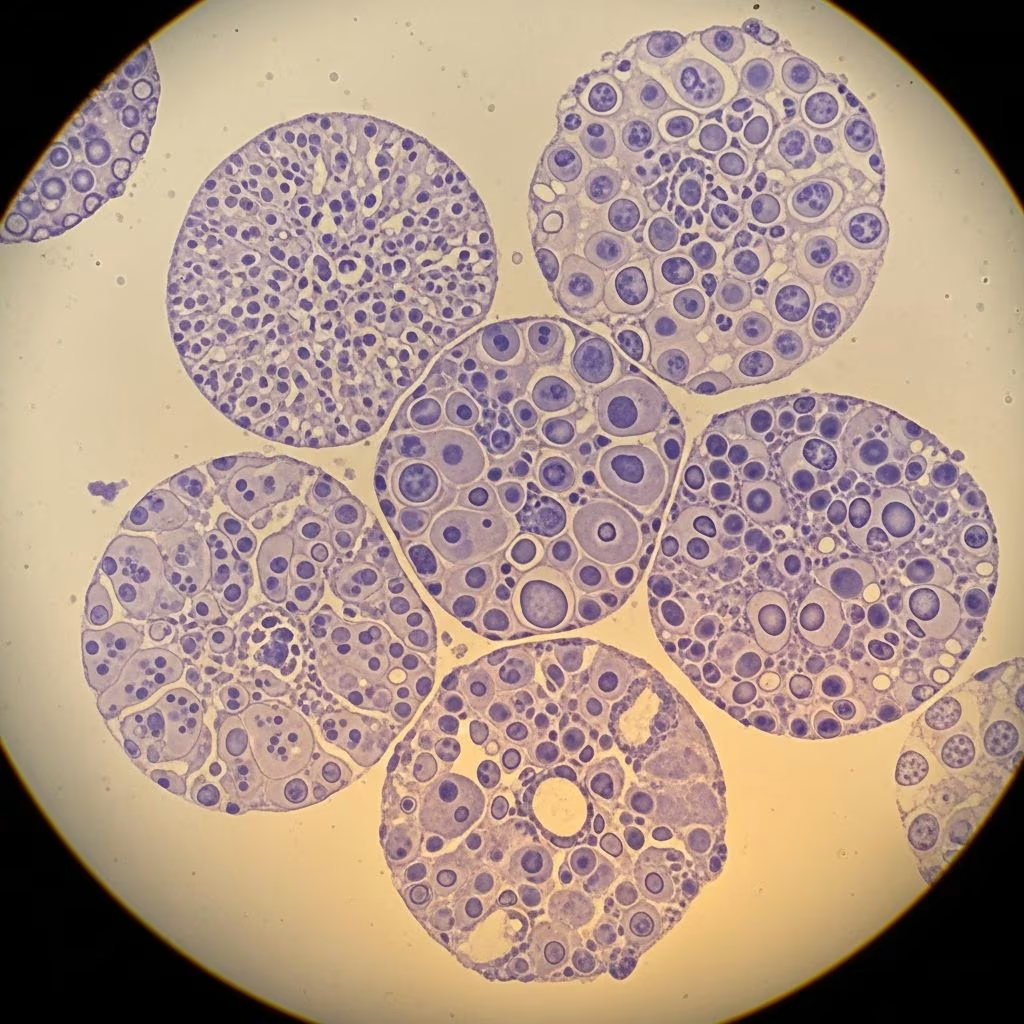
Round cell tumors represent a significant category of canine skin and subcutaneous neoplasms, characterized by their uniform, round-shaped cells under microscopic examination. These tumors, primarily of hematopoietic origin, include histiocytoma, mast cell tumor, plasmacytoma, transmissible venereal tumor, and lymphoma. They account for a substantial portion of cutaneous masses in dogs, with mast cell tumors being the most prevalent, comprising over 80% in some pathology reviews. Early detection through fine-needle aspiration cytology is crucial, as these tumors vary widely in behavior from benign and self-resolving to highly malignant with metastatic potential.
Understanding Round Cell Tumors: Origins and Identification
These neoplasms arise from immune system cells or their precursors, distinguishing them from epithelial or mesenchymal tumors via their non-cohesive, round morphology on cytology. Common presentations include raised dermal nodules, plaques, or subcutaneous masses, often alopecic (hairless) and variably ulcerated. Breeds like Boxers, Boston Terriers, and Cocker Spaniels show predispositions across types. Diagnosis typically starts with cytology, revealing round cells with species-specific features, followed by biopsy for histopathology and grading.
- Cytologic hallmarks: Discrete round cells, high nuclear-to-cytoplasmic ratios, and minimal matrix.
- Imaging and staging: Ultrasound, radiographs, or lymph node mapping for metastasis assessment.
- Grading systems: Essential for prognosis, especially in mast cell tumors using Patnaik (3-tier) or Kiupel (2-tier) schemes.
1. Canine Cutaneous Histiocytoma: The Benign Youthful Lesion
Histiocytomas are the quintessential benign round cell tumor, predominantly affecting young dogs under three years old. These self-limiting growths originate from Langerhans cells (a type of dendritic histiocyte) in the skin. Grossly, they appear as solitary, raised, button-like, red nodules, typically 0.5-2 cm in diameter, often on the head, ears, or limbs.
Histologically, they feature uniform round cells with abundant eosinophilic cytoplasm, kidney-shaped nuclei, and characteristic intracytoplasmic vacuoles. Mitoses are frequent but lack atypia. Spontaneous regression occurs in 2-3 months via immune-mediated apoptosis, though surgical excision is recommended if persistent or in older dogs to rule out malignancy.
| Breed Predisposition | Age Group | Typical Location | Prognosis |
|---|---|---|---|
| Boxers, Bulldogs, Dachshunds | <3 years | Head, limbs | Excellent (self-resolve) |
| Flat-coated Retrievers | Young adults | Ears, trunk | Excellent |
Rare aggressive variants, termed invasive histiocytomas, may metastasize to lymph nodes, but these are exceptional.
2. Mast Cell Tumors: The Most Common Culprit
Mast cell tumors (MCTs) dominate canine round cell tumors, representing 7-21% of all skin tumors and over 80% of round cell submissions in recent analyses. They arise from mast cells, which release histamine and heparin, causing variable gross appearances from pale plaques to edematous, ulcerated masses. Predisposed breeds include Boxers, Boston Terriers, Bulldogs, and Shar-Peis, typically in middle-aged to older dogs.
Cytology shows round cells with purple cytoplasmic granules (metachromatic with toluidine blue), often accompanied by eosinophils. Grading is pivotal: Kiupel’s high-grade tumors have poor prognosis with metastasis rates up to 50%, while low-grade are cured by wide excision. Lymph node staging uses Weishaar et al.’s HN0-HN3 system, where HN2/HN3 indicates overt metastasis and worse outcomes. Stefanello et al. (2024) confirmed that in clinically normal nodes, HN status adds little prognostic value beyond tumor grade.
- Treatment ladder: Surgery (first-line), tyrosine kinase inhibitors (e.g., masitinib for grade II/III), radiation for incompletely excised margins.
- Prognostic factors: Grade, location (limbs worse), KIT mutations.
Subtypes like diffuse cutaneous mastocytosis or urticaria pigmentosa-like lesions are rare, often regressing spontaneously.
3. Plasmacytoma: Plasma Cell Proliferations
Plasmacytomas, or plasma cell tumors, comprise about 8% of canine cutaneous round cell tumors. These occur in older dogs, with Cocker Spaniels, Yorkshire Terriers, and West Highland White Terriers at higher risk. Lesions present as small, raised, red, alopecic nodules, histologically showing a Grenz zone (collagen barrier to epidermis) and eccentric, clock-face chromatin nuclei in plasma cells.
Most are solitary cutaneous forms and benign, with surgical cure rates near 100%. However, 5-10% progress to malignant multiple myeloma, involving bone marrow and systemic signs like hyperglobulinemia. Cytology reveals flame cells or Mott cells (with Russell bodies). Differentiation from histiocytoma is key via immunohistochemistry (e.g., lambda light chain positivity).
Management: Complete excision; monitor for recurrence or myeloma via serum protein electrophoresis.
4. Transmissible Venereal Tumor: The Infectious Neoplasm
Unique among round cell tumors, the canine transmissible venereal tumor (TVT), also called sticker’s sarcoma, spreads via direct cell-to-cell contact during mating, causing genital masses in both sexes. It appears as friable, cauliflower-like, bleeding nodules on external genitalia, oral cavity, or nasal passages in endemic areas.
Cytology displays uniform round cells with large nuclei and vacuolated cytoplasm. Remarkably, TVT regresses under chemotherapy (e.g., vincristine), as the donor dog’s cells are rejected by the host’s immune system via karyotypic differences. No breed or age predilection; rare metastasis to lymph nodes or organs.
- Transmission: Coitus, biting, fomites.
- Treatment success: 90-95% with weekly vincristine (4-6 doses).
5. Cutaneous Lymphoma: The Aggressive Lymphoid Malignancy
Accounting for 4% of round cell tumors, cutaneous lymphomas are often epitheliotropic T-cell types (mycosis fungoides), presenting as multifocal plaques, erythroderma, ulcers, or nodules. Older dogs affected; no strong breed link. Histology shows lymphoid cells invading epithelium, with Pautrier microabscesses.
Prognosis is guarded; median survival 6-12 months despite multimodal therapy (chemotherapy like CHOP protocol, radiation). Differentiation from inflammatory dermatitis requires biopsy.
Diagnostic Approaches and Differential Lists
Fine-needle aspiration provides rapid round cell identification, but histopathology confirms type. Differentials include histiocytic sarcoma (2-3% of cases, subcutaneous, extremities) or melanoma (poorly pigmented variants mimic round cells).
| Tumor Type | Cytology Clue | Histology Key | Behavior |
|---|---|---|---|
| Histiocytoma | Kidney nuclei | CD1a+ Langerhans | Benign |
| MCT | Granules | c-KIT expression | Variable |
| Plasmacytoma | Clock-face nuclei | Grenz zone | Mostly benign |
| TVT | Vacuoles | Anisokaryosis low | Benign w/ tx |
| Lymphoma | Lymphoid | Epitheliotropism | Malignant |
Treatment Strategies Across Tumor Types
Surgery remains cornerstone for localized tumors. Adjuncts include:
- Chemotherapy: Vincristine for TVT/MCT; lomustine for lymphoma.
- Radiation: For incompletely excised MCTs or epitheliotropic lymphoma.
- Targeted therapy: Toceranib (Palladia) for c-KIT mutated MCTs.
- Monitoring: Serial cytology of sentinel nodes, abdominal ultrasound.
Prognosis hinges on grade, stage, and completeness of excision. Recent data emphasize sentinel lymph node mapping for MCTs.
Frequently Asked Questions (FAQs)
What causes round cell tumors in dogs?
Genetic mutations, breed predispositions, and environmental factors; exact etiology often idiopathic.
Are all round cell tumors cancerous?
No, histiocytomas and most plasmacytomas are benign; MCTs and lymphomas vary.
How is a round cell tumor diagnosed?
Cytology first, confirmed by biopsy and IHC.
Can round cell tumors be prevented?
No specific prevention; regular skin checks aid early detection.
What is the survival rate for mast cell tumors?
Low-grade: >90% with surgery; high-grade: 20-50% with multimodal therapy.
Recent Advances and Prognosis Insights
2024 studies refine lymph node classification, reducing overtreatment in MCTs with normal nodes. AI-assisted histopathology improves classification accuracy across 117 cases. Owners should consult veterinary oncologists for staging and personalized plans.
References
- Vetrepropath: Canine Round Cell Tumors of Skin and Subcutis — Vetrepropath. 2024. https://vetrepropath.com/VetDermPath/Canine/Canine_Masses/Canine_Skin_Neoplasms/Canine_round_cell_tumors.html
- Round Cell Tumors in Dogs – VCA Animal Hospitals — VCA Hospitals. 2023. https://vcahospitals.com/know-your-pet/plasmacytic-tumors
- Histopathological Classification of Canine Cutaneous Round Cell Tumors — PMC/NCBI. 2021-04-20. https://pmc.ncbi.nlm.nih.gov/articles/PMC8044886/
- Canine and Feline Cutaneous Round Cell Tumors — MSPCA-Angell. 2023. https://www.mspca.org/angell_services/canine-and-feline-cutaneous-round-cell-tumors/
- Tumors of the Skin in Dogs — Merck Veterinary Manual. 2025. https://www.merckvetmanual.com/dog-owners/skin-disorders-of-dogs/tumors-of-the-skin-in-dogs
- Differentiating the round cell tumors (Proceedings) — DVM360. 2022. https://dvm360.com/view/differentiating-round-cell-tumors-proceedings



