Rodents: 5 Key Suborders, Traits, And Ecological Roles
Explore the vast world of rodents, from common pests to vital lab models, and their unique adaptations across global ecosystems.
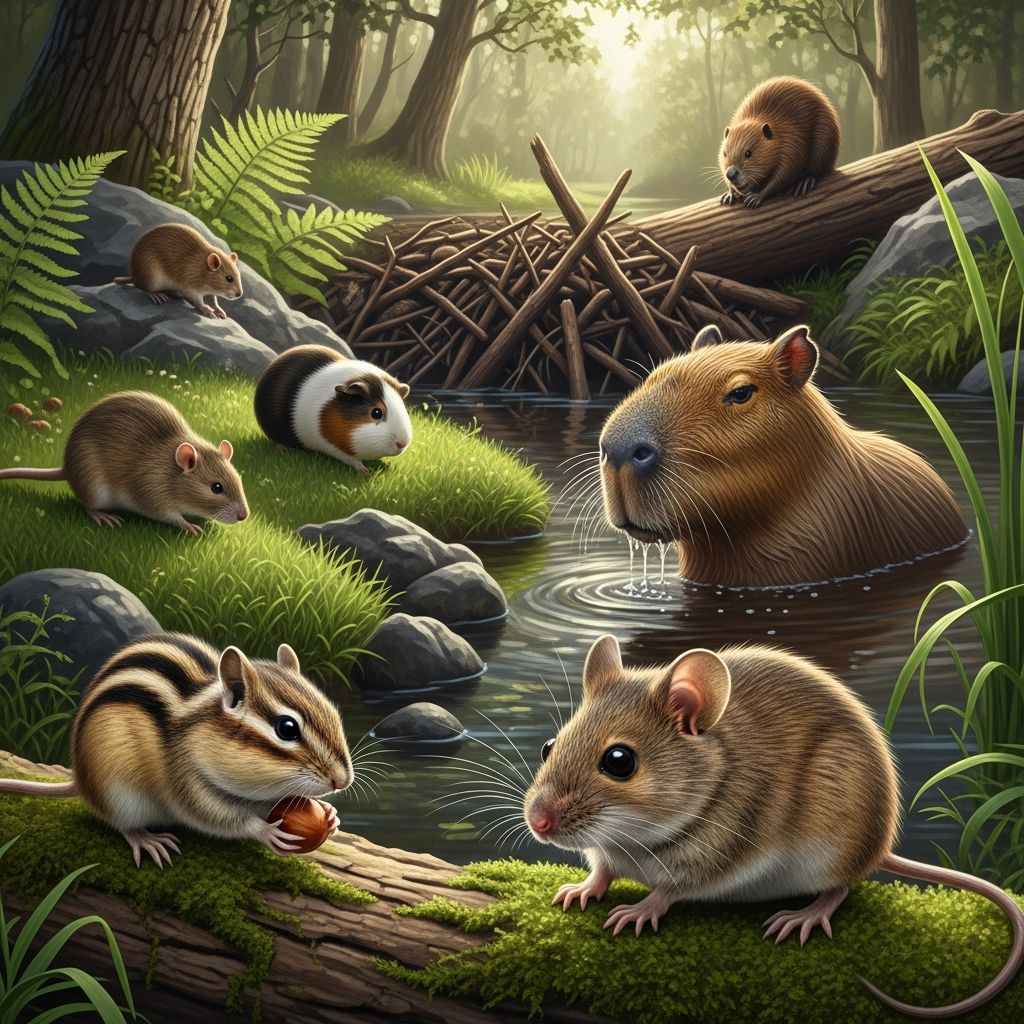
Rodents represent the most diverse order of mammals, encompassing over 2,000 species that thrive in nearly every terrestrial habitat worldwide except Antarctica. Defined by their continuously growing incisors, these animals exhibit remarkable adaptations that enable survival in varied environments, from forests to deserts.
Evolutionary Origins and Taxonomy
The order Rodentia traces its roots to the late Paleocene epoch, evolving from small, rodent-like mammals known as anagalids. Today, rodents account for about 40% of all mammal species, with classifications dividing them into suborders based on jaw morphology, skull structure, and molecular data.
Taxonomically, rodents fall under Kingdom Animalia, Phylum Chordata, Class Mammalia. Key suborders include:
- Sciuromorpha: Squirrel-like rodents with robust skulls, including squirrels, chipmunks, and beavers.
- Myomorpha: Mouse-like forms with elongated snouts, such as mice, rats, hamsters, and voles.
- Hystricomorpha: Porcupine-like rodents featuring specialized jaw angles, encompassing porcupines, capybaras, and guinea pigs.
- Castorimorpha: Includes beavers, pocket gophers, and kangaroo rats adapted for digging and semi-aquatic life.
- Anomaluromorpha: African specialists like scaly-tailed squirrels and springhares with gliding abilities.
Molecular phylogenetics further refines this into clades like Sciuriodea (squirrel-related) and Myodonta (mouse-related), highlighting evolutionary divergences.
Defining Physical Characteristics
All rodents share a signature trait: a single pair of upper and lower incisors that grow lifelong, maintained sharp by gnawing. These chisel-shaped teeth feature enamel only on the front, wearing down unevenly for efficiency. A diastema—a gap behind the incisors—separates them from molars, aiding in food processing.
Body plans vary widely: most are small (10g to a few kg), but capybaras reach 70kg as the largest. Common features include fur-covered bodies, tails for balance or fat storage, and short legs. Specializations abound:
- Cheek pouches in hamsters for food transport.
- Prehensile tails in some South American species.
- Quills in porcupines or dense fur in chinchillas.
- Elongated hind limbs in jerboas for jumping.
| Feature | Description | Examples |
|---|---|---|
| Incisors | Continuously growing, enamel-fronted | All rodents |
| Body Size | 10g to 70kg | Mouse to Capybara |
| Tail Adaptations | Balance, prehensile, fat storage | Squirrels, New World monkeys-like |
| Sensory | Large eyes/ears, vibrissae | Desert rats, nocturnal species |
Habitat Diversity and Ecological Roles
Rodents occupy niches from arboreal canopies to subterranean burrows, semiaquatic marshes, and arid rocky outcrops. South America boasts exceptional diversity due to historical isolation, producing unique forms like viscachas and tuco-tucos.
- Arboreal: Tree squirrels leap between branches.
- Fossorial: Mole rats and gophers tunnel extensively.
- Semiaquatic: Beavers build dams; muskrats inhabit wetlands.
- Saltatorial: Jerboas and kangaroo rats hop across dunes.
Ecologically, rodents serve as prey, seed dispersers, and soil aerators. However, some like rats damage crops and transmit diseases such as plague and hantavirus, costing billions annually.
Behavioral Patterns and Social Structures
Most rodents are nocturnal or crepuscular, relying on keen senses. Sociality varies: prairie dogs form complex colonies with alarm calls, while solitary porcupines defend territories. Reproduction is prolific; mice gestate 20 days, birthing litters of 5-10 multiple times yearly.
Behaviors include hoarding food, communal nesting, and migration in lemmings—though mass drownings are overstated myths. Intelligence shines in puzzle-solving rats and tool-using capybaras.
Rodents in Human Contexts
Pets and Companions
Guinea pigs, hamsters, and gerbils make popular pets due to small size, sociability, and low maintenance. They require spacious cages, chew toys for dental health, and herbivorous diets.
Laboratory and Research Importance
Mice and rats dominate biomedical research, modeling human diseases from cancer to neurology owing to genetic manipulability and short generations. Over 1100 Muridae species underscore their utility.
Economic Impacts
Positive: Fur from nutria, food in regions (capybara meat). Negative: Crop losses, structural damage by beavers.
Health Considerations in Captivity
Veterinary care for pet or lab rodents focuses on dental overgrowth, respiratory infections, and obesity. Diets must include hay for abrasion; enclosures need enrichment to curb stereotypic behaviors like bar-biting.
- Common issues: Wet tail in hamsters, ringtail in rats.
- Preventives: Clean bedding, balanced nutrition, quarantine.
Conservation Challenges
While abundant overall, habitat loss threatens species like the Iberian lynx-preyed rodents or island endemics. Capybaras face overhunting; naked mole rats intrigue for eusociality and cancer resistance.
Frequently Asked Questions (FAQs)
What defines a rodent?
Rodents have continuously growing incisors without roots, used for gnawing.
How many rodent species exist?
Over 2,000, in 30+ families.
Are all rodents pests?
No; many aid ecosystems, serve research, or are pets.
What’s the largest rodent?
Capybara, up to 70kg.
Do rodents carry diseases?
Some do, like hantavirus, but proper handling mitigates risks.
References
- Rodentia – PMC – NIH — National Institutes of Health. 2020-04-01. https://pmc.ncbi.nlm.nih.gov/articles/PMC7158172/
- Rodent Facts: The Ultimate Guide To The Order Rodentia — Active Wild. 2023-01-15. https://www.activewild.com/rodents/
- Essential Guide to the Different Types of Rodents — 369 Bugs. 2024-05-20. https://www.369bugs.com/blog/types-of-rodents/
- Rodents | Anatomy and Physiology — EBSCO Research Starters. 2022-11-10. https://www.ebsco.com/research-starters/anatomy-and-physiology/rodents
- Rodentia — UC Berkeley UCMP. 2023-08-05. https://ucmp.berkeley.edu/mammal/rodentia/rodentia.html
- Rodent – Wikipedia — Wikipedia Contributors. 2026-02-20. https://en.wikipedia.org/wiki/Rodent
Similar Articles








Read full bio of Sneha Tete