

Understanding Rodent Ulcers in Cats
Rodent ulcers, medically known as indolent ulcers or eosinophilic ulcers, are a common dermatological condition affecting cats worldwide. Despite their concerning name, these lesions have nothing to do with rodent bites. The term originated from an outdated misconception that the ulcers were caused by rodent attacks, but veterinary science has since clarified that these are inflammatory skin lesions caused by the cat’s own immune system response. Understanding this condition is crucial for cat owners seeking to provide proper care and treatment for their feline companions.
What Are Rodent Ulcers?
Rodent ulcers are eosinophilic lesions that form part of the feline Eosinophilic Granuloma Complex (EGC), a group of inflammatory skin conditions in cats. These ulcers typically appear as raised, eroded patches of skin with characteristic shallow depressions and crusting. The lesions are painless in most cases, which is why they’re called “indolent” ulcers—a term derived from the Latin word “indolens” meaning “without pain.” Most cats show no visible discomfort despite the ulcer’s striking appearance.
Location and Appearance
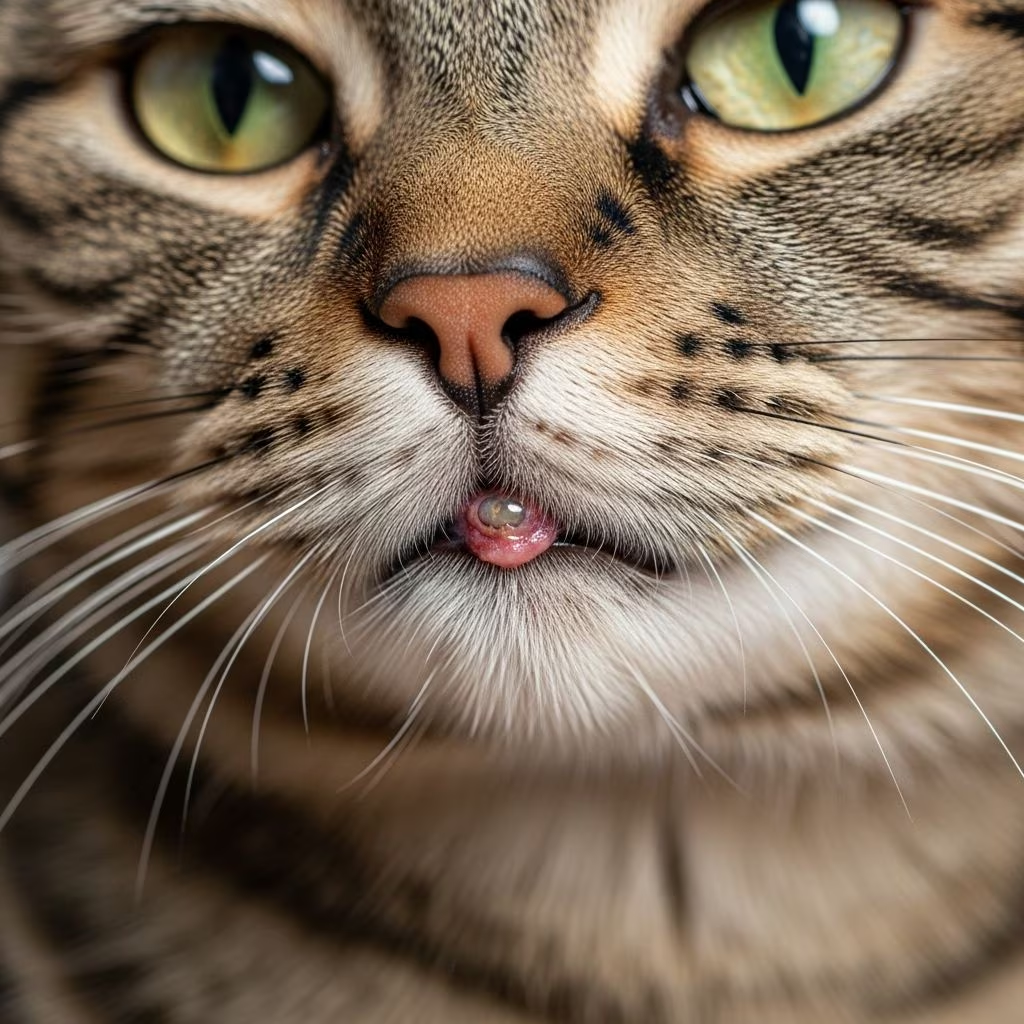
The most common site for rodent ulcers is the upper lip, particularly near the philtrum (the area between the nose and upper lip) or adjacent to the upper canine teeth. These ulcers can appear as small, barely noticeable lesions or develop into large, extensive sores that significantly disfigure the lips. Some lesions may bleed, and affected cats can develop swollen, puffy chins. The ulcers may present unilaterally (on one side) or bilaterally (on both sides) with symmetrical patterns. In some cases, lesions also develop on the roof of the mouth or other oral areas.
Clinically, indolent ulcers exhibit superficial crusting, erythema (redness), and depressed ulcers at the lip margin. Without treatment, these lesions can progress slowly or rapidly, becoming increasingly disfiguring over time.
Causes and Risk Factors
Rodent ulcers are not diseases themselves but rather clinical signs indicating an underlying condition. The presence of these lesions should alert veterinarians to investigate common causes of allergies in cats. The primary underlying causes include:
Flea Bite Hypersensitivity
Flea allergy is the most common cause of rodent ulcers in cats. Cats with flea bite hypersensitivity have an exaggerated immune response to flea saliva, even from a single flea bite. This heightened reaction triggers eosinophil accumulation in the skin, leading to ulcer formation. Interestingly, cats with this condition don’t need to have fleas to develop ulcers—historical flea exposure or minimal flea contact can trigger the response.
Food Allergies
Some cats develop rodent ulcers due to underlying food sensitivities. Food allergies can trigger an immune-mediated inflammatory response that manifests as these characteristic lip ulcers. Identifying food allergens through elimination diet trials may help resolve the condition in susceptible cats.
Environmental Allergies (Atopic Dermatitis)
Feline atopy, or environmental allergies to substances like pollen, dust mites, or mold, is another significant trigger for rodent ulcer development. Cats with atopic dermatitis may experience seasonal or year-round symptoms, with rodent ulcers being one manifestation of their allergic response.
Secondary Bacterial Infections
While not a primary cause, secondary bacterial infections can complicate existing ulcers and delay healing. The ulcer’s location and constant moisture in the oral cavity create an environment susceptible to bacterial colonization.
Clinical Signs and Diagnosis
Most cats with rodent ulcers present with minimal or no visible discomfort, making the condition easy to overlook initially. Pet owners often discover the ulcers incidentally during routine grooming or play.
Observable Symptoms
- Raised, eroded patches on the upper lip or mouth
- Superficial crusting and redness around the lesion
- Bleeding from some ulcers
- Swelling or puffiness of the chin or lip area
- Lesions that may appear on one or both sides of the mouth
- Progressive enlargement without treatment
- Occasionally, mild behavioral changes if the cat experiences discomfort while eating
Diagnostic Approach
A thorough veterinary examination is essential for proper diagnosis and treatment planning. Diagnostics typically include:
- Visual examination of the lesion and surrounding tissues
- Cytology (microscopic examination of cells from the ulcer) to identify eosinophils and check for bacterial involvement
- Bacterial culture and susceptibility testing if secondary infection is suspected
- Dermatological evaluation to identify other signs of allergic disease
- Oral examination to assess extent of involvement
- Allergy testing (intradermal or serum IgE testing) if environmental allergies are suspected
- Biopsy in atypical cases to rule out other conditions
A comprehensive history is also important, including flea exposure, diet changes, environmental factors, and any other dermatological or systemic signs.
Treatment Options
Successful treatment of rodent ulcers depends on identifying and addressing the underlying cause. A multi-faceted approach is typically most effective.
Flea Control
Strict flea control is essential in cats with rodent ulcers and should be the first treatment approach. Comprehensive flea prevention should be maintained for 2–4 months, even if fleas are not visible. Modern flea preventatives with rapid kill times are preferred, as they eliminate fleas before they can bite. Flea control should be continued indefinitely in susceptible cats to prevent recurrence.
Antimicrobial Therapy
If bacterial involvement is suggested by cytology, antibacterial therapy may be initiated for 3–4 weeks. Some cases respond to antibacterial therapy as the sole treatment. Suitable antibacterial agents include:
- Clindamycin at 11–22 mg/kg once daily
- Clavulanic acid potentiated amoxicillin at 12.5 mg/kg every 12 hours
- Doxycycline at 5–10 mg/kg every 12 hours
Lip ulcers and exudative lesions often improve with concurrent antimicrobial therapy based upon culture and susceptibility results. Empirical antimicrobial therapy without culture should be avoided.
Corticosteroids
Corticosteroids are the most common treatment for controlling rodent ulcer symptoms. These anti-inflammatory medications are available in different forms:
- Oral tablets or liquid preparations for regular administration
- Long-lasting injections for cats unable or unwilling to take oral medications
- Topical creams for localized application
Common corticosteroid dosages include prednisolone at 1–2 mg/kg orally every 24 hours until resolution, or triamcinolone acetate at 0.05–0.1 mg/kg orally every 24 hours for up to 10 days. Resolution typically takes several weeks. Side effects of corticosteroids are usually not significant in cats, though prolonged use may cause weight gain and predispose cats to diabetes mellitus.
Cyclosporine
For cats that don’t respond adequately to corticosteroids or require long-term management, cyclosporine is an effective immunosuppressive alternative. The initial dose is 7.5 mg/kg, tapering to the same dose every 48–72 hours. Many cats can be maintained on every 72-hour dosing. Cats receiving cyclosporine should be tested for FIV and FeLV viruses, and there is a small increased risk of Toxoplasma acquisition in outdoor cats.
Dietary Management
Some cats respond to elimination diet trials or hypoallergenic diets, suggesting an underlying food allergy is the cause. Most cats diagnosed with EGC benefit from a hypoallergenic food trial using commercial hydrolyzed diets for 6–8 weeks. If remission is not maintained once anti-inflammatory treatment is stopped, food intolerance can be effectively ruled out.
Surgical Intervention
In severe cases where skin refuses to heal despite medical management, surgery may be necessary to speed up recovery. However, most cats improve significantly with medical treatment alone.
Long-Term Management
Treatment may last for weeks or months because eosinophilic granulomas frequently recur. Prolonged treatment minimizes the chance of recurrence. Many cats require life-long treatment and repeat courses of medication to keep symptoms under control, especially if triggers for allergies cannot be completely avoided.
The most effective long-term approach involves:
- Maintaining year-round flea control
- Identifying and avoiding food or environmental triggers
- Using the lowest possible doses of anti-inflammatory medications
- Regular veterinary monitoring
- Adjusting treatment as needed based on response
Prognosis
The prognosis for rodent ulcer resolution depends significantly on successful identification and management of the underlying cause. If the underlying disease is identified and managed successfully, prognosis is excellent. If the underlying disease is not controlled, recurrence of the lesion is likely.
Most cats with eosinophilic dermatitis respond very well to treatment. In many cases, symptoms come and go throughout life but can usually be well-managed with ongoing medication. Cats with recurring lesions for which no underlying cause can be found usually require long-term drug therapy to maintain remission and have a more guarded prognosis.
In many cases, lesions may spontaneously vanish over time. However, if itching persists, affected cats may continue scratching at the lesion, preventing healing. If a cat doesn’t improve with standard treatment, referral to a specialist veterinary dermatology clinic for further investigations may be beneficial.
Frequently Asked Questions
Q: Why are they called rodent ulcers if they’re not caused by rodents?
A: The term originated from an outdated misconception that the ulcers were caused by rodent bites. This historical misnomer has persisted, though veterinary professionals now prefer the more accurate terms “indolent ulcers” or “eosinophilic ulcers.”
Q: Are rodent ulcers painful for cats?
A: Despite their striking appearance and severe ulceration, most cats with indolent ulcers are visibly comfortable and active with good appetites. Pruritus (itching) and pain are rare. However, some cats may experience mild discomfort while eating.
Q: Can rodent ulcers be prevented?
A: While complete prevention may not be possible for all cats, maintaining strict year-round flea control significantly reduces the risk. Additionally, identifying and managing underlying food or environmental allergies helps prevent ulcer development.
Q: How long does treatment take?
A: Treatment duration varies depending on the underlying cause and individual response. Resolution typically takes several weeks with appropriate therapy. However, many cats require long-term or life-long treatment to maintain remission.
Q: What happens if my cat doesn’t respond to treatment?
A: If standard treatment doesn’t produce improvement, consultation with a veterinary dermatologist is recommended. Further investigations may reveal underlying causes not initially identified, or alternative treatment protocols may be necessary.
References
- Eosinophilic Skin Diseases in Cats — Merck Veterinary Manual. 2025. https://www.merckvetmanual.com/integumentary-system/eosinophilic-inflammatory-skin-diseases/eosinophilic-skin-diseases-in-cats
- Eosinophilic Granuloma Complex in Cats — VCA Animal Hospitals. 2025. https://vcahospitals.com/know-your-pet/feline-eosinophilic-granuloma-complex-in-cats
- Feline Eosinophilic Dermatitis — PDSA. August 2020. https://www.pdsa.org.uk/pet-help-and-advice/pet-health-hub/conditions/feline-eosinophilic-dermatitis
- Indolent Ulcer — Veterinary Practice. 2025. https://www.veterinary-practice.com/article/indolent-ulcer
- Feline Indolent Ulcers and Their Significance — PMC National Center for Biotechnology Information. 2025. https://pmc.ncbi.nlm.nih.gov/articles/PMC6697023/
- Eosinophilic Granuloma Complex — Cornell Feline Health Center, Cornell University College of Veterinary Medicine. 2025. https://www.vet.cornell.edu/departments-centers-and-institutes/cornell-feline-health-center/health-information/feline-health-topics/eosinophilic-granuloma-complex



