

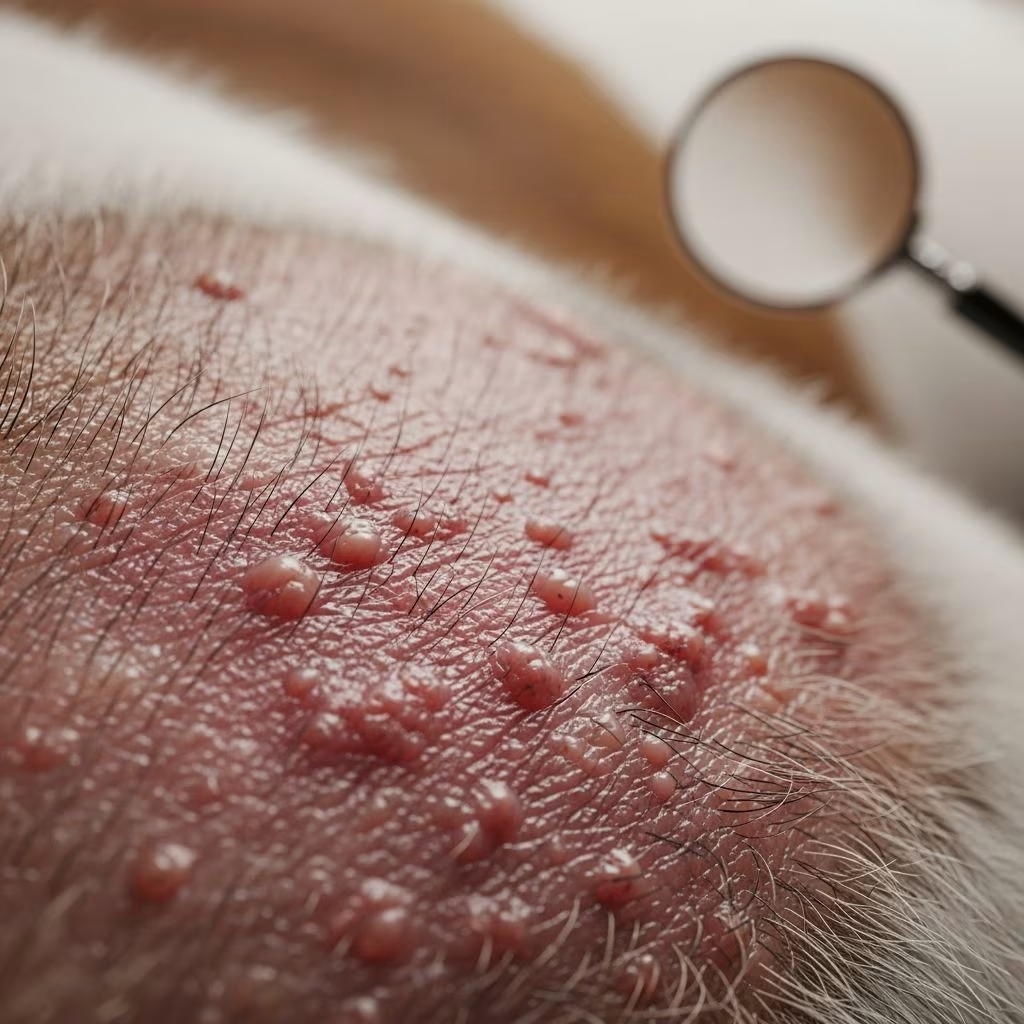
Rhabditic dermatitis represents a uncommon parasitic skin disorder primarily triggered by the nematode Pelodera strongyloides, previously known as Rhabditis strongyloides. This free-living organism typically inhabits decaying organic material but can opportunistically invade animal skin under specific environmental conditions, leading to inflammatory responses in affected hosts.
Biological Profile of the Causative Agent
The nematode Pelodera strongyloides belongs to the order Rhabditida and thrives as a saprophytic species in moist, organic-rich environments such as damp straw, soil, or manure piles. Measuring around 25-40 micrometers in diameter, its larvae possess a distinctive rhabditiform esophagus, which aids in microscopic identification. Adult forms exhibit specific morphological traits, including a copulatory bursa and spicules in males, and a tapered tail in females, observable via light and scanning electron microscopy.
These nematodes maintain a free-living life cycle but can enter a facultative parasitic phase when conditions favor skin penetration. In aberrant hosts like dogs and cattle, this shift provokes intense immune reactions due to poor adaptation, manifesting as dermatitis rather than a sustained infestation.
Environmental and Risk Factors
Occurrences are strongly linked to unsanitary, humid settings where animals rest on contaminated bedding. Damp straw or filthy stables provide ideal breeding grounds, allowing larvae to migrate onto skin surfaces in direct contact with the ground. Dogs housed outdoors, hunting breeds like Finnish Hounds, and livestock in poorly managed barns face heightened risks.
- Prolonged exposure to moist, decaying organic matter.
- Outdoor living without regular bedding changes.
- Compromised skin barriers from concurrent pyoderma or trauma.
Geographically, cases cluster in temperate regions including Central Europe, the United States, Finland, and Mediterranean areas, with reports extending northward.
Clinical Manifestations Across Species
Symptoms localize to ventral body regions touching contaminated surfaces: abdomen, thorax, legs, perineum, and tail base. Common signs include intense pruritus, alopecia, erythema, crusting, and papule formation.
Canine Presentations
In dogs, the condition often affects German Shepherds and hounds. Lesions appear as pruritic, alopecic patches progressing to ulcerative pyoderma in severe instances. A litter of German Shepherd puppies showed ventral involvement sparing the head and back, with some developing deep folliculitis. Finnish Hounds displayed milder folliculitis alongside pyoderma. Pruritus drives self-trauma, exacerbating crusts and secondary infections.
Bovine and Other Livestock Cases
Cattle may exhibit abdominal thickening, hyperkeratosis, and lichenification without marked pruritus. A Charolais bull developed a 12 cm dermal lesion resolving spontaneously post-relocation. Dairy herds report similar ventral dermatitis. Horses and sheep experience rare wool loss, erythema, or papules.
| Species | Primary Sites | Key Signs | Pruritus Level |
|---|---|---|---|
| Dogs | Ventral abdomen, legs, thorax | Alopecia, crusting, pyoderma | Moderate to marked |
| Cattle | Abdomen | Thickening, hyperkeratosis | Absent or mild |
| Horses/Sheep | Contact areas | Erythema, papules, wool loss | Variable |
Pathophysiological Mechanisms
Larvae penetrate hair follicles, eliciting epidermal hyperplasia, hyperkeratosis, folliculitis, and furunculosis. Histopathology reveals pyogranulomas, eosinophilic infiltrates, mast cells, and lymphocytes around follicles. Severe cases show panniculitis and deep dermatitis. This inflammatory cascade underscores the nematode’s maladaptation as a parasite, contrasting its benign saprophytic existence.
Diagnostic Approaches
Diagnosis hinges on history of damp bedding exposure combined with lesion distribution. Definitive confirmation involves identifying larvae in deep skin scrapings, where their size and esophageal morphology are diagnostic. Biopsies disclose nematodes within follicles amid inflammatory changes. Culturing on blood agar sustains strains for further study. Differential diagnoses include sarcoptic mange, demodicosis, and bacterial pyoderma.
- Collect scrapings from lesion margins.
- Examine under microscopy for rhabditiform larvae.
- Perform biopsy if scrapings are inconclusive.
Treatment Protocols
Primary therapy targets parasite elimination via ectoparasiticides. Organophosphates and ivermectin yield rapid resolution in canine cases. Supportive care includes antibiotics for pyoderma, topical antiseptics, and environmental decontamination. Relocating animals from infested areas promotes spontaneous clearance.
- Ivermectin: Effective orally in hounds and shepherds.
- Organophosphates: Suitable for litter outbreaks.
- Antibiotics: Address secondary infections.
Preventive Strategies
Control rests on hygiene: frequent bedding replacement, dry housing, and skin inspections. Hunting dogs benefit from routine ectoparasiticide prophylaxis. Herd management in cattle prevents outbreaks via clean stalls.
Global Incidence and Research Insights
Though rare, rhabditic dermatitis appears worldwide, with Finnish cases highlighting northern prevalence. Studies emphasize breed predispositions and morphological diagnostics via SEM. Ongoing surveillance aids early detection in veterinary practice.
Frequently Asked Questions (FAQs)
What causes rhabditic dermatitis in animals?
It stems from Pelodera strongyloides larvae invading skin from damp organic matter.
Which animals are most susceptible?
Dogs, especially outdoor breeds, followed by cattle; horses and sheep rarely.
How is it diagnosed?
Via skin scrapings revealing characteristic larvae, supported by history and biopsy.
Can it resolve without treatment?
Yes, removal from contaminated environments often leads to spontaneous recovery.
Is it contagious between animals?
No, it’s environmentally acquired, not directly transmitted.
Emerging Considerations for Veterinary Practice
Veterinarians should suspect rhabditic dermatitis in pruritic ventral lesions amid poor hygiene. Prompt diagnosis curtails suffering and secondary complications. Research underscores microscopy’s role, with cultures enhancing confirmation.
References
- Pelodera (syn. Rhabditis) strongyloides as a cause of dermatitis — PMC/NCBI. 2006-09-20. https://pmc.ncbi.nlm.nih.gov/articles/PMC1569853/
- Pelodera (syn. Rhabditis) strongyloides as a cause of dermatitis — PubMed. 2006-09-20. https://pubmed.ncbi.nlm.nih.gov/16987397/
- Pelodera (rhabditic) dermatitis — AskJPC. N/A. https://www.askjpc.org/vspo/show_page.php?id=RkpaS1NQU1cvY1BuNVZmZ1RacFdtZz09
- Rhabditic dermatitis in a bull apparently caused by Pelodera strongyloides — CIRAD. 1982. https://revues.cirad.fr/index.php/REMVT/article/download/9636/9630/9637
- Dermatitis in a Dairy Herd Caused by Pelodera strongyloides — Wiley Online Library. 2005. https://onlinelibrary.wiley.com/doi/full/10.1111/j.1439-0450.2005.00837.x



