

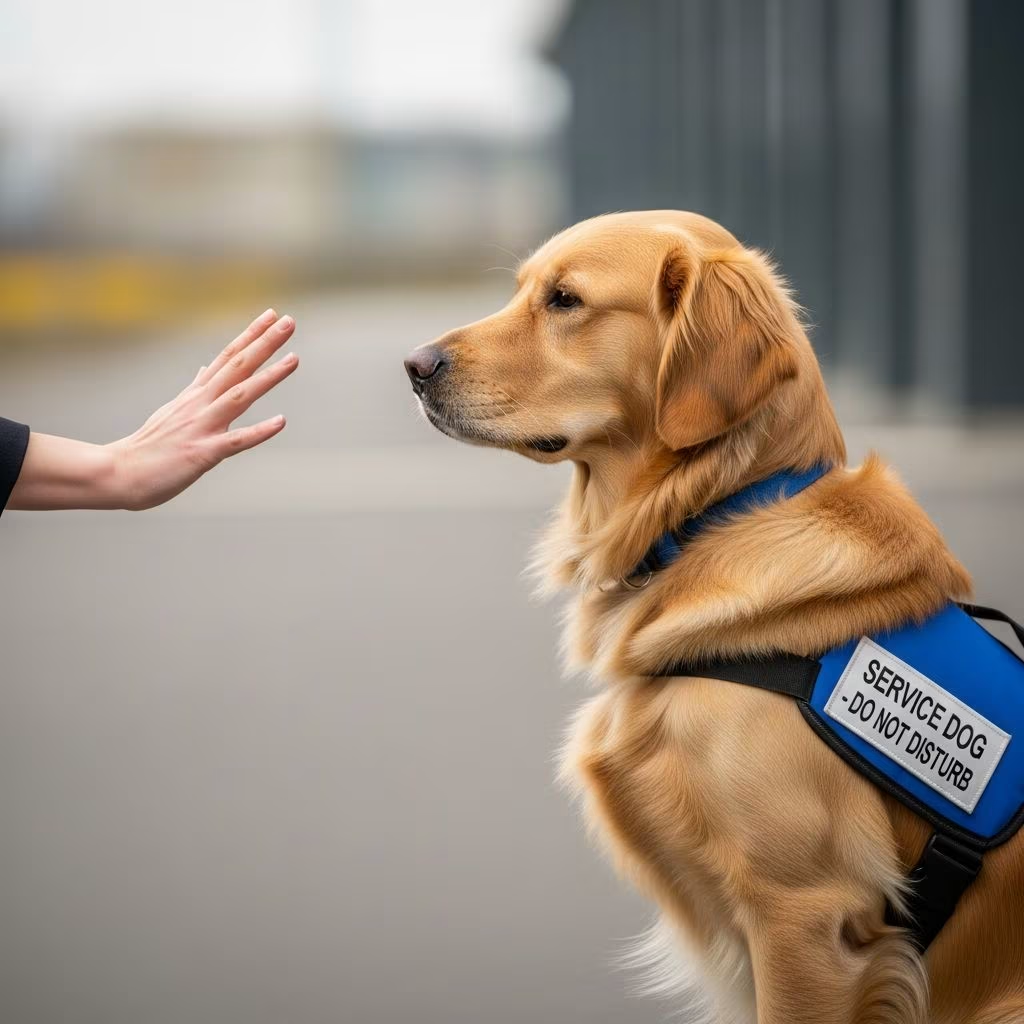
Service dogs play a vital role in enhancing the independence and safety of people with disabilities, performing trained tasks that directly mitigate their handler’s challenges. Under federal law, these dogs are not pets but working animals, and interacting with them through petting or distraction can lead to serious consequences. This article explores the legal framework, training demands, risks of interference, and guidelines for public behavior.
Defining Service Animals Under U.S. Law
The Americans with Disabilities Act (ADA) provides a precise definition for service animals, limiting recognition to dogs individually trained to perform specific work or tasks for individuals with disabilities. This excludes emotional support animals or pets providing mere comfort, as their role must directly relate to the disability, such as guiding the blind, alerting to seizures, or retrieving items.
Only dogs qualify under ADA Titles II and III, effective since March 15, 2011, though miniature horses may be considered in some cases. No certification, vest, or ID is required, and businesses or public entities cannot demand proof beyond two specific questions: whether the dog is required due to a disability and what tasks it performs.
| Context | Service Dogs Allowed | Comfort Animals Allowed |
|---|---|---|
| Government Spaces (ADA Title II) | Yes | No |
| Health Care Facilities | Yes | No |
| Housing (FHA) | Yes | Yes |
| Public Transportation | Yes | No |
| Workplaces (ADA Title I) | Yes | Yes* |
| *Depends on circumstances. Data from U.S. Department of Justice. | ||
The Intense Training Process for Service Dogs
Service dogs undergo rigorous training, often starting as puppies and lasting 1-2 years, to master tasks like balance support, medical alerts, or door opening. Handlers and trainers invest thousands of hours and significant costs, ensuring reliability in diverse environments from stores to airports.
State laws vary, with about half offering licensing fee waivers for verified service dogs, requiring affidavits in places like California to prevent fraud. Dogs in training (SDiTs) gain public access in most states except Hawaii, supporting the pipeline of qualified animals.
- Basic obedience: Heel, sit, stay under distraction.
- Task-specific skills: Seizure detection, glucose monitoring.
- Public access: Ignore food, crowds, remain calm.
This training emphasizes focus; any break in concentration, even momentary, undermines their effectiveness.
Risks of Distracting a Working Service Dog
Petting or approaching a service dog diverts its attention from critical duties, potentially causing mishaps like a seizure going undetected or a guide dog leading into hazards. Service dogs must remain under handler control via leash, harness, or voice signals, unless equipment interferes with tasks.
Out-of-control behavior—growling, biting, or lack of housebreaking—allows exclusion, but petting-induced distraction qualifies as interference. In aviation, dogs too large or disruptive can be denied boarding under ACAA.
Real-world dangers include:
- Mobility aid failure: Dog pulls wheelchair but gets patted, causing imbalance.
- Alert misses: Psychiatric service dog senses anxiety attack but sniffs a passerby.
- Navigation errors: Guide dog veers toward an excited child offering treats.
Legal Safeguards and Penalties for Interference
Federal regulations prohibit interference, with many states criminalizing harassment of service dogs as misdemeanors punishable by fines up to $1,000 or jail time. For example, Colorado deems it a class 3 misdemeanor to harm or distract a service animal, while Maine imposes strict liability for violations.
Public entities must permit access unless the dog fundamentally alters services, and no extra fees apply—pet policies waive for service dogs. Fraudulent misrepresentation carries fines from $100-$500 per offense in states like Illinois.
A service animal is excluded only if out of control and handler fails to act, offering the person alternative participation without the dog.
State Variations in Service Animal Protections
While ADA sets the federal baseline, states expand definitions or add protections. Maryland covers guide, signal, and mobility dogs with fines up to $500 for denial. Public accommodation laws in most states include SDiTs, ensuring training continuity.
| State Example | Key Provision | Penalty for Interference |
|---|---|---|
| California | Affidavit for license waiver | Up to $1,000 fine/jail |
| Maine | Strict liability crime | Class E crime |
| Colorado | Misdemeanor for harm | As per state code |
| Hawaii | No SDiT access | N/A |
Consult state attorney generals for local nuances.
Common Public Misconceptions About Service Dogs
Many assume vests certify status or petting is harmless affection, but gear is optional and distractions risky. Others demand demos of tasks, illegal under ADA—only the two questions permitted.
- Myth: All dogs in vests are service animals. Fact: Vests unregulated; focus on behavior.
- Myth: Emotional support equals service. Fact: No tasks performed.
- Myth: Businesses can ban by breed. Fact: Prohibited.
How to Interact Safely with Service Dog Teams
Ask the handler for permission before speaking to or about the dog. Maintain distance, avoid food offers, and speak to the person, not the dog. In housing or workplaces, assistance animals may qualify differently under FHA.
- Observe if dog is working (harnessed, focused).
- Direct questions to handler only.
- If dog misbehaves, report to handler, not directly.
- Teach children: Look, don’t touch.
Service Dogs in Transit and Air Travel
Public transport and airlines must accommodate under ADA/ACAA, barring safety threats or size issues. Dogs need not be crated if trained, but disruptions allow denial.
FAQs on Service Dog Etiquette
What if a service dog approaches me? It may be performing a task; wait for handler direction.
Can I pet if the handler says yes? Prioritize dog’s focus; best to decline politely.
Are there service cats or other animals? ADA limits to dogs/mini horses; housing broader.
What about hotels or restaurants? Allowed in public areas, even food prep zones.
How to report fake service dogs? Contact local authorities if fraud suspected; don’t confront.
Building a Culture of Respect for Assistance Teams
Education campaigns and signage promote awareness, reducing incidents. Handlers report frequent distractions, underscoring the need for vigilance. By understanding service dogs’ roles, society supports disability rights and safety.
Handlers often train their own dogs or partner with nonprofits, facing high attrition—only 50% graduate. Respect preserves this lifeline.
References
- Service Animals and Assistance Animals — U.S. Department of Justice. 2023-10-01. https://www.justice.gov/servicemembers/service-animals-and-assistance-animals-0
- ADA Requirements: Service Animals — ADA.gov. 2010-07-12. https://www.ada.gov/resources/service-animals-2010-requirements/
- Table of State Service Animal Laws — Animal Legal & Historical Center. 2024-01-15. https://www.animallaw.info/topic/table-state-assistance-animal-laws
- 28 CFR § 35.136 – Service animals — Cornell Law School. 2023-05-20. https://www.law.cornell.edu/cfr/text/28/35.136
- Service Animals — U.S. Department of Transportation. 2024-06-10. https://www.transportation.gov/resources/individuals/aviation-consumer-protection/service-animals
- Service Animals – Disability Law Guide — Library of Congress. 2023-11-05. https://guides.loc.gov/disability-law/service-animals



