Reptile Anatomy And Traits: A Complete Guide
Explore the diverse physical features, skin adaptations, and skeletal structures that define reptiles across their major groups.
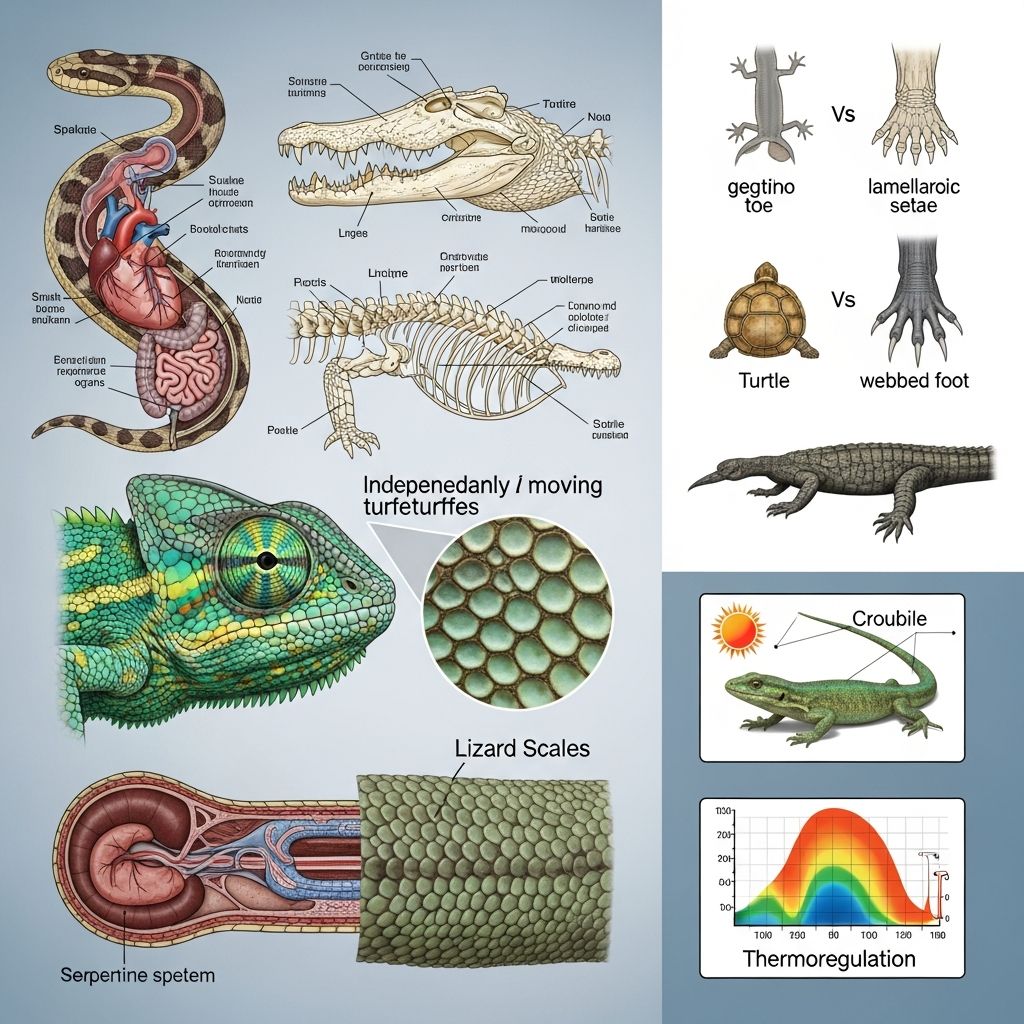
Reptiles represent a diverse class of vertebrates distinguished by key physical adaptations that enable survival in varied environments. These cold-blooded creatures feature scaly skin, amniotic eggs, and specialized skeletons, encompassing groups like turtles, snakes, lizards, crocodiles, and tuataras.
Core Physical Features of Reptiles
At their foundation, reptiles possess dry, keratinized skin covered in scales or scutes, preventing water loss and providing protection. Unlike amphibians, they do not rely on moist skin for respiration; instead, lungs handle gas exchange efficiently. Their bodies are supported by a robust skeleton adapted for terrestrial life, with modifications in limbless forms like snakes retaining vestigial limb structures.
Reproduction occurs via internal fertilization, with most laying leathery-shelled eggs on land. Some species exhibit ovoviviparity or viviparity, where young develop inside the mother. Ectothermy, or cold-bloodedness, allows them to regulate body temperature through behavioral means, such as basking or burrowing.
Skin Variations and Protective Coverings
Reptilian skin is a marvel of adaptation, primarily composed of keratin scales that overlap like shingles. In lizards and snakes (Squamata), these are small, granular, or plate-like, regularly shed in a process called ecdysis to accommodate growth and remove parasites.
- Granular scales: Found on lizard bellies, aiding flexibility.
- Tubercular scales: Raised bumps on backs for camouflage and defense.
- Scutes: Large, thick plates on turtle shells and crocodile backs.
Turtles feature a unique bony shell fused to the skeleton, consisting of dorsal carapace and ventral plastron, covered by keratinous scutes that grow incrementally. Crocodilians have osteoderms—bony plates embedded in skin—providing armor against predators.
| Reptile Group | Skin Type | Function |
|---|---|---|
| Squamata | Overlapping keratin scales | Flexibility, waterproofing, sensory pits |
| Testudines | Bony shell with scutes | Protection, enclosure |
| Crocodilia | Osteoderms and tough hide | Armor, sensory reception |
| Rhynchocephalia | Homogeneous scales |
Skeletal Structure and Locomotion
The reptilian skeleton is lightweight yet strong, with a elongated skull housing specialized jaws. Snakes have highly kinetic skulls with quadrate bones allowing extreme gape for swallowing large prey. Lizards typically have four limbs with clawed digits for climbing or digging, while snakes evolved limblessness from legged ancestors, using ventral scutes for propulsion.
Turtle skeletons are rigid, with ribs incorporated into the carapace, limiting flexibility but enhancing protection. Their necks retract into the shell via S-shaped (cryptodires) or side-folded (pleurodires) mechanisms. Crocodilians boast powerful tails for aquatic thrust and sprawling limbs for terrestrial movement, with skulls adapted for crushing bites.
Tuataras, the sole rhynchocephalians, retain primitive features like a diapsid skull with two temporal fenestrae, supporting strong jaw muscles.
Sensory Systems in Reptiles
Reptiles rely on acute senses tailored to their lifestyles. Vision varies: diurnal lizards have color vision and movable eyelids, while nocturnal snakes possess heat-sensing pits. The Jacobson’s organ, a chemosensory structure in the roof of the mouth, detects pheromones and scents via tongue flicking, especially prominent in snakes and lizards.
Hearing is adapted differently; lizards detect airborne sound via eardrums, snakes sense ground vibrations through jaws, and crocodiles have sensitive middle ear cavities for underwater hearing. Tuataras feature a parietal eye, a light-sensitive “third eye” on the head detecting day-night cycles.
Heat Detection Specializations
Certain pit vipers and boas have labial pits—facial depressions with heat receptors—enabling prey location in darkness by detecting infrared radiation.
Major Reptile Groups: Anatomical Highlights
Lizards and Snakes (Squamata)
The largest order, Squamata, includes over 9,200 species with scaly integument and flexible skulls. Lizards often have external ear openings and fringed toes for specific habitats, like geckos’ adhesive toe pads. Snakes lack limbs, eyelids, and external ears, compensating with elongated bodies and specialized teeth (e.g., fangs in venomous species).
Turtles and Tortoises (Testudines)
Defined by their shell, Testudines encompass ~325 species. Aquatic forms have flipper-like limbs, terrestrial tortoises domed shells for weight support. Toothless jaws form beaks suited to diet.
Crocodilians (Crocodilia)
With 25 species, these semi-aquatic giants feature armored skin, valvular nostrils for submersion, and a four-chambered heart partially separating oxygenated blood. Powerful tails and webbed feet aid swimming.
Tuataras (Rhynchocephalia)
Rare and endemic to New Zealand, two tuatara species exhibit primitive traits: acrodont teeth, no external ear, and slow growth rates.
Respiratory and Circulatory Adaptations
Lungs are the primary respiratory organs, with crocodilians uniquely possessing a hepatic piston pump aiding air movement. Circulatory systems are tripartite in most, with incomplete ventricle separation, but crocodiles approach four-chambered efficiency.
Unique Features and Variations
- Coloration: Cryptic patterns for camouflage; warning aposematism in venomous species.
- Tail Autonomy: Lizards drop tails to escape predators, regenerating later.
- Venom Delivery: Evolved in some lizards (e.g., monitors) and snakes.
Caring for Reptiles: Physical Traits in Captivity
Understanding anatomy informs husbandry. Shedding issues in Squamata require humidity control; turtle shells need UV for proper scute growth. Monitor for mites on scales or respiratory infections signaled by open-mouth breathing.
Frequently Asked Questions (FAQs)
What distinguishes reptile skin from other vertebrates?
Reptile skin is dry and scaly, keratinized for impermeability, unlike moist amphibian skin.
Do all reptiles have legs?
No, snakes and some lizards are limbless, but all descend from four-limbed ancestors.
How do turtles breathe with a rigid shell?
They use throat and cloacal muscles to pump air, as ribs are fused.
Are tuataras true lizards?
No, they form a separate order with primitive features.
Why do snakes flick their tongues?
To collect chemical cues for the Jacobson’s organ.
References
- A Brief Look At Reptile Taxonomy — Reptiles Magazine. Accessed 2026. https://reptilesmagazine.com/a-brief-look-at-reptile-taxonomy/
- Reptile — Wikipedia. Accessed 2026. https://en.wikipedia.org/wiki/Reptile
- Overview of Reptiles – Exotic and Laboratory Animals — Merck Veterinary Manual. Accessed 2026. https://www.merckvetmanual.com/exotic-and-laboratory-animals/reptiles/overview-of-reptiles
- Classes of Reptiles — Lumen Learning. Accessed 2026. https://courses.lumenlearning.com/wm-biology2/chapter/classes-of-reptiles/
- 29.4B: Characteristics of Reptiles — Biology LibreTexts. Accessed 2026. https://bio.libretexts.org/Bookshelves/Introductory_and_General_Biology/General_Biology_(Boundless)/29:_Vertebrates/29.04:_Reptiles/29.4B:_Characteristics_of_Reptiles
- Reptile | Definition, Characteristics, Examples, & Facts — Britannica. Accessed 2026. https://www.britannica.com/animal/reptile
Similar Articles








Read full bio of Sneha Tete