

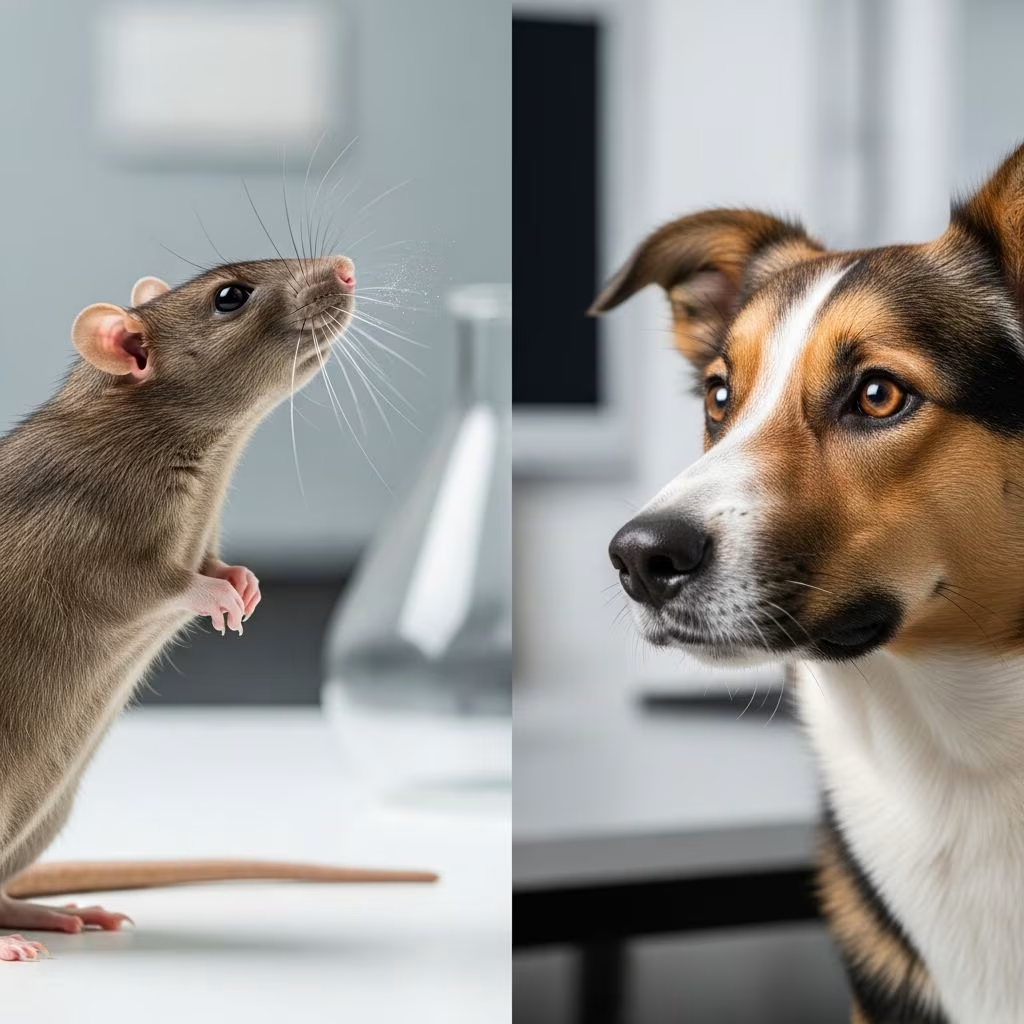
Animal intelligence reveals itself through diverse cognitive talents tailored to survival and adaptation. Rats and dogs, though vastly different in size and lifestyle, both display impressive mental capabilities that challenge simplistic rankings of brainpower. This exploration delves into their respective strengths across key domains like learning agility, memory retention, social dynamics, and adaptability, drawing from scientific insights to highlight why direct comparisons often miss the mark.
Defining Intelligence in the Animal Kingdom
Intelligence among animals encompasses multiple dimensions, including problem-solving speed, memory types, emotional awareness, and social navigation. Rather than a single metric, it reflects evolutionary pressures: rats honed skills for navigating complex urban and wild environments, while dogs evolved alongside humans for cooperative tasks. Researchers emphasize metacognition—the ability to monitor one’s own learning—as a hallmark seen in both species, placing them among elite thinkers like primates and cetaceans.
Studies indicate rats exhibit metacognitive decision-making, opting out of uncertain tasks much like humans do, suggesting they ponder their knowledge limits. Dogs, meanwhile, demonstrate this through nuanced responses to human gestures, adapting strategies based on perceived reliability of cues. These foundational traits set the stage for comparing their specialized abilities.
Mastering Mazes and Patterns: Rats’ Cognitive Edge
Rats stand out for their rapid pattern detection and spatial mastery. In experiments at KU Leuven University, rats surpassed human participants in applying learned visual discriminations to novel scenarios, showcasing superior generalization. This flexibility proves vital for foraging in unpredictable settings, where quick adaptation means survival.
Their hippocampus, a brain region key to spatial processing, enables creation of precise cognitive maps. Rats recall maze layouts after months, navigate via landmarks, and even detour around obstacles intuitively. Such prowess extends to episodic memory, allowing recollection of ‘what, where, and when’ events, a rare skill shared with few mammals.
- Pattern Recognition: Rats identify complex sequences faster than expected for their brain size.
- Spatial Navigation: They build mental blueprints rivaling those of birds known for homing.
- Rule Exploitation: Rats detect and leverage situational shortcuts to optimize rewards.
Dogs’ Social Genius and Human Synergy
Dogs excel where interspecies communication reigns. Domestication over millennia amplified their sensitivity to human signals, outperforming even wolves and chimps in following pointing gestures. Breeds like Border Collies learn 200+ commands, equivalent to a toddler’s vocabulary, with average dogs grasping 165 words.
Canine intelligence splits into instinctive (breed-specific tasks), adaptive (environmental problem-solving), and obedience-based learning. Herding dogs like German Shepherds thrive in dynamic work, while companions like Labradors bond deeply through emotional reciprocity. Dogs read human facial expressions, anticipate needs, and adjust behaviors accordingly, fostering unbreakable partnerships.
| Intelligence Type | Dog Strengths | Example Breeds |
|---|---|---|
| Instinctive | Hunting, guarding | Beagles, Rottweilers |
| Adaptive | Novel puzzles, routines | Poodles, Australian Shepherds |
| Obedience | Commands, tasks | Border Collies, Golden Retrievers |
Memory Showdown: Short-Term vs Long-Term Recall
Both animals boast robust memories, but applications differ. Rats’ spatial episodic memory shines in lab tests, remembering food cache locations and event sequences with pinpoint accuracy. This aids survival in resource-scarce habitats.
Dogs prioritize social memory, recognizing familiar faces after years apart and recalling commands amid distractions. Their associative learning links scents, sounds, and visuals to experiences, powering search-and-rescue feats. While rats edge in raw spatial feats, dogs integrate memory with emotional context for human-centric tasks.
Emotional Depth and Social Bonds
Rats surprise with empathy: they free trapped companions, prioritizing aid over personal gain, and giggle ultrasonically during play. Group living fosters hierarchies, cooperation, and individual recognition up to 50 cage-mates.
Dogs’ emotional intelligence focuses on humans, detecting stress via cortisol scents and offering comfort. Oxytocin surges during eye contact mirror human-pet bonding. Rats form cross-species ties too, but dogs’ scale with people is unmatched.
- Rats: Console distressed peers, share food.
- Dogs: Mirror owner moods, seek joint solutions.
Trainability Tactics: Rewards and Enrichment
Training leverages motivations—rats chase food puzzles and agility courses, mastering tricks via clicker methods. Dogs respond to praise, excelling in agility, service roles, and therapy.
Enrichment prevents boredom: rats need tunnels and toys; dogs crave interactive games. Both benefit from daily challenges to sustain cognitive health into old age.
Evolutionary Roots of Their Brilliance
Rats’ omnivorous adaptability across continents drove versatile cognition for exploitation of niches. Dogs’ selective breeding amplified cooperative traits, turning predators into partners. Neither is ‘smarter’ overall; contexts define supremacy.
Practical Implications for Pet Owners
Pet rats demand mental gyms: rotating toys, foraging boxes. Dogs flourish with obedience classes, scent work. Understanding these profiles enhances welfare, turning owners into cognitive coaches.
FAQs: Answering Common Curiosities
Do rats solve problems faster than dogs?
Rats often outpace in isolated pattern tasks, but dogs lead in collaborative human puzzles.
Which has better long-term memory?
Rats for spatial details; dogs for social associations.
Can rats learn as many tricks as dogs?
Rats master complex sequences quickly but prefer solitary challenges over performance.
Are rats more empathetic than dogs?
Both show empathy; rats within species, dogs across to humans.
How does brain size factor in?
Rats punch above weight with efficient neural packing; dogs leverage larger brains for social complexity.
References
- Are Rats as Smart as Dogs? A Cognitive Comparison — PetsCare.com. 2023. https://www.petscare.com/news/post/rats-vs-dogs-intelligence
- Super smart hero rats have the wow factor — Burgess Pet Care. 2022-10-15. https://www.burgesspetcare.com/blog/rats/super-smart-hero-rats-have-the-wow-factor/
- Are Rats Smarter Than Dogs? Vet-Verified Facts & FAQ — Dogster. 2024-05-20. https://www.dogster.com/lifestyle/are-rats-smarter-than-dogs



