Rat Breeding Guide: Essential Reproduction Tips For Pet Owners
Master the essentials of breeding pet rats successfully, from sexual maturity to litter care and common challenges.
Rats make excellent pets due to their intelligence and sociability, and for enthusiasts interested in breeding, understanding their reproductive biology is essential for success. Domestic rats, derived from wild Norway rats, exhibit rapid reproductive cycles that demand careful management to ensure health and welfare. This guide explores the key stages of rat breeding, from puberty to weaning, offering practical advice grounded in veterinary science.
Understanding Sexual Maturity in Pet Rats
Pet rats reach sexual maturity relatively quickly, marking the point when breeding considerations become critical. Males typically become fertile between 6 and 10 weeks of age, while females mature slightly later, around 8 to 12 weeks. At this stage, it’s vital to separate sexes to prevent unplanned litters, as rats are highly prolific breeders.
Early maturity influences housing decisions. Co-housing intact males and females post-maturity often leads to constant pregnancies, straining the female’s health. Veterinary recommendations emphasize sex separation by 5-6 weeks to avoid such issues.
- Male maturity: 6-10 weeks; characterized by testicular descent and increased aggression.
- Female maturity: 8-12 weeks; first estrus signals readiness.
- Best practice: Separate by 5 weeks regardless of visible signs.
The Rat Estrous Cycle and Optimal Mating Windows
Female rats are polyestrous, cycling every 4-5 days year-round, with spontaneous ovulation. The cycle includes proestrus, estrus (heat), metestrus, and diestrus. Ovulation occurs 8-12 hours into estrus, and mating can result in pregnancy within 24 hours.
Detecting estrus involves observing behaviors like lordosis (back arching) or vaginal cytology for accuracy in research settings. Pet breeders can note increased activity, vocalizations, or scent marking. Mating is nocturnal, with copulation lasting 2-24 hours per session, often repeated up to 100 times nightly.
| Cycle Phase | Duration | Key Signs |
|---|---|---|
| Proestrus | ~12-24 hours | Vaginal swelling, mucus |
| Estrus (Heat) | ~12-24 hours | Lordosis, receptivity |
| Metestrus | ~24 hours | Leukocytes in smear |
| Diestrus | ~48 hours | Rest phase |
Effective Mating Strategies for Breeding Success
Choosing the right mating approach balances efficiency, health, and pedigree tracking. Common methods include timed pairings and continuous housing.
Hand Breeding (Timed Mating): Introduce the pair during estrus, often overnight, to capitalize on peak fertility. This minimizes stress and aids reintroduction to colonies. Repeat if no pregnancy after 1-2 cycles.
Monogamous Pairing: One male with one female housed together. Allows postpartum estrus exploitation for back-to-back litters every 21 days, but requires weaning before new births to prevent overcrowding.
Polygamous or Trio Systems: One male with 2-3 females, separating pregnant ones early. Ideal for higher output but demands vigilant monitoring. Institutions often limit trios due to space.
A key indicator of mating is the vaginal plug—a semen coagulum from male vesicular glands, persisting 8-24 hours. It confirms copulation but not pregnancy.
Gestation: Monitoring Pregnancy in Rats
Rat gestation lasts 21-23 days, with litters averaging 6-12 pups, varying by strain and age. Pregnancy signs emerge around day 14: abdominal distension, weight gain, and mammary development. Gentle palpation from day 12 confirms fetuses.
Provide high-nutrition diet, quiet environment, and nesting materials like tissue paper. Avoid disturbances to reduce abortion risks from stress or malnutrition.
- Days 1-7: Embryonic implantation; no visible signs.
- Days 8-14: Palpable swellings; monitor weight.
- Days 15-23: Rapid growth; prepare nest.
Parturition and Initial Newborn Care
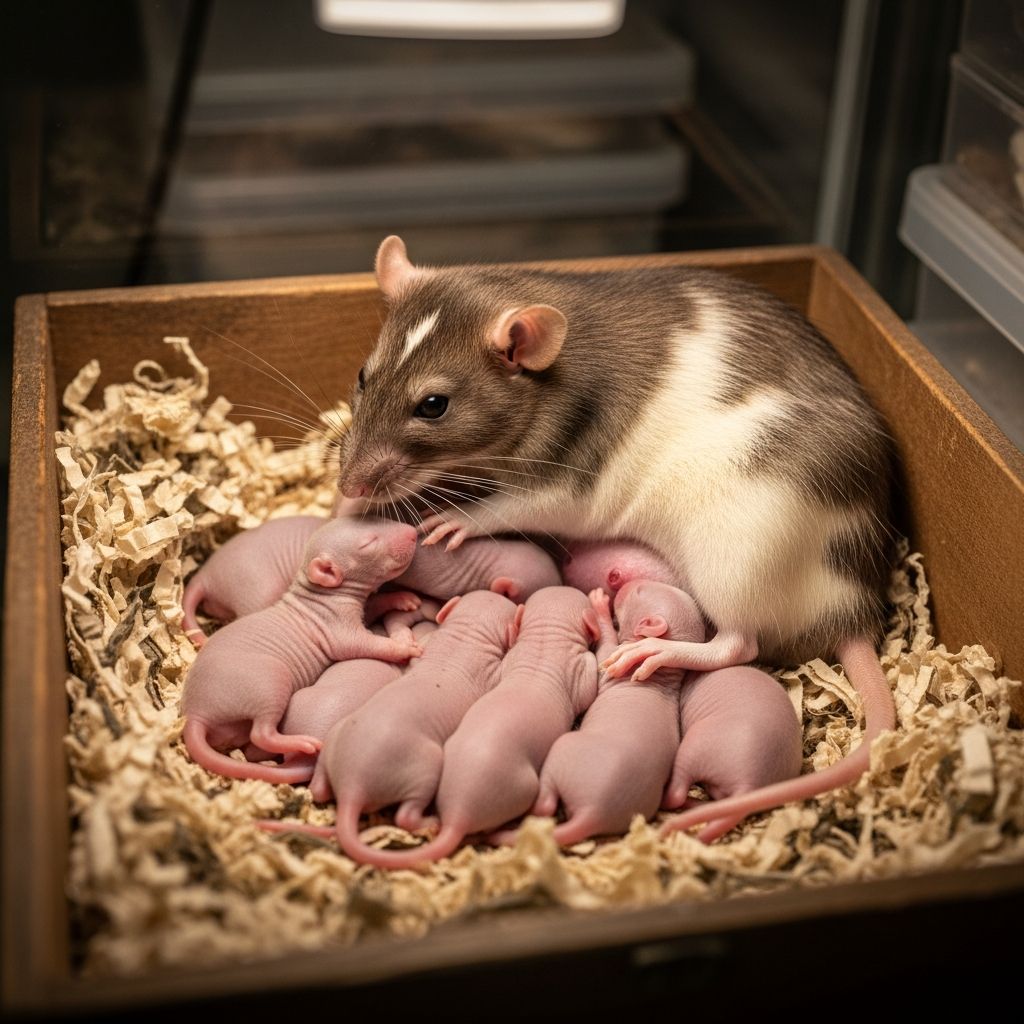
Birth occurs at night, with females delivering 1 pup every 5 minutes. Pups are born hairless, pink, with closed eyes and ears. Dams lick them clean, eat placentas, and nurse immediately.
Postpartum estrus within 48 hours boosts fertility; over 50% success if mated then. Disturbances like noise or poor housing can lead to cannibalism or abandonment.
Human intervention: Check daily without handling newborns first week. Ensure ample food/water; supplement with puppy milk if needed.
Raising Rat Pups: From Birth to Weaning
Pups open eyes at 14-17 days, becoming mobile. Weaning at 21-23 days aligns with independence. Separate sexes post-weaning to prevent inbreeding.
Monitor for runts or illness; cull deformed pups humanely if dam rejects. Socialize pups early for tame adults.
| Age (Days) | Milestones | Care Tips |
|---|---|---|
| 0-7 | Hairless, nursing | Minimal disturbance |
| 14-17 | Eyes open, teeth erupt | Introduce soft food |
| 21-23 | Weaning | Sex separation |
Breeding Schemes Comparison
| Scheme | Pros | Cons | Best For |
|---|---|---|---|
| Monogamous Pair | Pedigree tracking, health | Slower output | Pet breeders |
| Trio (1M:2F) | Higher litters | Overcrowding risk | Colony expansion |
| Hand Breeding | Control, low stress | Time-intensive | Timed pregnancies |
Factors Affecting Fertility and Litter Health
Fertility declines with age (optimal 3-12 months), malnutrition, light disruptions, cold, or ovarian issues. Average reproductive lifespan: 12-15 months.
Abortion/cannibalism triggers: overcrowding, dehydration, deformed pups, noise. Maintain 22°C, 12:12 light cycle, balanced diet.
Health Checks and Veterinary Guidance
Regular vet exams detect tumors or cysts early. Strain-specific fertility varies; consult for difficulties. Ethical breeding prioritizes welfare over quantity.
Frequently Asked Questions (FAQs)
How do I know if my rat is pregnant?
Look for weight gain, swollen abdomen by day 14, or palpate gently from day 12.
Can rats breed year-round?
Yes, as polyestrous animals with 4-5 day cycles.
When should I separate male and female rats?
By 5-6 weeks to prevent accidental breeding.
What is the average litter size?
6-12 pups, depending on age and strain.
Is postpartum mating recommended?
Yes, within 48 hours for high success, but monitor dam’s health.
Conclusion
Successful rat breeding requires knowledge of cycles, careful mating, and attentive care. Prioritize animal welfare for thriving litters.
References
- Breeding and Reproduction of Rats — Merck Veterinary Manual. Accessed 2026. https://www.merckvetmanual.com/all-other-pets/rats/breeding-and-reproduction-of-rats
- Mating – Rat Guide — Rat Guide. Accessed 2026. https://ratguide.com/breeding/breeding_rats/mating.php
- RAT BREEDING COLONY MANAGEMENT — McGill University Research. 2023-06-09. https://www.mcgill.ca/research/files/research/609-_rat_breeding_colony_management.pdf
- Rodent Breeding and Weaning — Wayne State University IACUC. Accessed 2026. https://research.wayne.edu/iacuc/rodentbreedingandweaning
- Breeding Systems – Rat Guide — Rat Guide. Accessed 2026. https://ratguide.com/breeding/breeding_rats/breeding_systems.php
Similar Articles








Read full bio of Sneha Tete