

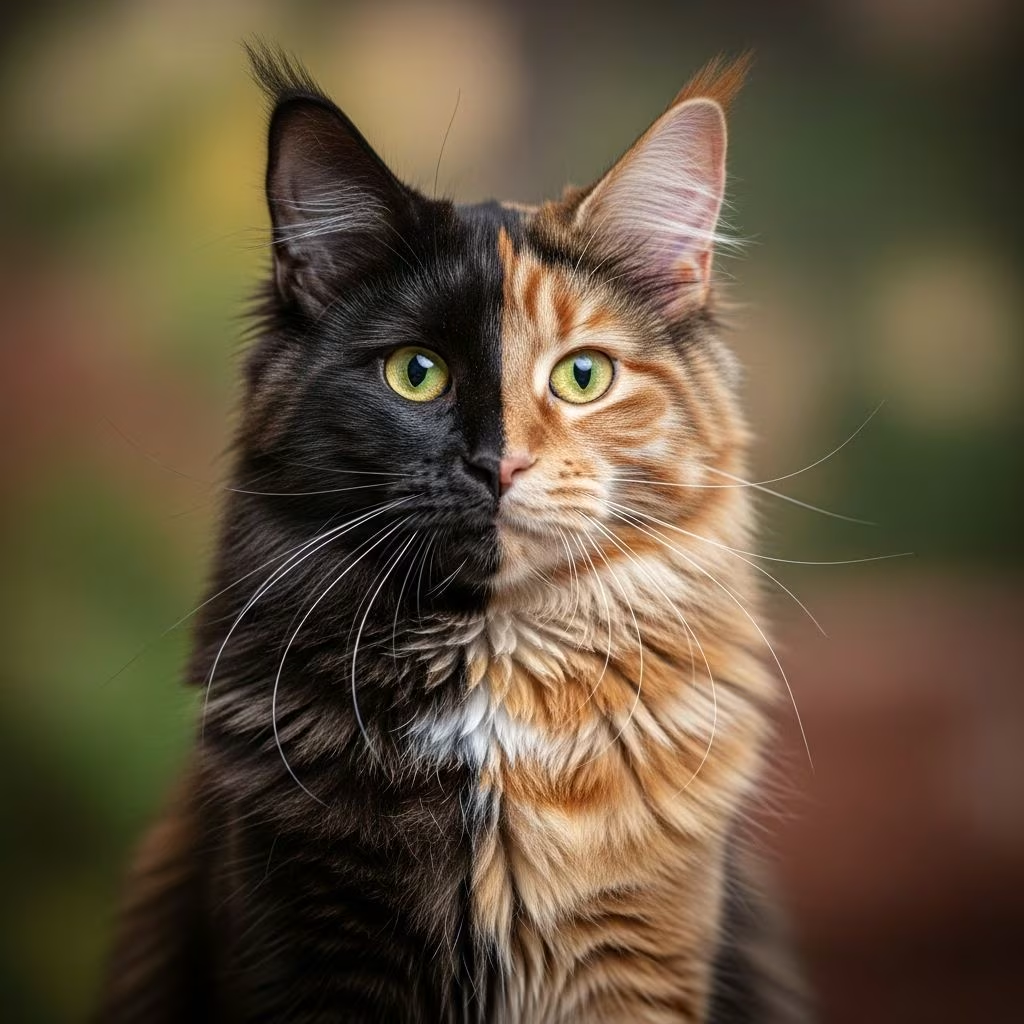
Cat coats display an astonishing variety of colors and patterns, each governed by intricate genetic mechanisms. While common tabby stripes dominate most domestic cats, certain rare configurations emerge from specific gene combinations, captivating breeders and owners alike. These uncommon fur designs not only enhance a cat’s aesthetic appeal but also reveal evolutionary adaptations and selective breeding outcomes.
Genetic Foundations of Feline Fur Diversity
The foundation of cat coat variation lies in multiple genes interacting to control pigment production, distribution, and hair structure. Eumelanin produces black or brown pigments, while phaeomelanin yields reds and oranges. Key loci like the agouti gene (A/a) create banded hairs for tabby backgrounds, and the tabby gene (Taqpep) dictates stripe or spot formation. Dominant and recessive alleles determine whether patterns manifest boldly or subtly.
Research identifies transmembrane aminopeptidase Q (Taqpep) as pivotal for tabby phenotypes, with mutations altering stripe visibility in species like cheetahs and domestic cats. Similarly, the ticked locus (Ti) on chromosome B1 suppresses traditional markings, producing even-toned coats rare outside select breeds. Understanding these interactions explains why some patterns appear in only a fraction of the feline population.
Ticked Coats: The Subtle Elegance
Ticked tabby coats represent one of the scarcest patterns, where individual hairs feature multiple color bands without pronounced stripes or bars. This effect arises from the dominant Ti^A allele, prevalent in Abyssinians and Singapuras but elusive in random-bred cats. Stripes may faintly appear on legs, tails, or faces in heterozygotes, adding intrigue to the otherwise uniform ruddy or sorrel hues.
Stanford researchers pinpointed DKK4 gene mutations, such as p.Ala18Val, as drivers of ticked patterns in Abyssinians, blurring tabby marks into a shaded blur. In Savannah cats, the same variant yields servaline spots, demonstrating how one gene reshapes pattern scale and density. These coats evoke wild ancestry, mimicking African wildcats while remaining domestic rarities.
Silver and Smoke Variations: Ethereal Glows
Silver coats inhibit eumelanin in hair shafts, leaving tips white against darker roots for a shimmering effect. The inhibitor gene (I/i) plays a central role, often combined with wide-band factors for chinchilla or shaded patterns. Smoke variants extend this inhibition deeper, creating a hazy undercoat that lightens dramatically.
Though the exact smoke/silver gene evades full identification, it interacts with agouti and tabby genes to produce tipped (shell) or shaded pigmentation. Breeds like the Russian Blue showcase silver shading, where black underfur fades to silver tips, a look demanding precise homozygous inheritance for purity. These luminous coats stand out in low light, highlighting their scarcity.
- Silver Chinchilla: Extreme tipping with nearly all-white hairs.
- Shaded Silver: Gradual color fade midway down shafts.
- Smoke: Full undercoat inhibition for smoky base.
Chocolate and Diluted Tones: Subdued Browns
Chocolate coats stem from the recessive b allele at the B locus, diluting black eumelanin to rich brown. Cats require bb genotype for expression, making solids or pointed patterns infrequent. Influencing genes modulate shade intensity, from deep mahogany to lighter fawn when further diluted.
Cream and blue arise from dilute (d/d) modifiers on red or black bases, softening vibrancy. These pastel tones appear in under 10% of cats, often surprising owners of mixed lineage pets. Breeds like the Havana Brown preserve chocolate purity through rigorous selection.
Exotic Pointed and Gloved Mutations
The colorpoint pattern, linked to TYR gene mutations at the albino locus, restricts pigment to extremities, as in Siamese. Rarer offshoots include Birman white gloving (w^g), adding paw socks via recessive alleles. The salmiak pattern (w^sal), discovered in Finland, features root-colored hairs fading to white tips, except on the head—a true genetic novelty.
These temperature-sensitive expressions demand homozygous recessives, limiting prevalence. Burmese variants show partial ticking from related mutations.
Tortoiseshell and Calico Uniqueness
Tortoiseshell (tortie) coats blend black and orange patches due to X-chromosome inactivation, where female cats (XX) randomly silence one color gene per cell. Males rarely exhibit this without XXY anomalies, explaining the 80% female ginger prevalence inversely. Calicos add white spotting (S/s), creating tri-color mosaics unique to each individual.
No two torties share identical patterns, as cellular lyonization ensures variability.
| Pattern | Genetic Basis | Rarity Factor | Breed Examples |
|---|---|---|---|
| Ticked | Ti^A, DKK4 mutations | Fixed in few breeds | Abyssinian, Singapura |
| Silver/Shaded | I/i + wide band | Requires multiple recessives | Russian Blue, Chinchilla |
| Chocolate | b/b | Double recessive | Havana Brown |
| Tortie/Calico | XO/ Xb mosaicism + S | Female-specific, unique | Random-bred |
Longhair and Texture Anomalies
Beyond color, rarity extends to textures via FGF5 mutations for long coats in Ragdolls and Maine Coons. Rex variants like Devon (KRT71) and Cornish (LPAR6) curl fur uniquely, while Wirehair (Wh) bends shafts for springiness. York Chocolate lacks undercoat, altering fluff profoundly.
Why These Patterns Persist
Rare patterns endure through breed standards and genetic drift. Selective breeding amplifies recessives, while wild traits like ticking echo survival advantages in camouflage. Advances in genomics, including single-cell analysis of fetal skin, illuminate pattern formation via signaling like Dkk4.
FAQs on Rare Cat Coats
Can rare coats appear in mixed-breed cats?
Yes, recessives from both parents can combine unexpectedly, yielding chocolates or silvers in kittens.
Do rare patterns affect health?
Generally no, but some like colorpoint link to vision issues; albinism variants pose photosensitivity.
How to identify ticked vs. mackerel tabby?
Ticked lacks body stripes, showing only ghost marks on extremities.
Are torties always female?
Overwhelmingly yes, due to X-linkage; rare male torties are sterile XXY.
What causes silver tipping?
Inhibitor gene blocks pigment ascent in hairs.
Preserving Feline Genetic Treasures
Cat fanciers champion rare coats through ethical breeding, avoiding inbreeding depression. Genetic testing confirms carriers, ensuring diversity. These patterns enrich our bond with cats, blending science and beauty.
References
- Cat coat genetics — Wikipedia. 2024-01-15. https://en.wikipedia.org/wiki/Cat_coat_genetics
- 12 Rare Coat Colors and Patterns in Cats — Cats.com. 2023-05-20. https://cats.com/rare-coat-colors-in-cats
- Spots, stripes and blotches: Color patterns of cat fur tracked to a key gene — Stanford Medicine. 2021-09-07. https://med.stanford.edu/news/all-news/2021/09/cat-fur-color-patterns.html
- Developmental genetics of color pattern establishment in cats — PMC (Nature Communications). 2021-09-07. https://pmc.ncbi.nlm.nih.gov/articles/PMC8423757/
- Cat Genetics: A Progressive Look at Coat Colors & Patterns — Liz’s Kitty Bootcamp. 2020-08-24. https://lizskittybootcamp.com/2020/08/24/cat-genetics-a-progressive-look-at-coat-colors-patterns/



