Rabbit Anatomy: 46 Vertebrae, Teeth, Muscles, And Care Tips
Discover the unique physical traits and skeletal structure that define rabbits as agile, delicate pets requiring careful handling.
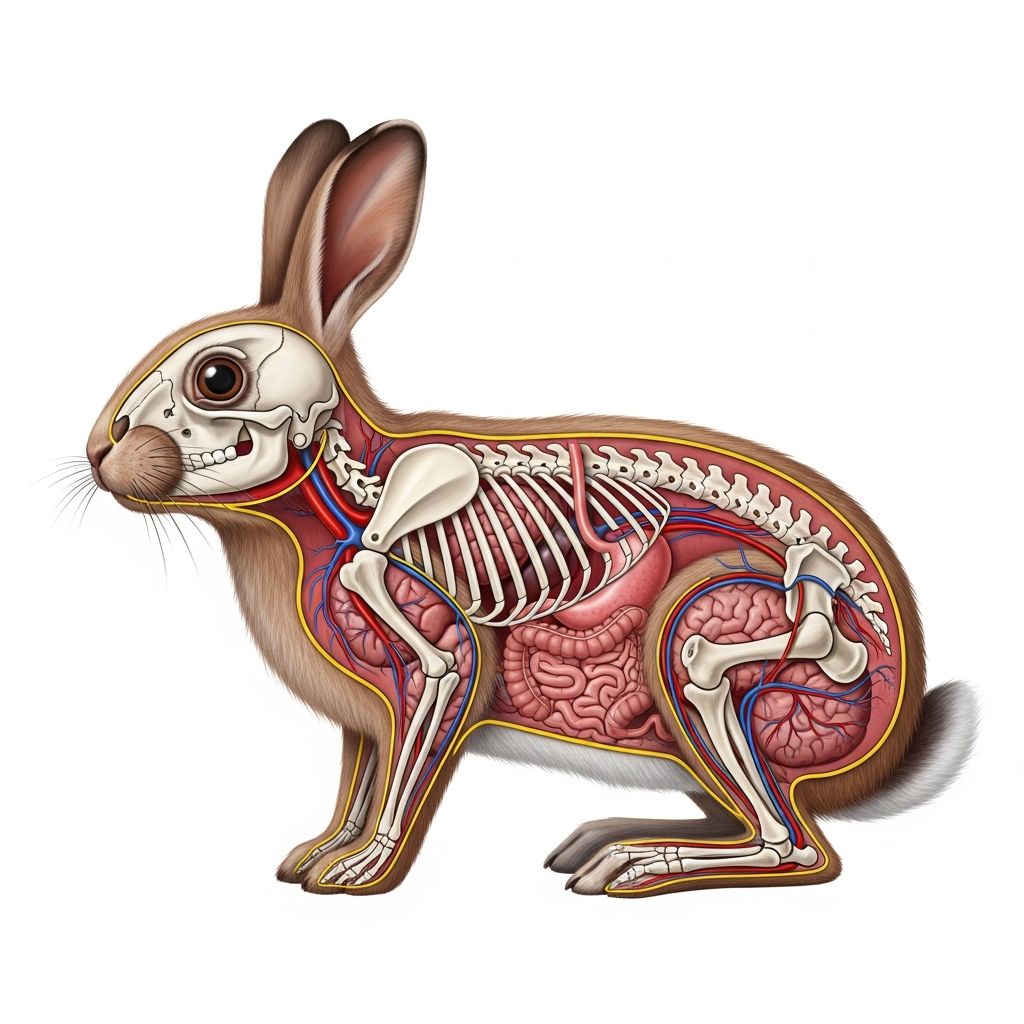
Rabbits possess a distinctive anatomical profile optimized for speed, agility, and herbivorous efficiency, featuring a lightweight skeleton, elongated hind limbs, and continuously growing teeth. These traits enable explosive movements but also make them prone to specific injuries, demanding attentive care from owners and veterinarians.
The Delicate Skeletal Framework
The rabbit’s skeleton constitutes merely 7-8% of its total body weight, significantly less than the 12-13% observed in cats or dogs, reflecting thin cortical bone walls and low overall density. This lightweight design supports remarkable flexibility and rapid acceleration, essential for evading predators, yet it heightens vulnerability to fractures, particularly in the spine and limbs.
Comprising 46 vertebrae, the spinal column includes 7 cervical, 12 thoracic, 7 lumbar, 4 sacral, and 16 coccygeal segments, allowing pronounced mobility but risking paralysis from improper handling or sudden forces. The lumbar region, especially vertebrae L6 and L7, stands out as a frequent fracture site due to elongated vertebral bodies and minimal protective bone thickness.
- Cervical vertebrae (7): Facilitate neck flexibility for grazing and vigilance.
- Thoracic vertebrae (12): Anchor ribs, protecting vital organs while permitting torso twists.
- Lumbar vertebrae (7): Enable powerful hindquarter propulsion but are fracture-prone.
- Sacral vertebrae (4, fused): Form a stable pelvic base.
- Coccygeal vertebrae (16): Support a short, mobile tail for balance.
Hind limbs dominate skeletal emphasis, with long femur, tibia, and fused fibula optimized for propulsion rather than endurance, while forelimbs prioritize steering with shorter, finer bones like the radius and ulna. Each forepaw bears five digits with claws for digging and grip, hind paws four for thrust, all requiring regular trimming as nails grow continuously.
Muscular Power and Propulsion Systems
Over 50% of a rabbit’s body mass derives from skeletal muscle, dwarfing the skeletal proportion and fueling bursts of speed up to 40 km/h. Hind limb musculature, segmented into foot, thigh, and leg, generates maximum force through fused tibia-fibula and robust attachments, contrasting forelimbs structured as shock absorbers.
This imbalance explains common injuries: powerful kicks can snap the owner’s spine if unsupported, while forelimbs, lighter and digitigrade during runs, absorb landing impacts. Thermoregulation relies on highly vascularized ears and hind legs, dissipating heat via extensive blood vessel networks.
| Limb Type | Key Bones | Primary Function | Digits/Claws |
|---|---|---|---|
| Hind Limbs | Femur, Tibia-Fibula fusion, Tarsals | Propulsion, Acceleration | 4 toes |
| Forelimbs | Radius, Ulna, Carpals | Steering, Balance | 5 toes (incl. dewclaw) |
Dental Structure for Continuous Grinding
Rabbits feature 28 open-rooted, ever-growing teeth following the formula 2( I2/1, C0/0, P3/2, M3/3 ), comprising 6 incisors, 10 premolars, and 12 molars, adapted for lateral grinding of fibrous vegetation rather than vertical biting. The mandible hinges for extensive fore-aft and minor lateral motion, preventing wear imbalance that could lead to malocclusion.
Upper jaws include a second incisor pair (peg teeth) behind primaries, aiding chisel-like cropping, while rootless growth demands constant abrasion via hay and forage to avoid overgrowth.
Sensory Adaptations: Eyes, Ears, and Beyond
Lateral-positioned eyes grant near-360° vision, with large corneas occupying 30% of the globe for enhanced light capture, complemented by a prominent nictitating membrane for protection. Ears, long and slender in many breeds, serve hearing, balance via inner ear structures, and thermoregulation through vascular skin.
Nasal passages, fragile and extensive, support olfactory acuity vital for detecting predators and food, while the small mouth belies powerful jaw muscles extending forward and back.
Respiratory and Cardiovascular Efficiency
Lungs exhibit monopodial branching, with the right comprising four lobes (cranial, middle, caudal, accessory) and the left two (cranial, caudal, heart-displaced), aiding efficient gas exchange during frantic activity. The diaphragm drives respiration, and the heart’s right atrioventricular valve has two cusps, differing from the human tricuspid.
Digestive and Reproductive Physiology
A non-vomiting gut features a large cardiac stomach stomach with striated muscle, fundic secretory region, and pylorus prone to compression, alongside a massive cecum for hindgut fermentation and lymphoid-rich appendix. The duplex uterus with independent cervices supports litters up to 12, with four mammary pairs in does. Females often develop a dewlap, a sub-jaw fat fold for nursing.
Handling Implications and Injury Prevention
Given spinal fragility, support the hindquarters fully during lifts to avert lumbar fractures; avoid sudden restraints triggering panic kicks. Monitor nail growth monthly, provide chew toys for teeth, and ensure spacious enclosures for natural postures, as plantigrade rest shifts to digitigrade sprints.
Frequently Asked Questions (FAQs)
Why is the rabbit skeleton so lightweight?
It comprises 7-8% body weight with thin bones for agility, contrasting denser carnivore skeletons.
How many teeth do rabbits have, and do they grow?
28 continuously erupting teeth for grinding, requiring dietary abrasion.
Can rabbits vomit?
No, due to esophageal sphincter and pyloric mechanics.
What causes common back injuries in rabbits?
Fractures from unsupported hind kicks or falls, targeting lumbar vertebrae.
How do rabbits regulate body temperature?
Via vascular ears and limbs, panting, and ear flapping.
Conclusion
Understanding rabbit anatomy empowers better husbandry, reducing risks from their specialized, fragile build while appreciating evolutionary adaptations for survival.
References
- Rabbit Skeleton Explained: Skull, Spine & Bone Structure — Redbeck Rabbit Boarding. 2023. https://redbeck-rabbit-boarding.co.uk/understanding-the-rabbit-skeleton/
- Rabbit – Wikipedia — Wikimedia Foundation. 2024-02-20. https://en.wikipedia.org/wiki/Rabbit
- Historical Special Topic Overview on Rabbit Comparative Biology — PMC/NCBI. 2016-11-01. https://pmc.ncbi.nlm.nih.gov/articles/PMC5129783/
- Biology of the Rabbit — Louisiana Veterinary Medical Association. 2023. https://lvma.org/Main/LVMA/For_Pet_Owners/Educational_Material/Biology_of_the_Rabbit.aspx
- Basic Anatomy, Physiology, and Husbandry — Veterian Key. 2022-05-15. https://veteriankey.com/basic-anatomy-physiology-and-husbandry-2/
- Rabbit Anatomy: Ears to Floof Poof — Small Pet Select. 2024. https://smallpetselect.com/rabbit-anatomy-ears-to-floof-poof/
Similar Articles








Read full bio of medha deb