

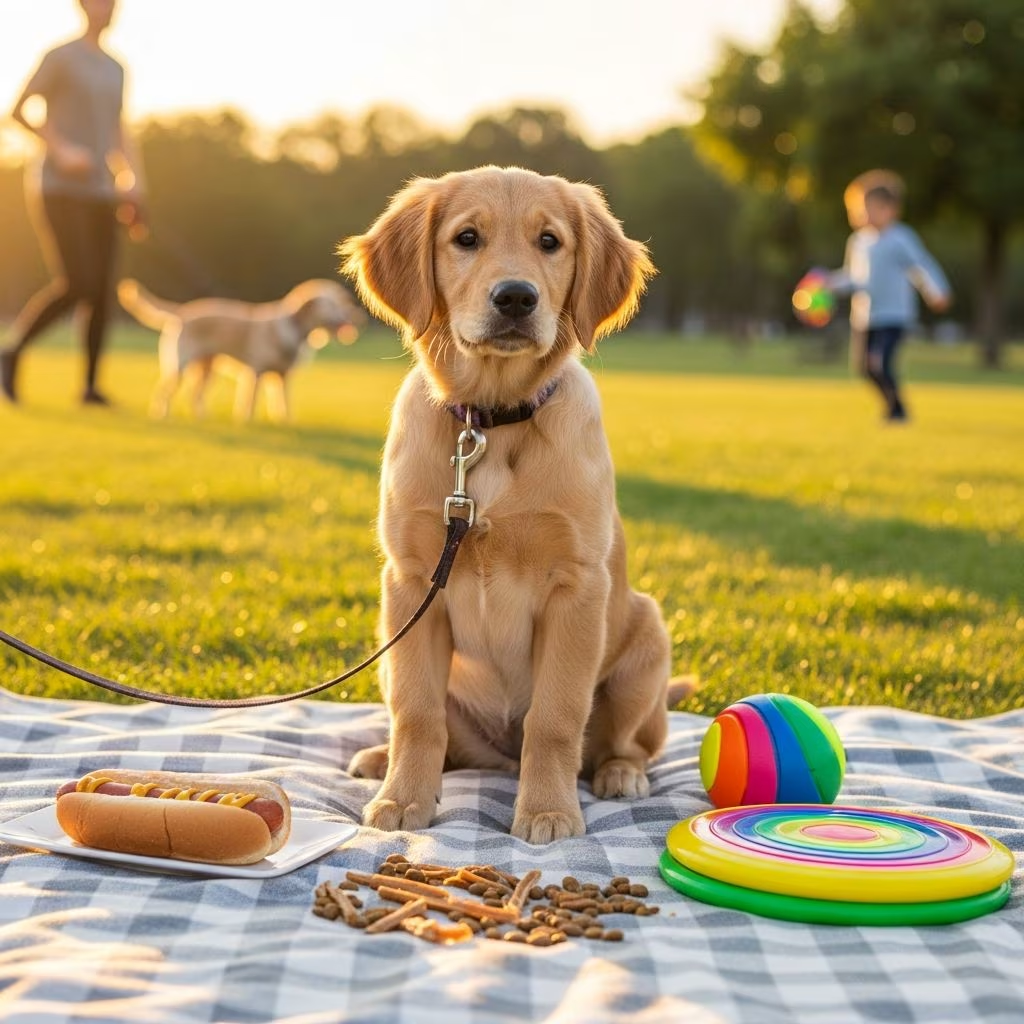
One of the most valuable skills you can teach your growing puppy is the ability to resist immediate gratification and demonstrate restraint around tempting objects, food, and distractions. This foundational behavior, rooted in impulse control, becomes the cornerstone for numerous advanced commands and ensures your puppy’s safety in real-world situations. Whether your puppy encounters dropped food on a walk, approaches another dog, or investigates potentially dangerous items, a well-trained ability to disengage from these temptations can literally save their life.
Building impulse control in puppies requires patience, consistency, and a clear understanding of how dogs learn. Rather than relying on punishment or force, modern training methodologies emphasize positive reinforcement, which creates a cooperative relationship between you and your puppy while building their confidence and trust.
Understanding Why Impulse Control Matters for Puppies
Puppies are naturally driven by instinct and impulse. When they see something interesting—whether a tasty morsel, an exciting toy, or another animal—their first inclination is to investigate and interact with it immediately. Without training, this instinctive behavior persists into adulthood, creating situations where your dog might eat something toxic, run into traffic, or display aggressive behaviors toward other animals.
Impulse control training teaches puppies that pausing and looking to you for guidance is more rewarding than acting on their immediate desires. This shift in perspective forms the psychological foundation for the “leave it” command and similar obedience behaviors. Beyond safety, puppies with strong impulse control are generally better-behaved, easier to manage in public settings, and less likely to develop behavioral problems as they mature.
The training process also strengthens the bond between you and your puppy, as they learn to trust your guidance and understand that compliance leads to positive outcomes.
Preparing for Training Success: Environment and Resources
Before introducing any formal training, you need to establish the right conditions for learning. Your puppy learns best in controlled environments where distractions are minimal and you can provide immediate feedback.
Essential Training Setup
- Choose a quiet location: Begin in a space where your puppy has limited exposure to external distractions. A living room or small room works well initially.
- Gather appropriate treats: You’ll need two types of treats—low-value treats (such as regular kibble) that your puppy finds mildly interesting, and high-value treats (such as small pieces of chicken or cheese) that your puppy finds irresistible.
- Prepare a training marker: Decide whether you’ll use a clicker device, a specific word like “yes,” or enthusiastic verbal praise to mark the exact moment your puppy demonstrates the desired behavior.
- Have a leash readily available: A leash provides safety and control, especially as you progress to training in more stimulating environments.
- Schedule training sessions appropriately: Train when your puppy is alert but not overly energetic. Avoid training immediately after meals or during times when your puppy typically naps.
Phase One: Building Foundational Impulse Control Without Verbal Cues
The first phase establishes the underlying concept that restraint results in rewards. This phase intentionally excludes verbal commands, allowing your puppy to learn the behavioral concept independently.
The Hand Fist Exercise
Start by sitting comfortably with your puppy facing you. Hold a low-value treat in your closed fist at chest height. Your puppy will naturally investigate, licking, pawing, and nosing your hand in attempts to retrieve the treat. This is completely normal and expected.
Remain silent and patient during this phase. Do not open your hand, scold your puppy, or provide any verbal feedback. Simply wait. Eventually—whether after seconds or minutes, depending on your puppy’s age and temperament—your puppy will pause in their efforts and disengage, even briefly. The moment this disengagement occurs, immediately use your training marker (“yes” or clicker), then open your hand and say “take it” while offering the treat.
This sequence teaches your puppy that the pathway to the reward is not through persistence and effort, but through stopping the attempt. Repeat this exercise multiple times in each training session, aiming for consistency in your puppy’s responses.
Progressing to Open-Palm Presentation
After your puppy demonstrates consistent disengagement with your closed fist, advance to the next step. Place a low-value treat on your open palm and present it to your puppy. Again, your puppy will attempt to consume the treat. Close your fist the moment your puppy lunges or makes contact with the treat. Wait for disengagement, then mark and reward with a high-value treat from your other hand.
This progression is crucial because it introduces a variable—the treat is now visible and accessible, not protected by your closed hand. This requires your puppy to exercise greater self-control. Practice until your puppy can sit with the low-value treat on your open palm without attempting to take it.
Phase Two: Introducing the Verbal Cue “Leave It”
Once your puppy reliably demonstrates impulse control with hand-based exercises, introduce the verbal cue. The timing of this introduction is important—your puppy should already understand the concept through repetition before you attach the words to the behavior.
Pairing the Cue with the Behavior
Repeat the open-palm exercise, but now say “leave it” just as you present the treat. Your puppy has already learned what happens next through repetition, so they may not need the explicit cue at first. However, consistent pairing of the words with the established behavior helps your puppy associate the sounds with the action.
Continue this for multiple training sessions, gradually increasing the duration your puppy must resist before receiving their reward. Work toward your puppy successfully ignoring the low-value treat for at least two to three seconds after hearing the cue and seeing the presented treat.
Phase Three: Transitioning to Floor-Based Training
Real-world scenarios rarely involve treats in your hand. As your puppy’s control strengthens, begin placing treats on the ground—the environment where they’ll encounter most real-world temptations.
Initial Floor Exercises
Place a low-value treat on the floor close to your seated position. While your puppy watches, say “leave it” and wait. If your puppy attempts to consume the treat, quickly cover it with your foot or hand to prevent access. Once your puppy disengages or looks toward you, mark the behavior and immediately reward with a high-value treat.
Repeat this exercise with the treat in gradually different positions. Over multiple sessions, progressively increase the distance between you and the treat, and decrease the distance between the treat and your puppy. This progression helps maintain your puppy’s success rate while building confidence.
Row of Treats Progression
After your puppy masters individual floor treats, arrange several low-value treats in a line spaced a few feet apart. Begin at one end of the row with your leashed puppy. Say “leave it” and walk past each treat slowly. Each time your puppy successfully ignores a treat, immediately mark and reward with a high-value treat.
Once your puppy can successfully navigate past individual treats without attempting to consume them, attempt walking past the entire row while providing a single “leave it” cue at the beginning. Reward successful completion with an especially valuable reward, such as a favorite toy or extended play session.
Phase Four: Building Reliability Through Multiple Environments
A critical principle of dog training is that behaviors taught in one environment don’t automatically transfer to other settings. Your puppy doesn’t inherently understand that “leave it” in the living room applies to “leave it” on the sidewalk or in the park.
Environmental Generalization
Systematically practice your puppy’s impulse control training in progressively more stimulating environments. Begin in your home, then move to your yard, then to a quiet street, then to busier outdoor spaces. Each new environment resets your puppy’s understanding, so you may need to go backward in difficulty when introducing a new location.
For example, if your puppy reliably ignores treats placed on open palms in your home, you might need to restart with hand-based exercises when training in a new park. This isn’t failure—it’s normal learning progression. With patience and repetition in each new environment, your puppy’s understanding generalizes to the concept that “leave it” applies everywhere.
Phase Five: Incorporating Real-World Distractions
Once your puppy demonstrates solid impulse control around food-based temptations in various locations, introduce the additional variable of social distractions—other dogs, people, moving objects, and exciting stimuli.
Training with Other Dogs Present
If you have access to another well-trained dog or a friend with a calm dog, begin incorporating this distraction gradually. Start at a significant distance—perhaps 20-30 feet apart—and practice “leave it” with your puppy while the other dog is visible. As your puppy demonstrates reliability, gradually decrease the distance over multiple training sessions.
This training step serves an important purpose beyond simple obedience. In off-leash environments or situations where your puppy might have the opportunity to approach another dog, a reliable “leave it” command provides crucial safety. It acts as an emergency “circuit breaker,” helping your puppy disengage from problematic interactions before they escalate.
Managing Distraction-Based Failure
If your puppy fails to respond to “leave it” when distractions are introduced, this signals that the distraction level exceeded your puppy’s training level. Rather than repeatedly giving the command your puppy doesn’t obey—which actually teaches them to ignore you—return to training in controlled environments and gradually reintroduce distractions more slowly.
Common Training Challenges and Solutions
| Challenge | Likely Cause | Solution |
|---|---|---|
| Puppy ignores “leave it” cue | Distraction level too high; cue introduced before foundational understanding | Return to hand exercises in quiet environment; ensure foundational phases are solid before moving forward |
| Puppy only responds some of the time | Inconsistent rewards; training in too many different environments simultaneously | Ensure high-value rewards every successful attempt; focus on one location until reliability is consistent |
| Puppy responds when stationary but not during walks | Movement and forward momentum conflict with “leave it” understanding | Practice “leave it” while walking in controlled environments; gradually add environmental stimulation |
| Puppy gives up too quickly during training | Training sessions too long; puppy fatigued or bored | Limit sessions to 5-10 minute increments; maintain high-value rewards throughout |
Frequently Asked Questions
At what age should I start training impulse control?
Puppies can begin learning basic impulse control as early as 8 weeks old. Young puppies have shorter attention spans and less developed self-control, so keep initial sessions very brief and use especially high-value rewards. As your puppy matures, gradually increase session length and complexity.
What if my puppy has already developed bad habits around food?
It’s never too late to teach impulse control, though older puppies with established habits may require more patience and repetition. Return to foundational exercises and ensure consistency in your rewards and timing. Avoid letting your puppy practice the unwanted behavior while training the desired behavior.
Can “leave it” be used for non-food items?
Absolutely. Once your puppy understands the concept through food-based training, the same principle applies to toys, sticks, and other objects. Many trainers expand “leave it” to cover any item the puppy shouldn’t have, providing a comprehensive safety tool.
How long until my puppy reliably responds?
Timeline varies based on puppy age, temperament, and training consistency. Most puppies show basic understanding within 2-4 weeks of regular practice. Reliability in distracting environments typically requires 8-12 weeks of consistent training across multiple locations.
Long-Term Benefits of Impulse Control Training
Teaching your puppy impulse control provides immediate safety benefits while establishing a foundation for advanced obedience throughout your dog’s life. Dogs with strong impulse control are easier to manage, safer in public environments, and generally report better quality of life—they can safely enjoy more freedoms and activities because they respond reliably to your guidance.
The training process itself strengthens your relationship with your puppy, creating a partnership based on mutual understanding and positive associations. Your puppy learns that compliance with your guidance leads to rewards, building confidence in your leadership and establishing healthy behavioral patterns that persist well into adulthood.
References
- How to Teach Your Dog the ‘Leave It’ Command — American Kennel Club. 2024. https://www.akc.org/expert-advice/training/learning-the-leave-it-command/
- “Leave It”: A Critical Command to Teach Your Dog — Happy Hounds Dog Training. 2024. https://happyhoundsdogtraining.ca/leave-it-a-critical-command-to-teach-your-dog/



