

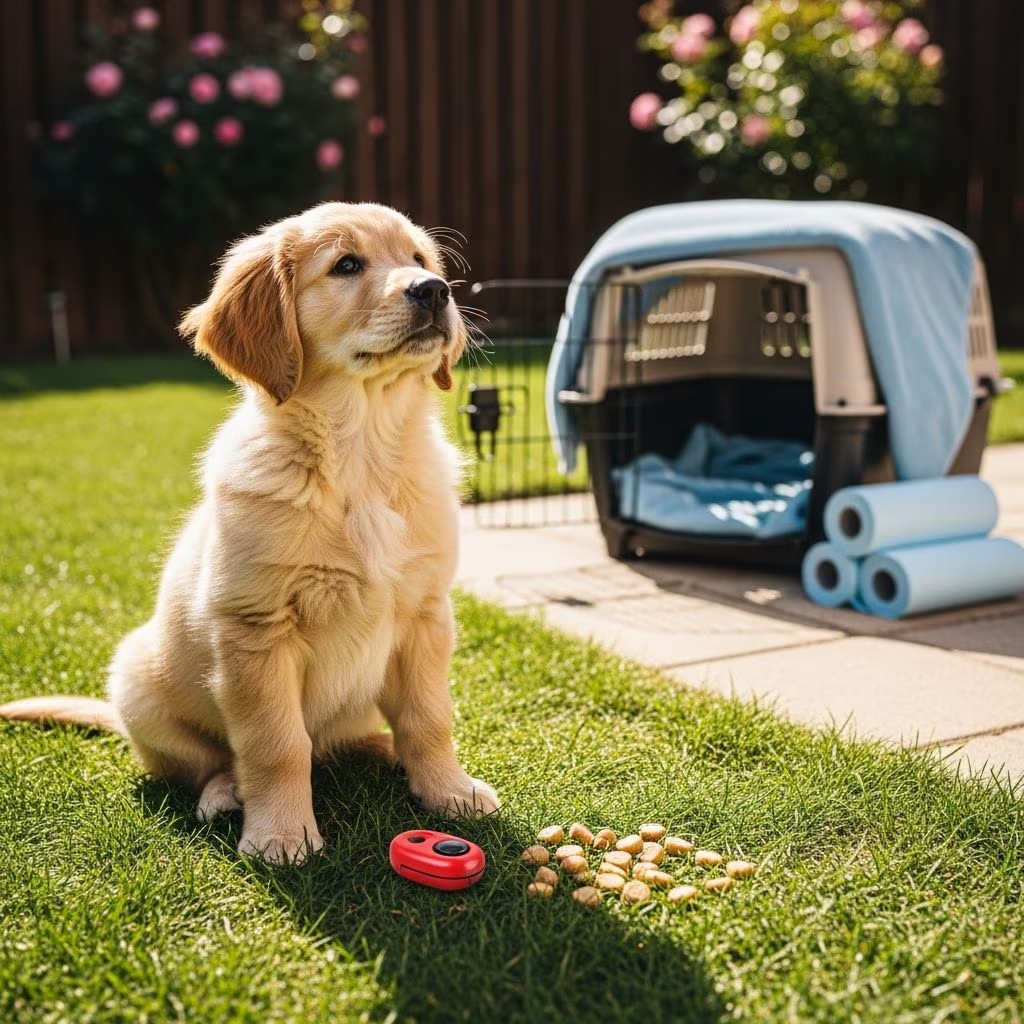
Bringing a new puppy into your home is an exciting experience, but one of the first challenges new dog owners face is teaching their young companion where and when to eliminate waste. This essential aspect of pet ownership requires dedication, planning, and a thorough understanding of canine developmental stages. Unlike training advanced obedience commands, housebreaking forms the foundation for a harmonious living relationship between you and your puppy.
The process of teaching a puppy proper bathroom habits involves multiple interconnected strategies working together. Success depends not on a single technique but rather on a comprehensive approach that combines environmental management, behavioral psychology, and consistent reinforcement. Many first-time dog owners underestimate the time investment required, often expecting results within days rather than weeks or months.
Understanding Your Puppy’s Biological Development
Before implementing any training strategy, recognizing the biological realities of puppy development is crucial. Young puppies possess physical limitations that directly impact their ability to control their bladder and bowels. A puppy’s age in months roughly correlates to the number of hours they can hold their bladder—a two-month-old puppy can typically hold it for approximately two hours, while a four-month-old may manage four hours.
During the first eight to twelve weeks of life, puppies lack sufficient neurological development to maintain voluntary control over their elimination muscles throughout extended periods. This means accidents during early stages are not behavioral failures but rather natural developmental occurrences. Understanding this distinction helps owners maintain patience and avoid counterproductive punishment strategies that damage trust and create anxiety around elimination.
Puppies also experience predictable elimination patterns related to their activities. They typically need to eliminate shortly after eating, immediately upon waking from naps, during or after play sessions, and before sleeping at night. Recognizing these natural rhythms allows owners to anticipate needs rather than constantly reacting to accidents.
Building Your Training Foundation Through Environmental Design
The physical space where your puppy spends time significantly influences training success. Rather than relying solely on correction after mistakes occur, smart environmental management prevents most accidents from happening in the first place. This proactive approach reduces frustration for both owner and puppy while accelerating the learning process.
Designating a specific bathroom area—whether indoors using training pads or outdoors in your yard—establishes clear expectations. When puppies repeatedly use the same location, they naturally develop associations between that space and the act of elimination. The scent markers from previous bathroom visits provide olfactory cues that encourage your puppy to eliminate in the appropriate location.
For apartment dwellers or owners without immediate yard access, indoor training solutions offer viable alternatives. Puppy pads placed in accessible locations can serve as temporary designated elimination zones. The transition from indoor pads to outdoor areas can occur gradually, preventing confusion while your puppy develops stronger control and outdoor habits.
Establishing Consistent Daily Routines
Consistency represents perhaps the most powerful tool in any training program. Puppies learn through repetition and predictability, so maintaining regular schedules for feeding, potty breaks, play, and sleep accelerates housebreaking success.
A well-structured daily cycle might follow this pattern:
- Morning potty break immediately upon waking
- Feeding followed by bathroom opportunity within fifteen to thirty minutes
- Supervised playtime or activity
- Midday potty break
- Afternoon feeding and subsequent bathroom access
- Evening play or training session
- Final potty break before nighttime confinement
By feeding your puppy at the same times daily, you create predictable elimination schedules. This regularity enables owners to anticipate when outdoor breaks are needed and position themselves to reinforce correct behavior through praise and rewards.
Additionally, maintaining consistent bathroom visit durations helps puppies understand that outdoor time is specifically designated for elimination. If you take your puppy outside and wait until they successfully use the bathroom before returning inside, you create a clear cause-and-effect relationship between outdoor visits and relief.
Leveraging Crate Training as a Management Tool
Crate training serves dual purposes in the housebreaking process. First, it provides a safe confined space where your puppy can rest without supervision. Second, it capitalizes on puppies’ natural instinct to keep their sleeping areas clean.
Dogs naturally avoid eliminating where they sleep, making appropriately sized crates valuable training instruments. The crate should be large enough for your puppy to stand, turn around, and lie down comfortably—but not so spacious that they can eliminate in one area while sleeping in another. A crate that allows room for growth while maintaining manageable size prevents the behavior deterioration that occurs when oversized crates permit elimination in one corner.
Using crates during times when you cannot actively supervise—such as when running errands or overnight—prevents unsupervised accidents that would otherwise confuse your puppy’s learning process. When you return home, immediately taking your puppy outside provides the opportunity for appropriate elimination followed by enthusiastic praise.
It’s important to introduce crates positively, using treats, toys, and patient acclimation rather than forcing puppies inside. A crate should become a comfortable refuge, not a punishment location, to maintain the positive associations necessary for effective training.
Active Supervision and Immediate Intervention
When you are home and able to observe your puppy, maintaining close supervision dramatically improves training outcomes. This doesn’t mean constant physical contact but rather maintaining visual awareness of your puppy’s movements and behaviors.
Learning to recognize pre-elimination signals allows intervention before accidents occur. Common indicators include sniffing the ground, circling, whining, scratching at doors, or displaying restlessness. When you notice these signs, immediately take your puppy to their designated bathroom area, wait for them to eliminate, then provide abundant praise and rewards.
Keeping your puppy on a leash during indoor time serves multiple purposes. The leash prevents sneaking away to hidden corners for elimination, maintains closer physical proximity for signal recognition, and enables immediate guidance outdoors when needed. This tethering strategy keeps young puppies within your sphere of awareness, making real-time supervision significantly easier.
For moments when active engagement isn’t possible, confining your puppy to smaller spaces like playpens or limited room access restricts their ability to wander elsewhere in your home. This management approach combined with frequent bathroom breaks substantially reduces opportunities for unintended elimination.
Reinforcement Strategies That Accelerate Learning
Positive reinforcement creates powerful learning connections in puppy brains. When your puppy successfully eliminates in the correct location, enthusiastic praise combined with treats reinforces the behavior far more effectively than correction addresses mistakes.
Timing of reinforcement matters critically—puppies make behavioral associations within seconds of an action’s completion. This means you must praise and reward immediately after successful outdoor elimination, before returning inside. Delayed rewards create confusion about which behavior earned approval.
Verbal markers like “Good potty!” paired with treats create positive associations with the elimination location. Over time, puppies begin anticipating rewards when taken to their bathroom area, increasing their motivation to eliminate there rather than elsewhere.
Consistency among all household members regarding rewards and praise ensures unified messaging. When different people respond variably to the same behavior, puppies receive conflicting signals that slow learning progress. Family meetings establishing standardized responses prevent accidental mixed messages that create confusion.
Managing Accidents Without Damaging Training Progress
Despite best efforts, puppies will have accidents during the learning process. How owners respond to these inevitable mistakes significantly impacts overall training success and your puppy’s emotional development.
Punishment-based responses—including scolding, spanking, or nose-rubbing in accidents—prove counterproductive. These approaches create fear and anxiety around elimination, potentially causing puppies to hide when eliminating or develop anxiety-based elimination problems. Puppies cannot understand that punishment relates to location rather than the act itself, leading to confusion and damaged trust.
When accidents occur, calmly clean the area thoroughly with enzymatic cleaners that eliminate odor markers. Lingering scent signals encourage repeated elimination in the same spot. Simply wiping with regular cleaners leaves olfactory cues that confuse your training efforts.
If you catch your puppy mid-accident indoors, interrupt calmly and immediately take them outside to their designated bathroom area. If they continue eliminating outside, provide praise—this teaches them where you want elimination to occur rather than simply punishing mistakes.
Adapting Your Approach for Different Living Situations
| Living Situation | Primary Strategy | Key Considerations |
|---|---|---|
| House with Yard | Outdoor direct elimination | Frequent outdoor access; establish consistent potty spot; minimize indoor pad dependency |
| Apartment | Indoor pads transitioning outdoors | Gradual pad movement toward door/outside; frequent elevator/stair breaks; consider rooftop or nearby park access |
| Townhouse/Condo | Hybrid indoor-outdoor approach | Balance pad training with outdoor opportunities; manage neighbor considerations; establish clear outdoor routine |
| Cold Climate Regions | Indoor pads with seasonal transitions | Winter months may require indoor solutions; plan extended cold exposure acclimation gradually |
Different living environments require flexible training adaptations. Apartment dwellers initially employing indoor training pads can gradually transition puppies to outdoor elimination by slowly moving pads toward doors and eventually outside. This gradual approach prevents confusion while building outdoor habits.
For regions experiencing harsh winters, temporary indoor solutions during extreme weather don’t derail outdoor training. Many owners successfully maintain both winter indoor and summer outdoor bathroom locations, as puppies readily understand location-specific expectations.
Recognizing Individual Puppy Differences
Puppy training timelines vary significantly based on individual temperament, breed characteristics, and previous experiences. Some puppies demonstrate rapid comprehension and control within weeks, while others require several months to achieve consistent reliability.
Smaller breeds often require extended training periods due to smaller bladder capacities and their tendency toward independent decision-making. Large breed puppies may achieve reliable control faster despite their larger size, reflecting different developmental rates and trainability factors.
Prior experiences also influence learning curves. Puppies raised in clean environments demonstrate faster comprehension than those from less organized backgrounds. Patience with individual variation prevents frustration and maintains the positive mindset necessary for successful long-term training.
Frequently Asked Questions About Puppy Housebreaking
How long does puppy housebreaking typically require?
Most puppies achieve reliable daytime control between four and six months of age, with nighttime control developing later. Some puppies need six to twelve months for complete reliability, particularly smaller breeds.
What should I do if my puppy regresses after showing progress?
Regression often indicates stress, diet changes, medical issues, or inconsistent routine. Consult your veterinarian to rule out urinary tract infections or other health concerns, then review and reinforce your training schedule.
Can I use both indoor pads and outdoor training simultaneously?
Yes, particularly for apartment dwellers. However, clearly designate which areas are appropriate for each, as some puppies become confused by mixed-location training. Gradually transition from indoor to outdoor as your puppy develops better control.
Is nighttime housebreaking different from daytime training?
Yes—puppies develop nighttime control later than daytime control due to continued bladder development. Restricting water intake two hours before bedtime, establishing nighttime crate routines, and accepting occasional overnight accidents is necessary during early months.
When should I be concerned about persistent housebreaking difficulties?
Puppies older than six months experiencing frequent accidents or sudden regression warrants veterinary evaluation to rule out urinary tract infections, diabetes, or other medical conditions.
Building Long-Term Success Through Patience and Perspective
Successful puppy housebreaking represents a gradual learning process rather than a rapid transformation. The techniques, consistency, and patience you invest during these early months establish foundational behaviors and trust that benefit your relationship throughout your puppy’s life.
Remember that every puppy develops according to individual timelines and that occasional setbacks represent normal learning progression rather than training failure. By maintaining consistent routines, using positive reinforcement, managing your environment effectively, and responding calmly to accidents, you create ideal conditions for your puppy to develop reliable, lifelong bathroom habits.
The housebreaking period, while demanding, ultimately passes quickly. The well-trained adult dog that results from your early efforts will reward your investment through years of reliable behavior and companionship.
References
- Housetraining Your Puppy — UC Davis School of Veterinary Medicine. Accessed February 2026. https://www.vetmed.ucdavis.edu/sites/g/files/dgvnsk491/files/inline-files/Housetraining_Your_Puppy.pdf
- How to Potty Train Puppies: A Comprehensive Guide for Success — American Kennel Club. Accessed February 2026. https://www.akc.org/expert-advice/training/how-to-potty-train-a-puppy/
- The Ultimate Guide to Potty Training Your Puppy — Pet-Go-Round. Accessed February 2026. https://www.pet-go-round.com/blogs/education/the-ultimate-guide-to-potty-training-your-puppy
- Master the Art of Potty Training Your Puppy — Hilton Butler. Accessed February 2026. https://www.hiltonbutler.com/blog/potty-train-your-puppy/
- Potty Training Puppies at Home: Quick, Gentle, and Effective Methods — Newport Veterinary & Rehab Hospital. Accessed February 2026. https://newportvetrh.com/effective-potty-training-puppies-at-home/



