

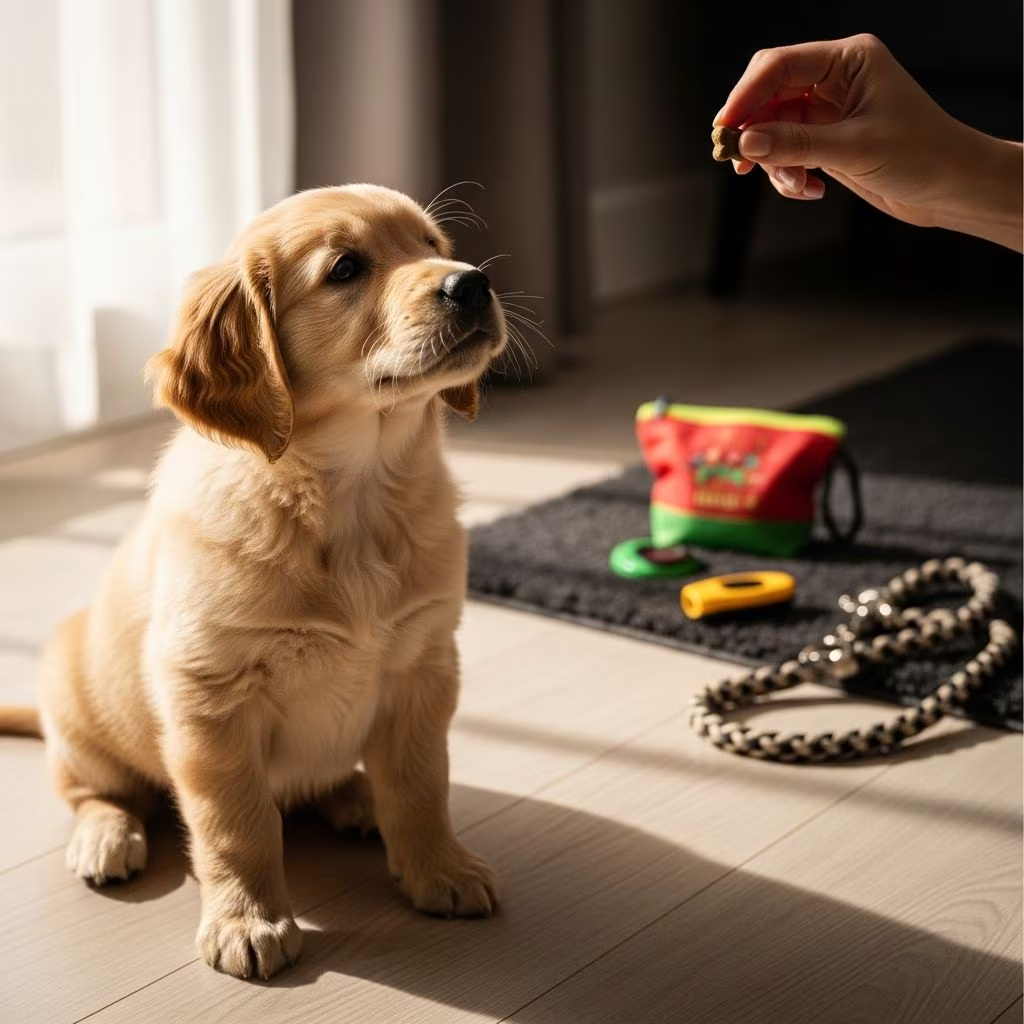
Understanding Puppy Behavior and Training Basics
Puppies begin their learning journey from the moment they are born, making early training and socialization fundamental to developing well-behaved, confident dogs. Understanding the basics of puppy behavior and establishing effective training methods from the start can prevent many common behavioral problems and create a harmonious relationship between you and your new companion. This comprehensive guide covers everything you need to know about puppy training fundamentals and behavioral development.
When to Start Training Your Puppy
One of the most common misconceptions about puppy training is that you should wait until your dog reaches a certain age. In reality, training should begin immediately when your puppy comes home, typically around 8 weeks of age. Puppies are capable of learning simple commands and behaviors from a very young age, and early training establishes positive habits that last a lifetime.
The critical period for puppy learning extends from birth through their first several months. During this window, puppies are naturally curious and receptive to new experiences. Starting training early means your puppy learns what behaviors are acceptable in your household before bad habits have a chance to develop. This proactive approach is far more effective than trying to correct problematic behaviors later.
The Importance of Handling and Socialization
Before formal command training begins, proper handling and socialization form the foundation of puppy development. Handling refers to gently touching and manipulating your puppy’s body, including their paws, ears, mouth, and tail. This builds comfort with human contact and makes grooming, veterinary care, and general care much easier throughout your dog’s life.
Socialization is equally critical and involves exposing your puppy to various people, animals, environments, and experiences in a positive way. Puppies that are well-socialized tend to be more confident, less fearful, and better equipped to handle new situations as adults. Proper socialization during the early weeks of life can significantly reduce anxiety and aggression issues later on.
Basic Puppy Training Principles
Successful puppy training relies on several key principles that should guide your approach to teaching your new companion.
Start Early and Keep Sessions Brief
Begin training as soon as your puppy arrives home. However, remember that puppies have short attention spans, so keep training sessions to 5-10 minutes initially. Multiple short sessions throughout the day are far more effective than one long training session. This approach maintains your puppy’s enthusiasm and prevents frustration for both you and your dog.
Be Consistent and Clear
Consistency is essential for effective puppy training. Use the same commands, hand signals, and rewards each time you train. If you’re not consistent, your puppy will become confused about what behavior you’re asking for and what’s expected of them. Everyone in your household should use the same commands and enforce the same rules to reinforce learning.
Stay Positive and Reward Success
Positive reinforcement is the most effective training method for puppies. Reward desired behaviors immediately with treats, praise, or play to create a strong association between the behavior and the reward. This approach builds confidence in your puppy and makes training enjoyable for both of you. Avoid punishment-based methods, which can create fear and anxiety.
Timing is Critical
When training puppies, the timing of your reward is crucial. Deliver the reward within a fraction of a second of the desired behavior occurring. This tight timing helps your puppy make the connection between their action and the positive consequence. For example, when teaching \”sit,\” give the treat and praise the moment your puppy’s rear touches the ground.
Teaching Basic Commands and Cues
Once your puppy is comfortable with handling and socialization, you can begin teaching basic commands. These foundational cues provide mental stimulation and establish communication between you and your puppy.
How to Teach Your Puppy to Sit
The \”sit\” command is often the first behavior puppies learn because it’s relatively easy and builds confidence. There are two main methods for teaching this command:
Luring Method:
– Start by getting your puppy’s attention- Hold a small piece of kibble or treat close to your puppy’s nose- Slowly move the treat toward the back of their head, causing them to naturally sit as they follow the food- The moment their rear touches the ground, say \”sit,\” give them the treat, and offer enthusiastic praise- Repeat this process multiple times until your puppy understands the action- Once they’re sitting consistently with the hand motion, add the verbal cue \”sit\” before the hand signal
Capturing Method:
– Stand in front of your puppy holding treats or kibble- Watch for them to sit naturally- The moment they sit, say \”yes,\” give them a treat- Step backward or sideways to encourage them to stand again- Wait for them to sit again and immediately reward- After several repetitions, begin saying \”sit\” right as they start to sit
How to Teach Your Puppy to Come
The \”come\” command is essential for your puppy’s safety. Teaching a reliable recall takes patience and consistent practice in low-distraction environments before moving to more challenging settings.
– Sit with your puppy and say their name or the word \”come\”- Each time you say \”come\” or their name, immediately give them a treat, even if they’re not performing the behavior yet- Drop a treat on the floor near you; when your puppy finishes eating, say their name, and when they look up, give them another treat- Once your puppy can turn around to face you, add movement by tossing a treat and taking a few quick steps away while calling their name- Make coming to you extremely rewarding with lots of praise, treats, or play- Gradually increase distance and practice in different locations- Always practice recall in safe, enclosed areas until the behavior is completely reliable
How to Teach Your Puppy to Stay
The \”stay\” command teaches your puppy to remain in one position until released. This is a duration behavior that requires building up time gradually.
– Start with your puppy in a position they already know, such as sit- First, teach the release word (such as \”okay,\” \”free,\” or \”break\”) by saying the word and immediately tossing a treat on the floor- Once your puppy understands the release cue, put them in a sit and face them- Give them a treat for staying in position, pause, and give another treat- Gradually increase the time between treats by silently counting to yourself- Take one step back from your puppy while facing them and say \”stay\”- If they remain in position, return and reward them calmly- If they break position, return to a shorter distance- Gradually increase the distance over multiple training sessions- Remember to use the release word to let them know when they’re done with the behavior
How to Teach Your Puppy Down
The \”down\” command teaches your puppy to lie flat, which is useful for settling and can be paired with the \”stay\” command.
– Start with your puppy in a sitting position- Hold a small treat close to their nose- Slowly move the treat down to the ground right in front of their front paws, then drag it slowly along the ground away from them in an \”L\” shape- Your puppy will follow the treat and naturally lie down- As soon as they lie down, praise them calmly and give the treat- Repeat this several times before adding the verbal cue \”down\”- After your puppy consistently lies down with the lure, begin saying \”down\” right before they perform the behavior- Once they understand, you can pair this with other cues like \”stay\”
How to Teach Loose Leash Walking
Teaching your puppy to walk politely on a leash without pulling is important for both safety and enjoyable walks together.
– Before walking, play with your puppy to burn off excess energy, which makes training easier- Put the leash on and begin by standing still in an area free from distractions- Wait for your puppy to stop pulling on the leash, then immediately reward this behavior with a treat- Walk a few steps together, stop, and wait for your puppy to stop pulling or sit before offering a treat- Continue this pattern until your puppy realizes that staying beside you with a loose leash is the desired behavior- Gradually increase walking pace and add sudden turns to the right or left to keep things interesting- Anytime your puppy pulls, stop moving and wait for them to calm down and the leash to become loose again before rewarding- Always praise warmly when they follow the desired behavior
Common Training Mistakes to Avoid
Understanding what not to do is just as important as knowing what to do when training puppies. Never physically put your puppy into a position, as this can be confusing or upsetting to them. Instead, let them discover the behavior naturally through luring or capturing. Also avoid over-exciting your puppy with excessive enthusiasm during training, as this can distract them and make it difficult to continue the session.
Another common mistake is inconsistency. If family members use different commands or enforce different rules, your puppy will become confused about expectations. Additionally, avoid training when your puppy is tired, hungry, or overstimulated. The best training happens when your puppy is alert, motivated by treats, and in a calm mental state.
Preventing Behavior Problems Through Training
Most behavior problems can be prevented through proper training and socialization as a puppy. By establishing good habits early, teaching your puppy what behaviors are acceptable, and providing appropriate outlets for natural behaviors like chewing and play, you can prevent many issues from developing. Puppies that are well-trained are more confident, less anxious, and better adjusted to their environments.
Creating a Training Schedule
Consistency in training includes having a regular schedule. Aim for multiple 5-10 minute training sessions throughout the day. The best times to train are often after your puppy has had a nap and is rested, or before meals when they’re motivated by food rewards. Keep training sessions fun and end on a positive note, even if your puppy hasn’t fully mastered the behavior.
Frequently Asked Questions About Puppy Training
Q: At what age can I start training my puppy?
A: You can start training puppies as soon as they come home, usually around 8 weeks of age. Early training focuses on handling, socialization, and simple commands.
Q: How long should each training session be?
A: Keep initial training sessions to 5-10 minutes. Puppies have short attention spans, and multiple short sessions are more effective than one long session.
Q: What’s the best reward for training?
A: Small treats work well for most puppies, but some respond better to praise or play. Use what motivates your individual puppy most.
Q: Why is consistency so important in puppy training?
A: Consistency helps your puppy understand exactly what behavior is expected. If rules and commands change, puppies become confused and training becomes ineffective.
Q: Should I use punishment when my puppy misbehaves?
A: No. Positive reinforcement is far more effective than punishment. Punishment can create fear and anxiety, damaging your relationship with your puppy.
Q: How do I handle a puppy that doesn’t seem interested in treats during training?
A: Try different treats, train before meals when your puppy is hungry, or use toys and play as rewards. Find what motivates your individual puppy.
Q: When should I introduce my puppy to other dogs?
A: After your veterinarian gives approval and your puppy has completed initial vaccinations, controlled introductions to other dogs are important for socialization.
References
- Basic Puppy Training 101 — Purina. 2025. https://www.purina.com/articles/dog/puppy/training/puppy-training
- Teach Your Puppy These 5 Basic Cues — American Kennel Club. 2025. https://www.akc.org/expert-advice/training/teach-your-puppy-these-5-basic-commands/
- Dog Training Basics — FOUR PAWS in US. 2025. https://www.fourpawsusa.org/our-stories/publications-guides/dog-training-basics
- Behavior Guide for Your New Puppy — Veterinary Medical Center, Ohio State University. 2025. https://vmc.vet.osu.edu/resources/behavior-guide-your-new-puppy
- Puppy Behavior and Training Basics — VCA Animal Hospitals. 2025. https://vcahospitals.com/know-your-pet/puppy-behavior-and-training-training-basics
- Puppy Training Basics — Positively.com. 2025. https://positively.com/dog-training/article/foundations-puppy-life-skills



